QlikView QSDA2022 Online Practice
Questions and Exam Preparation
QSDA2022 Exam Details
Exam Code
:QSDA2022
Exam Name
:Qlik Sense Data Architect Certification - 2022
Certification
:QlikView Certifications
Vendor
:QlikView
Total Questions
:77 Q&As
Last Updated
:Jul 13, 2026
QlikView QSDA2022 Online Questions &
Answers
Question 1:
Refer to the exhibits.
A music teacher needs to know which artists are eligible to enter this year's competition.
The teacher needs to find only the artists who have a music grade rank above two and play more than one instrument.
Which expression is needed for the Number of Instruments measure in the table?
A. Count({$}Instrument) B. Count({S}Instrument) C. Count({$}Instrument) D. Count ({S2"}>}Instrument)
A. Count({$}Instrument)
Explanation/Reference:
The correct expression to use for the Number of Instruments measure in the table is Option A. This expression will count the number of instruments played by artists with a music grade rank greater than two.
How to build a data architecture to drive innovation--today and ... https://www.mckinsey.com/capabilities/mckinsey-digital/our-insights/how-to-build-a-data- architecture-to-drive-innovation-today-and-tomorrow
Big data in healthcare: management, analysis and future prospects ... https://journalofbigdata.springeropen.com/articles/10.1186/s40537-019-0217-0
Obtaining Data From Electronic Health Records - Tools and ...
https://www.ncbi.nlm.nih.gov/books/NBK551878/
Question 2:
A data architect needs to develop multiple apps for various departments. More departments are requesting apps over time The company uses specific requirements for the number interpretation variables (e.g., ThousandSep, DecimalSep) found at the beginning of a LOAD script.
The data architect wants to reduce duplicate scripts but does not want to copy and paste the number interpretation variables each time new app is created. The data architect prefers to use the least amount of script in Qlik Sense.
How should the data architect meet these requirements?
A. Save the script for the number interpretation variables in a text file and use the CALL function to insert the variables. B. Create an Excel file with the number interpretation variables and use a FOR Next loop to load the variables into Qlik Sense C. Save the script for the number interpretation variables in a text file and INLUDE function to insert the variables D. Create an Excel file with the number interpretation variables and apply the variables to the app using a mapping table
C. Save the script for the number interpretation variables in a text file and INLUDE function to insert the variables
Explanation/Reference:
This method involves saving the script for the number interpretation variables in a separate text file, and then using the INCLUDE function to insert the variables into each new app script that is created. This reduces the need to
copy and paste the number interpretation variables each time a new app is created and allows the data architect to use the least amount of script in Qlik Sense.
The INCLUDE function is a script statement that allows you to insert the contents of one script file into another script file. This can be used to insert common scripts, such as the number interpretation variables, into multiple app scripts.
Question 3:
Refer to the exhibit.
A data architect must classify each product into a price group. The price groups must be the same width by default and allow users to dynamically change the width of the bucket during analysis. Which feature should the data architect use to meet these requirements?
A. Class function in the script and use variables B. Class function in a calculated dimension C. Nested IFs in a calculated dimension D. IntervalMatch and use variables
B. Class function in a calculated dimension
Question 4:
A company decides to migrate all apps from QlikView to Qlik Sense. After converting an apps: there are several unconverted objects. What should the data architect do?
A. Save the unconverted objects as extensions and import them into Qlik Sense B. Remove the set analysis statements from the unconverted objects C. Re-create the unconverted objects D. Save the unconverted objects as master items
C. Re-create the unconverted objects
Explanation/Reference:
After migrating an app from QlikView to Qlik Sense, there may be some unconverted objects. In this case, the data architect should re-create the unconverted objects in order to ensure that the app works properly in Qlik Sense. The other options will not work, as saving the unconverted objects as extensions or master items will not ensure that the app works properly, and removing set analysis statements will not help either. qlik-sense-certification-exam-study-guide-en.pdf https://www.qlik.com/us/-/media/files/training/global-us/qlik-sense-certification-exam-study- guide-en.pdf?la=enandhash=9DA9DEBC7D27BF1CA8373E81F2614C85
Talk to Experts Tuesday - Migrating from QlikView to Qlik Sense FAQ https://community.qlik.com/t5/Support-Knowledge-Base/Talk-to-Experts-Tuesday- Migrating-from-QlikView-to-Qlik-Sense/ta-p/1746935 Certifications and Qualifications | Qlik https://www.qlik.com/us/services/training/certifications-and-qualifications
Question 5:
Refer to the exhibit.
A data architect needs to add a Budget table to the current Qlik Sense app. A Budget table with the fields Budget, CustomerlD, and ProductlD is loaded into the model. What will be created?
A. A circular reference with one table disconnected B. A synthetic table with two synthetic keys C. A synthetic table with three synthetic keys D. A synthetic table and one synthetic key
A. A circular reference with one table disconnected
Question 6:
Refer to the exhibit.
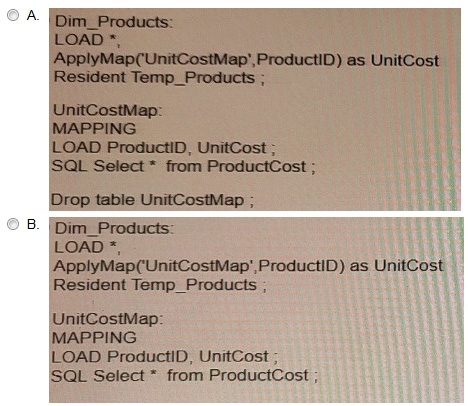
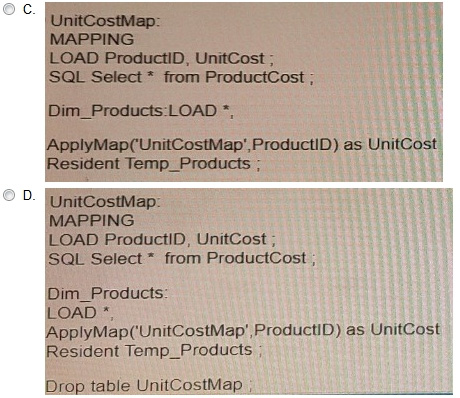
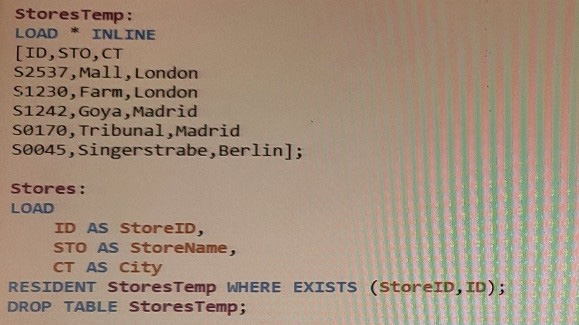
A customer needs to load forecast data from an Excel file. Which preceding load statement should the data architect use to load the data?
A. Option A B. Option B C. Option C D. Option D
D. Option D
Explanation/Reference:
Question 7:
Refer to the exhibit.
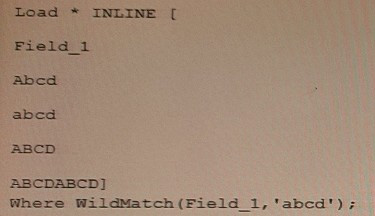
A data architect executes the script.
What will be the value of the first row for Field_1?
A. A B. D C. Null D. 4
B. D
Question 8:
Refer to the exhibit.
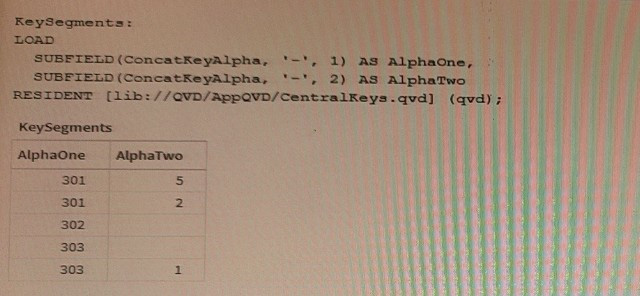
A data architect is loading the tables and a synthetic key is generated.
How should the data architect resolve the synthetic key?
A. Create a composite key using OrderlD and LineNo B. Remove the LineNo field from Shipments and use the AutoNumber function on the OrderlD field C. Remove the LineNo field from both tables and use the AutoNumber function on the OrderlD field D. Create a composite key using OrderlD and LineNo, and remove OrderlD and LineNo from Shipments
A. Create a composite key using OrderlD and LineNo
Explanation/Reference:
This is the recommended approach to resolving synthetic keys, as it allows you to maintain the integrity of the data by combining two or more fields into a single key. The composite key can then be used to join the two tables together, ensuring that the data is consistent and accurate.
Question 9:
Users of a published app report incomplete visualizations. The data architect checks the app multiple times and cannot replicate the error. The error affects only one team. What is the most likely cause?
A. An Omit field has been applied B. Section access restricts too many records C. A security rule has been applied to the sheet object D. The affected users were NOT added to the Section table
B. Section access restricts too many records
Explanation/Reference:
Section access restricts access to certain records, and if too many records are restricted, it can lead to incomplete visualizations.Source: Qlik Section access is used to control access to the data in an app. If the section access settings are too restrictive, they can prevent certain users or teams from seeing all of the data they need, resulting in incomplete visualizations. It is possible that the affected team has been assigned a section access that is too restrictive, preventing them from seeing all of the necessary data. This could be a misconfiguration or an oversight in the section access settings.
Question 10:
Refer to the exhibit
A data architect is working on an app that contains orders, invoices, and shipping data. There are three different date fields within the data:
*
OrderDate
*
InvoiceDate
*
ShippingDate
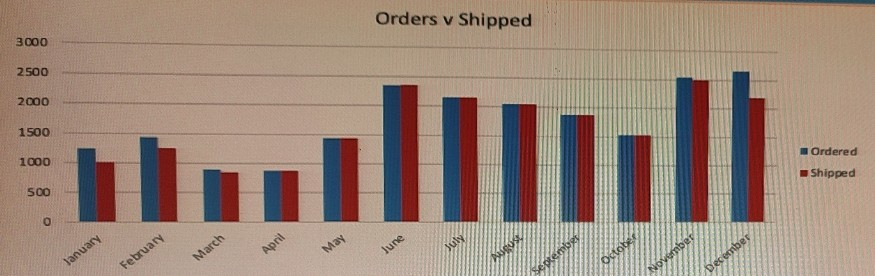
The business analyst needs to replicate the chart above to show Order and Shipping amounts on the same Month axis.
What should the data architect do?
A. Create a Month field for each of the three dates in the fact table and use that in the chart B. Load the key field and the three date fields into a concatenated bridge table that contains KeyField and Date C. Left Join the three date fields onto one bridge table using the key field containing KeyField and Date
B. Load the key field and the three date fields into a concatenated bridge table that contains KeyField and Date
Nowadays, the certification exams become more and more important and required by more and more
enterprises when applying for a job. But how to prepare for the exam effectively? How to prepare
for the exam in a short time with less efforts? How to get a ideal result and how to find the
most reliable resources? Here on Vcedump.com, you will find all the answers.
Vcedump.com provide not only QlikView exam questions,
answers and explanations but also complete assistance on your exam preparation and certification
application. If you are confused on your QSDA2022 exam preparations
and QlikView certification application, do not hesitate to visit our
Vcedump.com to find your solutions here.