PW0-250 Exam Details
-
Exam Code
:PW0-250 -
Exam Name
:Certified Wireless Design Professional (CWDP) -
Certification
:CWNP Certifications -
Vendor
:CWNP -
Total Questions
:65 Q&As -
Last Updated
:Jul 13, 2026
CWNP PW0-250 Online Questions & Answers
-
Question 51:
Multicast video applications typically require special treatment on the Wi-Fi network due to the nature of multicast traffic. Many vendors implement proprietary multicast-to-unicast conversion for this reason.
Which of the following is NOT a valid reason for special unicast conversion of downlink multicast traffic?
A. In QoS WLANs, multicast traffic is always assigned to the best effort (AC_BE) transmit queue.
B. Group addressed downlink frames are not acknowledged on the wireless medium.
C. Multicast traffic must always be transmitted via omnidirectional antennas.
D. Frames with a group receiver address must always be sent at a rate in the Basic Rate Set. -
Question 52:
In a centralized WLAN architecture, what new problem may arise when you change the data forwarding model from centralized to distributed? (Choose 2)
A. APs that were designed for a centralized forwarding model may not support all features in distributed forwarding mode.
B. The Ethernet switch ports to which APs are connected may need to be reconfigured to support VLAN tagging and QoS at the network edge.
C. All RRM controls will also need to be distributed to a master AP that acts as a channel and transmit power arbiter for other APs in the ESS.
D. Centralized control functions, such as key management and distribution, RRM, and load balancing will no longer be supported.
E. APs will not have the processing capabilities to support AES-CCMP, so TKIP will be the recommended encryption method. -
Question 53:
Why does a frame transmitted at 1 Mbps have a greater usable range than the same frame transmitted at 54 Mbps?
A. Free space path loss causes greater signal dispersion for higher rate transmissions.
B. Receiver sensitivity requirements are lower for frames transmitted with less complex modulation and coding.
C. To improve reliability, 802.11 STAs increase transmit power as the signaling rate decreases.
D. Lower data rate RF transmissions travel at higher speeds and are less likely to experience collisions.
E. Frames sent at higher data rates are also sent at higher power levels and are therefore more prone to collisions and multipath. -
Question 54:
You are working on a VoWLAN design with your customer's wired networking team. How many distinct priority levels do you expect for the voice applications?
A. 1 priority level, but 2 queues (one for uplink traffic, one for downlink traffic)
B. 1 priority level per client and AP pair, so the total number depends on the expected number of clients
C. 1 priority level for voice RTP, 1 priority level for voice control and RTCP
D. 1 priority level for VoWLAN client traffic, 1 priority level for wired VoIP client traffic -
Question 55:
Multicast video applications typically require special treatment on the Wi-Fi network due to the nature of multicast traffic. Many vendors implement proprietary multicast-to-unicast conversion for this reason.
Which of the following is NOT a valid reason for special unicast conversion of downlink multicast traffic?
A. Multicast traffic must always be transmitted via omnidirectional antennas.
B. Group addressed downlink frames are not acknowledged on the wireless medium.
C. In QoS WLANs, multicast traffic is always assigned to the best effort (AC_BE) transmit queue.
D. Frames with a group receiver address must always be sent at a rate in the Basic Rate Set. -
Question 56:
One of your customers plans on providing wireless coverage to a warehouse facility. After performing an initial walkthrough, you collect the following information:
-
The central part of the warehouse is between 400 and 600 feet (122 to 183 meters) from the warehouse switches mounted on the walls.
-
The warehouse map was provided by the customer and is displayed in the exhibit.
-
The warehouse storage is composed of metallic racks with varying inventory levels and contents, from electronics and plastic toys to food pallets and juice bottles.
-
Workers need basic data coverage from their working location, and are not highly mobile. They usually work from one single aisle, and their laptop is on a cart with wheels.
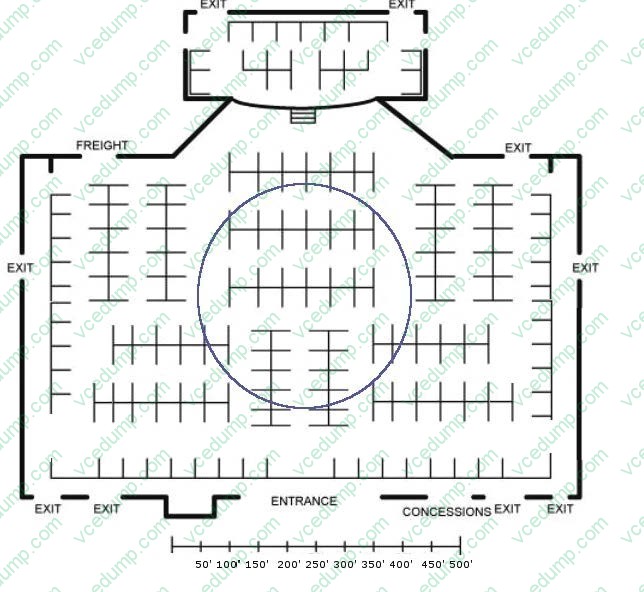
What would be your recommendation to provide coverage to the central area (indicated by a blue circle) of the warehouse?
A. Equip workers laptops with a directional antenna and install APs less than 328 feet (100m) away from the switch.
B. In this case, extend the cable length just beyond 328 feet (100 m) and position APs as close as possible to the central area of the warehouse.
C. Position APs along the walls, and equip the APs with Yagi antennas to cover the central area.
D. Install APs for client access in the central area and use a mesh backhaul link to connect to the DS. -
Question 57:
In this question, you will compare the mobility processes of a network that supports WPA2- Personal and WPA2-Enterprise. Assume the use of a 15-character ASCII passphrase for WPA2- Personal and EAP-TTLS/MSCHAPv2 with WPA2Enterprise. Also, assume that proprietary roaming protocols are not supported.
When a device transitions from one BSS to another within the same ESS, what steps must be performed in the WPA2-Enterprise transition that are not performed in the WPA2-Personal transition? (Choose 2)
A. Open System Authentication
B. 802.11 Reassociation
C. 802.1X authentication
D. 4-Way Handshake
E. Transfer of PMK from AAA server to authenticator
F. Conversion of passphrase to PMK -
Question 58:
What is the DSCP Per Hop Behavior equivalent classification of the 802.11e AC_VO priority level?
A. AF31
B. EF
C. VO
D. AF12
E. CS3 -
Question 59:
What type of pattern matches the 12 dBi antenna displayed in the exhibit?

A. Figure 1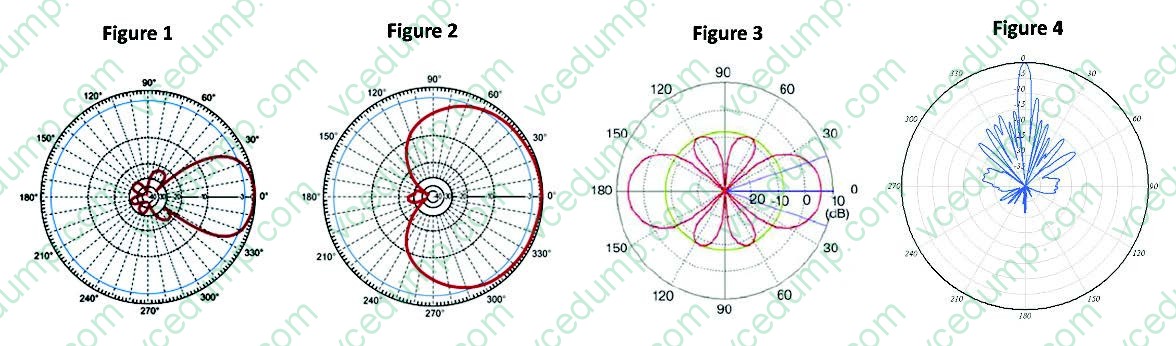
B. Figure 2
C. Figure 3
D. Figure 4 -
Question 60:
You captured the wireless frame shown in the exhibit during a post-deployment verification site survey.
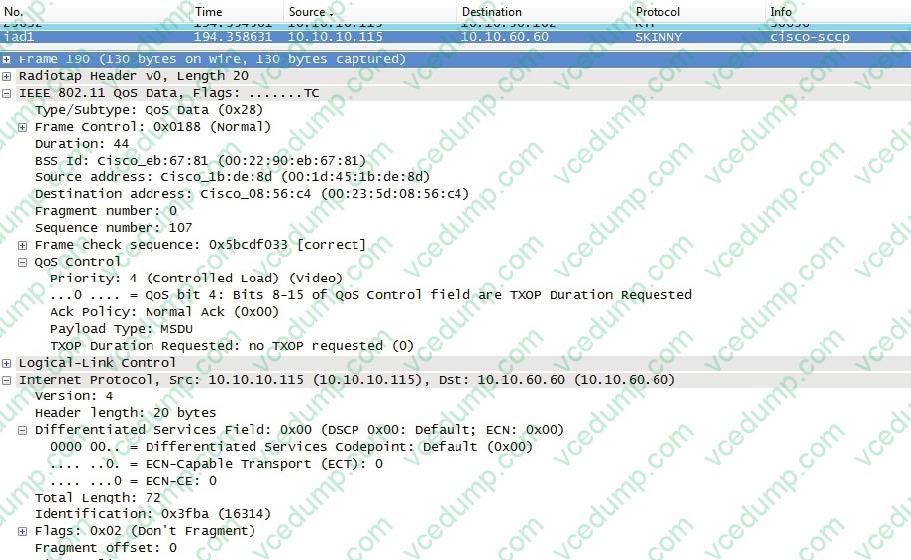
What can you tell the customer about this network?
A. This is a video stream packet, and there is a QoS marking issue on the wired side, because the DSCP value should not be set to 0.
B. This is a voice control packet, and the configuration looks normal, as voice control may or may not have a DSCP tag.
C. This is a video stream packet, and the configuration looks normal, as DSCP is always set to 0 when 802.11e QoS is specified at Layer 2.
D. This is a voice RTP packet, and its marking was downgraded from Voice to Video which is a sign of congestion issues.
Related Exams:
-
CWAP-402
Certified Wireless Analysis Professional -
CWAP-403
Certified Wireless Analysis Professional -
CWAP-404
Certified Wireless Analysis Professional -
CWAP-405
Certified Wireless Analysis Professional -
CWDP-303
Certified Wireless Design Professional -
CWDP-304
Certified Wireless Design Professional -
CWDP-305
Certified Wireless Design Professional -
CWISA-102
Certified Wireless IoT Solutions Administrator -
CWISA-103
Social Media Strategist -
CWNA-106
Certified Wireless Network Administrator
Tips on How to Prepare for the Exams
Nowadays, the certification exams become more and more important and required by more and more enterprises when applying for a job. But how to prepare for the exam effectively? How to prepare for the exam in a short time with less efforts? How to get a ideal result and how to find the most reliable resources? Here on Vcedump.com, you will find all the answers. Vcedump.com provide not only CWNP exam questions, answers and explanations but also complete assistance on your exam preparation and certification application. If you are confused on your PW0-250 exam preparations and CWNP certification application, do not hesitate to visit our Vcedump.com to find your solutions here.