PW0-250 Exam Details
-
Exam Code
:PW0-250 -
Exam Name
:Certified Wireless Design Professional (CWDP) -
Certification
:CWNP Certifications -
Vendor
:CWNP -
Total Questions
:65 Q&As -
Last Updated
:Jul 13, 2026
CWNP PW0-250 Online Questions & Answers
-
Question 21:
Use the exhibit as a reference.
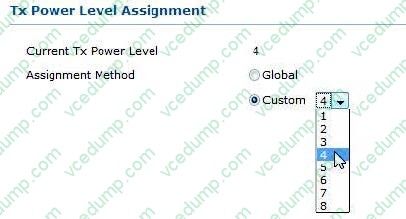
Given:
-
In your regulatory domain, a Tx Power Level of "1" is equivalent to 17 dBm.
-
For every integer increment (e.g. from 1 to 2) to the Tx Power Level, the AP's transmit power is halved. In units of mW, what is the actual transmit power for an AP configured at a Tx Power Level of "4"?
A. 200 mW
B. 50 mW
C. 12.5 mW
D. 8 mW
E. 6.25 mW
F. 2.5 mW -
Question 22:
In a centralized WLAN architecture, what new problem may arise when you change the data forwarding model from centralized to distributed? (Choose 2)
A. APs that were designed for a centralized forwarding model may not support all features in distributed forwarding mode.
B. Centralized control functions, such as key management and distribution, RRM, and load balancing will no longer be supported.
C. All RRM controls will also need to be distributed to a master AP that acts as a channel and transmit power arbiter for other APs in the ESS.
D. The Ethernet switch ports to which APs are connected may need to be reconfigured to support VLAN tagging and QoS at the network edge.
E. APs will not have the processing capabilities to support AES-CCMP, so TKIP will be the recommended encryption method. -
Question 23:
Given: Use the exhibit as a reference. ABC Company has a WLAN controller with 10 controller- based APs; the Voice SSID is configured for centralized data forwarding. Each AP is connected to an access port on a layer-2 Ethernet switch. Each layer-2 switch is uplinked to a single layer-3 core Ethernet switch. The WLAN controller is connected directly to the layer-3 core Ethernet switch. Layer-3 tunnels are created between all controller-based APs and the WLAN controller. A voice server is connected to the layer-3 Ethernet switch.
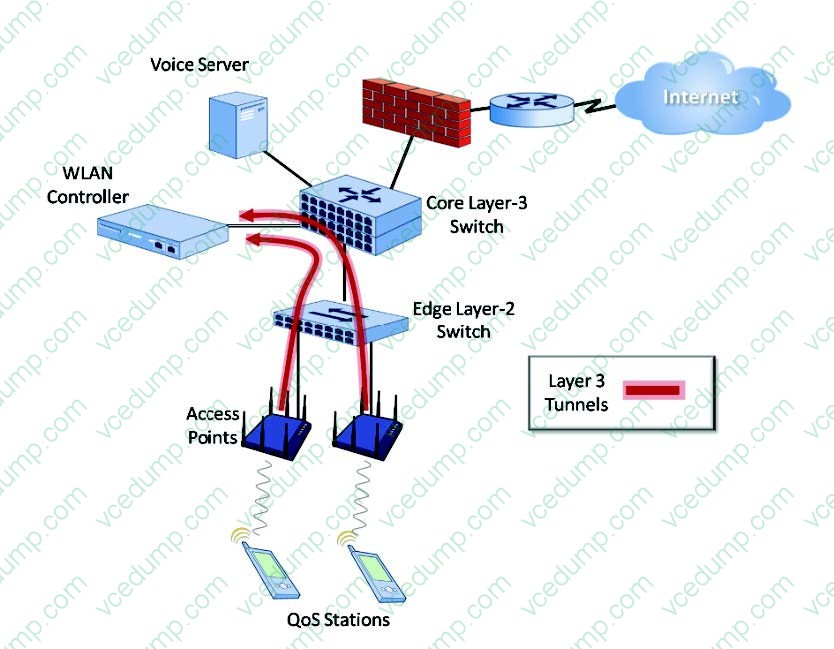
When a voice-enabled QoS STA sends an IP data packet to a voice server in this scenario, the DSCP value carried in the STA's IP data packet gets mapped to what and by which device?
A. The DSCP value is mapped to an IEEE 802.1Q priority tag value by the WLAN controller.
B. The DSCP value is mapped to the DSCP value in the encapsulating IP header by the layer-3 switch.
C. The DSCP value is mapped to an IEEE 802.1p (802.1D-2004) UP value by the access point.
D. The DSCP value is mapped to an IEEE 802.1Q VLAN tag by the access point.
E. The DSCP value is mapped to the VLAN ID by the layer-2 Ethernet switch. -
Question 24:
You are tasked with designing the WLAN to accommodate certain high density areas on your university campus where users are highly transient (frequently come and go). With a limited DHCP pool size (subnet mask = 255.255.252.0) for this WLAN subnet, you want to ensure that your DHCP addresses are used efficiently and are not exhausted, which would prevent new client associations. The DHCP server is a Windows Server 2008 machine. Your design task is to determine the best configuration to allow as many users as possible while avoiding WLAN service interruptions and also to use the available addresses as efficiently as possible.
What setting would be most effective at achieving this design task?
A. Set the RTS threshold to 2346 bytes
B. Set the inactive wireless client timeout (client age-out) to 5 minutes
C. Set the maximum client limit per radio to 64
D. Set the DHCP lease for this pool to 20 minutes
E. Enable WLAN Controller DHCP relay
F. Enable mandatory admission control
G. Set the AES rekey interval to 5 minutes
H. Set the 802.1X re-authentication timer to 10 minutes -
Question 25:
After surveying for the ideal mounting locations for APs, you have been asked to compromise RF propagation optimization due to aesthetic concerns raised by your customer. In the end, you've decided to mount the APs in the ideal locations and paint the APs so they go unnoticed in the environment.
What is a valid recommendation or consideration when painting APs? (Choose 2)
A. Always use paints with metallic dye in them to prevent potential RF propagation impact.
B. Do not paint the notification LEDs on the AP, but configure them to be dim or turned off altogether until troubleshooting is required.
C. Painting APs may void the product manufacturer's warranty.
D. Most AP models for indoor environments come in a variety of form factors and colors. Painting is never recommended.
E. Painting APs always introduces a fire and gas emissions hazard and should be avoided for all indoor APs. -
Question 26:
You told your customer that multipath fading may be mitigated simply by moving one or both of the receiver's antennas a little bit, usually by one to four wavelengths away from its original position. Your customer is prepared to make the change, but does not know the wavelength for 802.11a.
What is the approximate wavelength of an 802.11a radio wave?
A. 5.5 cm (2.16 inches)
B. 12 cm (4.72 inches)
C. 15.24 cm (6 inches)
D. 45 cm (17.71 inches)
E. 58 cm (22.83 inches) -
Question 27:
Which definition correctly describes the "local MAC" variation of the centralized WLAN architecture?
A. All MAC functions are performed by the AP. A minimal subset of network control is offloaded to the WLAN controller along with management and monitoring functions.
B. PHY functions are performed directly by the AP. MAC functions are divided almost equally between the WLAN controller and the AP, according to the time sensitivity of the feature or service.
C. The AP provides the RF termination point for the WLAN, but performs very few of the WLAN functions or services. The WLAN controller performs all MAC functions and the AP is very simple and lightweight.
D. All RF-, data-, and control-related WLAN functions are performed by the AP. APs coordinate network services with one another and are managed by a WNMS, so no WLAN controller is used in this architecture. -
Question 28:
You are site surveying a network for VoWiFi. You have positioned an AP for a manual survey and are moving away from the AP with a phone in Survey Mode in your hand and you are reading the RSSI value of the signal received from the AP. You have previously determined that the noise floor was approximately -94 dBm on this floor of the building. The phone's documentation does not specify a recommended RSSI or SNR value for best performance. Based on the information provided and the type of device (VoWiFi phone) you are deploying, what minimum RSSI should you plan for in all areas you are monitoring and where VoWiFi service is desired?
A. -75 dBm
B. -72 dBm
C. -67 dBm
D. -62 dBm
E. -58 dBm -
Question 29:
In a large enterprise (5000+ wireless users), by what recommended methods are IP addresses and VLANs assigned to different clients associated to the same AP? (Choose 3)
A. Each SSID is mapped to a static VLAN assignment
B. Upstream AAA servers dynamically assign VLANs to each user or group profile
C. Radio signal metrics (RSSI, SNR, etc.) of WLAN clients are triangulated for location-based VLAN assignment during association
D. Each BSSID is assigned a unique VLAN to help manage the size of broadcast domains on the wired network
E. Multiple VLAN pools are designated for an SSID and user IP addresses are selected in a round-robin fashion from the associated pools.
F. In a centralized data forwarding model, clients automatically receive an IP address on the native VLAN of the AP's Ethernet access port.
G. The configuration profile of the client supplicant is hard-coded with a VLAN ID. -
Question 30:
What statement is true of a WLAN design that supports Real-Time Location Services (RTLS) with 802.11 RFID asset tags? (Choose 2)
A. When passive tags are implemented, the AP density should be increased by 25% to make up for the shorter transmit range of passive tags as compared to active tags.
B. Active RFID tags periodically transmit 802.11 beacon management frames that must be synchronized with the AP for proper location of the tagged asset.
C. With passive tags, AP transmit gain should be increased to supply extra power for near-field coupling or backscatter modulation from the tag to the AP since the passive tag lacks an internal power source.
D. Passive tags do not communicate directly with the WLAN infrastructure, but instead they rely on the tag interrogator to communicate tag information to the infrastructure's location tracking server/database.
E. Active tags transmit directly to the APs and may not require 802.11 authentication and association to pass data traffic to the RTLS engine.
F. When tracking assets with passive RFID tags, some APs should be moved, or additional APs be added, to provide more accurate triangulation and location services.
Related Exams:
-
CWAP-402
Certified Wireless Analysis Professional -
CWAP-403
Certified Wireless Analysis Professional -
CWAP-404
Certified Wireless Analysis Professional -
CWAP-405
Certified Wireless Analysis Professional -
CWDP-303
Certified Wireless Design Professional -
CWDP-304
Certified Wireless Design Professional -
CWDP-305
Certified Wireless Design Professional -
CWISA-102
Certified Wireless IoT Solutions Administrator -
CWISA-103
Social Media Strategist -
CWNA-106
Certified Wireless Network Administrator
Tips on How to Prepare for the Exams
Nowadays, the certification exams become more and more important and required by more and more enterprises when applying for a job. But how to prepare for the exam effectively? How to prepare for the exam in a short time with less efforts? How to get a ideal result and how to find the most reliable resources? Here on Vcedump.com, you will find all the answers. Vcedump.com provide not only CWNP exam questions, answers and explanations but also complete assistance on your exam preparation and certification application. If you are confused on your PW0-250 exam preparations and CWNP certification application, do not hesitate to visit our Vcedump.com to find your solutions here.