PCNSE Exam Details
-
Exam Code
:PCNSE -
Exam Name
:Palo Alto Networks Certified Network Security Engineer - PAN-OS 11.x (PCNSE) -
Certification
:Palo Alto Networks Certifications -
Vendor
:Palo Alto Networks -
Total Questions
:860 Q&As -
Last Updated
:Mar 23, 2026
Palo Alto Networks PCNSE Online Questions & Answers
-
Question 211:
An administrator notices interface ethernet1/2 failed on the active firewall in an active I passive firewall high availability(HA) pair.
Based on the image below, what -if any -action was taken by the active firewall when the link failed?
A. No action was taken because interface ethernet1/1 did not fail.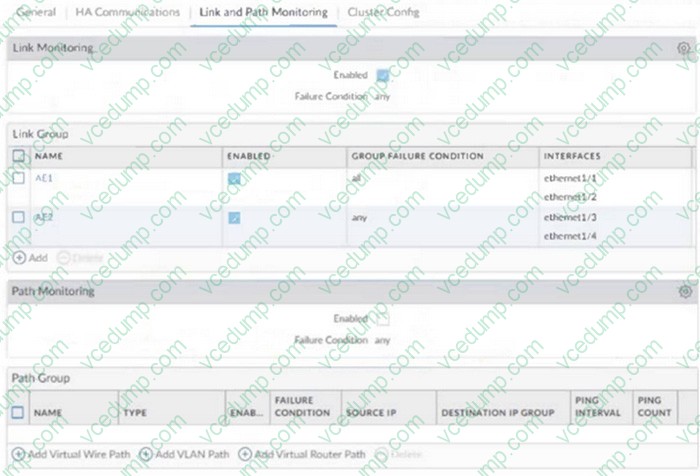
B. The active firewall failed over to the passive HA member due to an AE1 Link Group failure.
C. No action was taken because Path Monitoring is disabled.
D. The active firewall failed over to the passive HA member because "any" is selected for the Link Monitoring "Failure Condition". -
Question 212:
The following objects and policies are defined in a device group hierarchy
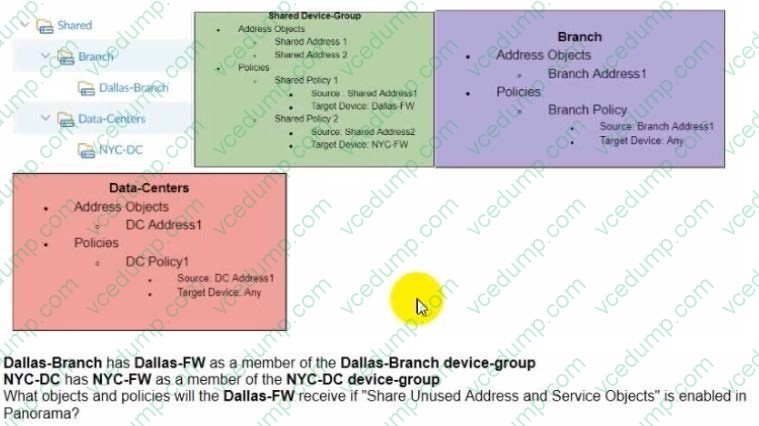
A. Option A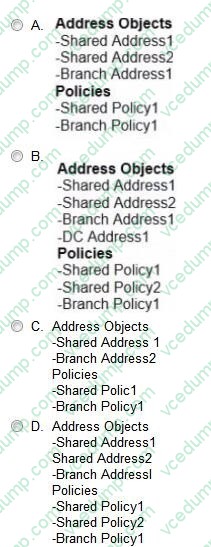
B. Option B
C. Option C
D. Option D -
Question 213:
Which three firewall states are valid? (Choose three.)
A. Active
B. Functional
C. Pending
D. Passive
E. Suspended -
Question 214:
The firewall team has been asked to deploy a new Panorama server and to forward all firewall logs to this server By default, which component of the Palo Alto Networks firewall architect is responsible for log forwarding and should be checked for early signs of overutilization?
A. Management plane CPU
B. Dataplane CPU
C. Packet buffers
D. On-chip packet descriptors -
Question 215:
An ISP manages a Palo Alto Networks firewall with multiple virtual systems for its tenants.
Where on this firewall can the ISP configure unique service routes for different tenants?
A. Setup > Services > Virtual Systems > Set Location > Service Route Configuration > Inherit Global Service Route Configuration
B. Setup > Services > Global > Service Route Configuration > Customize
C. Setup > Services > Virtual Systems > Set Location > Service Route Configuration > Customize
D. Setup > Services > Global > Service Route Configuration > Use Management Interface for all -
Question 216:
Which GlobalProtect gateway setting is required to enable split-tunneling by access route, destination domain, and application?
A. No Direct Access to local networks
B. Satellite mode
C. Tunnel mode
D. IPSec mode -
Question 217:
What is the dependency for users to access services that require authentication?
A. An Authentication profile that includes those services
B. Disabling the authentication timeout
C. An authentication sequence that includes those services
D. A Security policy allowing users to access those services -
Question 218:
An administrator has users accessing network resources through Citrix XenApp 7 x. Which User-ID mapping solution will map multiple users who are using Citrix to connect to the network and access resources?
A. Client Probing
B. Terminal Services agent
C. GlobalProtect
D. Syslog Monitoring -
Question 219:
An enterprise has a large Palo Alto Networks footprint that includes onsite firewalls and Prisma Access for mobile users, which is managed by Panorama The enterprise already uses GlobalProtect with SAML authentication to obtain iP-touser mapping information.
However information Security wants to use this information in Prisma Access for policy enforcement based on group mapping Information Security uses on-prermses Active Directory (AD) but is uncertain about what is needed for Prisma Access to learn groups from AD.
How can portaes based on group mapping be learned and enforced in Prisma Access?
A. Configure Prisma Access to learn group mapping via SAML assertion
B. Assign a master device in Panorama through which Prisma Access learns groups
C. Set up group mapping redistribution between an onsite Palo Alto Networks firewall and Prisma Access
D. Create a group mapping configuration that references an LDAP profile that points to on-premises domain controllers -
Question 220:
A network administrator created an intrazone Security policy rule on the firewall. The source zones were set to IT, Finance, and HR. Which two types of traffic will the rule apply to? (Choose two.)
A. traffic between zone Finance and zone HR
B. traffic between zone IT and zone Finance
C. traffic within zone HR
D. traffic within zone IT
Related Exams:
-
PAN-CSP
Palo Alto Networks Cloud Security Professional -
PAN-NGFE
Palo Alto Networks Network Next-Generation Firewall Engineer -
PAN-NSA
Palo Alto Networks Network Security Analyst -
PAN-NSG
Palo Alto Networks Network Security Professional -
PAN-NSP
Palo Alto Networks Network Security Professional -
PAN-SDWE
Palo Alto Networks SD-WAN Engineer -
PAN-SOP
Palo Alto Networks Security Operations Professional -
PAN-SSEE
Palo Alto Networks Security Service Edge Engineer -
PAN-XDRA
Palo Alto Networks XDR Analyst -
PAN-XDRE
Palo Alto Networks XDR Engineer
Tips on How to Prepare for the Exams
Nowadays, the certification exams become more and more important and required by more and more enterprises when applying for a job. But how to prepare for the exam effectively? How to prepare for the exam in a short time with less efforts? How to get a ideal result and how to find the most reliable resources? Here on Vcedump.com, you will find all the answers. Vcedump.com provide not only Palo Alto Networks exam questions, answers and explanations but also complete assistance on your exam preparation and certification application. If you are confused on your PCNSE exam preparations and Palo Alto Networks certification application, do not hesitate to visit our Vcedump.com to find your solutions here.