
OMG-OCEB2-FUND100 Real Exam Questions

OMG-Certified Expert in BPM 2 - Fundamental

111 questions available · Page 1 of 12

Updated Exam DumpsVerified AnswersPass Guarantee

Get Complete Exam Dumps
Question 1 Single choice

Which BMM element evaluates the impact of an influencer?

  1. A

    Directive

  2. B

    Assessment

  3. C

    Strategy

  4. D

    Objective

Show answer and explanation

Correct answer: B

Explanation

An Assessment in BMM evaluates the impact of Influencers on the organization. It determines whether the influence is positive or negative. Therefore, the correct answer is B.

Question 2 Single choice

Michael Porter created a strategic thinking framework called Porter's Five Forces.

Which is a set of those forces?

  1. A

    adjust value creation, improve associated activities, segment customer base, analyze product
    performance, align business area to top two segments

  2. B

    elements of barriers to entry, threats of substitute products or services, suppliers' bargaining power, customers' bargaining power, and competitive rivalry

  3. C

    define organization's purpose, establish mission-consistent goals and objectives, develop resources to attain goals, set timeframe for the strategy, develop critical products and services

  4. D

    determine where an organization is going over the next year or more, how it is going to get there, how it will know if it got there or not, the cost of the value chain, and the risk involved

Show answer and explanation

Correct answer: B

Explanation

Porter's Five Forcesis a classicstrategic analysis frameworkfrequently referenced inbusiness architecture and BPMto understand the external environment that shapes processes and strategies.
The five forces are: Barriers to entry / Threat of new entrants-How easy is it for new competitors to enter the market? Threat of substitute products or services-Can customers switch to something different that satisfies the same need?
Bargaining power of suppliers-How much power do suppliers have over price, quality, and terms?
Bargaining power of customers (buyers)- How much power do customers have to push prices down or demand more value?
Competitive rivalry within the industry-Intensity of competition among current players. OMG'sBusiness Motivation Model (BMM)and enterprise strategy views use these kinds of external assessments to drive: Ends(goals, objectives).
Means(strategies, tactics).
Resultingbusiness processesmodeled in BPMN.
Why the other options are incorrect: A, C, and Dmix in elements ofstrategic planning steps,value chain analysis, orgoal setting, but none of them match the canonical list of the Five Forces.
Thus, the correct set of Porter's Five Forces is exactly what is listed inOption B.

Question 3 Single choice

Which BPMN artifact is used to group elements without affecting the process flow?

  1. A

    Pool

  2. B

    Lane

  3. C

    Group

  4. D

    Sub-Process

Show answer and explanation

Correct answer: C

Explanation

A Group in BPMN is an artifact used for documentation and visual organization. It does not affect execution semantics, sequence flow, or data flow. Pools and Lanes define participants and responsibilities, while Sub-Processes define execution structure. Therefore, the correct answer is C.

Question 4 Single choice

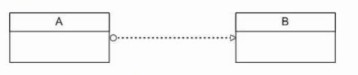
Which statement is true about this scenario?

  1. A

    A pushes data into

  2. B

    A is associated with B.

  3. C

    A is performed before B.

  4. D

    A sends a message to B.

Show answer and explanation

Correct answer: D

Explanation

The diagram shows two Participants (A and B) connected by adashed line with an open circle at the source and an arrow at the target. In BPMN this is aMessage Flow.
Semantics of a Message Flow: It indicates thatone participant sends a message to another(cross-pool communication).

Mapping options:
A. "Pushes data"describes data association, not a BPMN message flow. B. "Associated with"refers to
BPMNAssociation, which is also dashed, but used between artifacts and flow objects without the open
circle/arrow message notation.
C. "Performed before"would be asequence flow, which is solid, not dashed. D. "A sends a message to
B."exactly describes a Message Flow.
So, the correct interpretation isD.
Question 5 Single choice

What happens if a process has no End Event?

  1. A

    The end of the Process is undefined.

  2. B

    Every Process must have at least one End Event.

  3. C

    The stakeholder of the Process can decide when the Process ends.

  4. D

    Every Flow Object that has no outgoing Sequence Flow marks the end of a path.

Show answer and explanation

Correct answer: D

Explanation

In BPMN,End Events are optional. If no End Event is modeled, a path of execution ends whenever a token reaches aFlow Object with no outgoing Sequence Flow(for example, a Task or Gateway with no outgoing Sequence Flow). So: A: "End is undefined" - incorrect; BPMN clearly defines termination on lack of outgoing flow. B: "Every Process must have at least one End Event" - incorrect; not required.
C: "Stakeholder decides when the Process ends" - not a BPMN rule. Dcorrectly reflects the BPMN execution semantics:Every Flow Object that has no outgoing Sequence Flow marks the end of a path.

Question 6 Single choice

According to the Business Motivation Model (BMM), what are the parts of a Mission statement?

  1. A

    A goal part and an action part

  2. B

    An action part, a product or service part, and a market or customer part

  3. C

    A key market part, a customer part, a contribution part, and a distinction part

  4. D

    A content part, a quantitative or measurable part, and an operative part

Show answer and explanation

Correct answer: B

Explanation

The OMGBusiness Motivation Model (BMM)defines aMissionas a concise declaration ofwhat the organization does.
A Mission statement must include exactly three components: Action part-what the organization does (e.g., "provide," "deliver," "create"). Product or service part-what is being offered (e.g., "loans," "support," "transportation"). Market or customer part-for whom the organization acts (e.g., "for small businesses," "for local residents"). This tripartite structure is explicitly defined in the BMM specification.
Therefore, Option B is the correct and only BMM-conforming answer.

Question 7 Single choice

What is the main purpose of process modeling in BPM?

  1. A

    To define IT system architecture

  2. B

    To document and analyze business processes

  3. C

    To replace organizational structure

  4. D

    To eliminate all manual tasks

Show answer and explanation

Correct answer: B

Explanation

Process modeling is used to document, analyze, and improve business processes. It supports understanding and optimization but does not inherently eliminate manual tasks or define IT architecture.
Therefore, the correct answer is B.

Question 8 Single choice

Why is Service Oriented Architecture (SOA) beneficial to BPM?

  1. A

    SOA allows monolithic applications to be replaced by new innovative systems.

  2. B

    SOA removes the reliance of processes on the technologies of underlying applications.

  3. C

    SOA permits IT to create customized solutions to satisfy each department's specific needs.

  4. D

    SOA forces a comprehensive integration between processes and their essential back-end systems.

Show answer and explanation

Correct answer: B

Explanation

In OMG-aligned BPM architecture,SOA decouples processes from specific application technologiesby exposing system functions as standardized services.
This allows BPM processes to: Orchestrate services regardless of underlying technology Promote reuse, loose coupling, and interoperability Increase agility and maintainability OptionBis correct because SOAremoves the tight dependenceof process logic on the specific technologies used in back-end systems. OptionAdescribes a possible outcome, not the core benefit.
OptionCcontradicts SOA's goal of standardization and reuse. OptionDincorrectly implies forced tight integration; SOA actually promotesloosely coupledintegration. Thus,SOA benefits BPM by separating
business processes from application-specific technologies, enabling flexible orchestration.

Question 9 Single choice

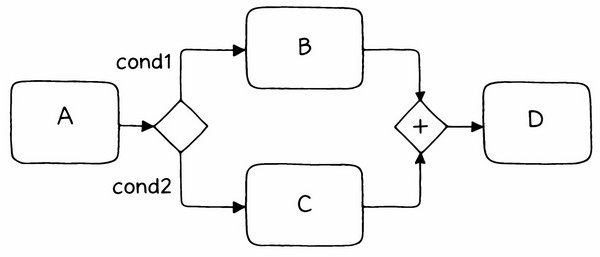
What is wrong with this BPMN diagram?

  1. A

    The gateways are interchanged.

  2. B

    The activity D can never be reached.

  3. C

    It is not deterministic if B or C follows A.

  4. D

    The condition expressions of the exclusive gateway are not marked correctly.

Show answer and explanation

Correct answer: B

Explanation

In the given diagram: After activityA, there is anexclusive gateway(with conditionscond1andcond2), soeither B or Cis chosen-never both.
AfterBandC, their flows go into a gateway with aplus sign, which is aParallel Gateway (AND-join)in BPMN.
AParallel Joinwaits fora token from every incoming branchbefore it can release a token onward toD. But due to the earlier exclusive split,only oneof the two branches (B or C) ever receives a token. The other branch never activates, so the parallel join never gets all required tokens.
Consequences:
The join gateway willnever be satisfied, Therefore, the flownever proceeds to activity D.
So the defect is exactly what optionBsays: The activity D can never be reached.
That is the correct answer.

Question 10 Single choice

Which BPMN task type is executed automatically by a system without human intervention?

  1. A

    Manual Task

  2. B

    User Task

  3. C

    Service Task

  4. D

    Script Task

Show answer and explanation

Correct answer: C

Explanation

A Service Task represents automated execution using a service or application. Manual Tasks require human effort without system support, User Tasks involve human interaction with systems, and Script Tasks are executed by the engine but not via external services. Therefore, the correct answer is C.