OGEA-103 Exam Details
-
Exam Code
:OGEA-103 -
Exam Name
:TOGAF Enterprise Architecture Combined Part 1 and Part 2 -
Certification
:The Open Group Certifications -
Vendor
:The Open Group -
Total Questions
:125 Q&As -
Last Updated
:Jul 12, 2026
The Open Group OGEA-103 Online Questions & Answers
-
Question 111:
Which of the following are the four purposes that typically frame the planning horizon, depth and breadth of an Architecture Project, and the contents of the EA Repository-?
A. General Foundational Subordinate and Superior Architecture
B. Segment, Capability. Enterprise and End-to-end Target Architecture
C. Avant-Garde Big-Bang, Discreet and Cohesive
D. Strategy Portfolio Project Solution Delivery -
Question 112:
Which of the following best describes purpose of the Business Scenarios?
A. To identify risk when implementing an architecture project
B. To identify and understand requirements
C. To catch errors in a project architecture early
D. To guide decision making throughout the enterprise -
Question 113:
Please read this scenario prior to answering the question
You are the Lead Enterprise Architect at a major agribusiness company. The company's main annual harvest is lentils, a highly valued food grown worldwide. The lentil parasite, broomrape, has been an increasing concern for many years and is now becoming resistant to chemical controls. In addition, changes in climate favor the propagation and growth of the parasite.
As a result, the parasite cannot realistically be exterminated, and it has become pandemic, with lentil yields falling globally.
The CEO appreciates the seriousness of the situation and has set out a change in direction that is effectively a new business for the company. There are opportunities for new products, and new markets. The company will use the fields for another harvest and will cease to process third-party lentils. Thus, the target market will change, and the end-products will be different and more varied. This is a major decision and the CEO has stated a desire to repurpose rather than replace so as to manage the risks and limit the costs.
The company has a mature Enterprise Architecture practice based in its headquarters and uses the TOGAF standard as the method and guiding framework. The practice has an established Architecture Capability, and uses iteration for architecture development. The CIO is the sponsor of the activity.
The CIO has assigned the Enterprise Architecture team to this activity. At this stage there is no shared vision, or requirements.
Refer to the scenario
You have been asked to propose the best approach for architecture development to realize the CEO's change in direction for the company.
Based on the TOGAF standard which of the following is the best answer?
A. You propose that the team focus on architecture definition, with emphasis on defining the change parameters to support this new business strategy that the CEO has identified. Once understood, the team will be in the best position to identify the requirements, drivers, issues, and constraints for the change. You would ensure that the architecture development addresses non-functional requirements to assure that the target architecture is robust and secure.
B. You propose that this engagement define the baseline Technology Architecture first in order to assess the current infrastructure capacity and capability for the company. Then the focus should be on transition planning and incremental architecture deployment. This will identify requirements to ensure that the projects are sequenced in an optimal fashion so as to realize the change.
C. You propose that the priority is to understand and bring structure to the definition of the change. The team should focus iteration cycles on a baseline first approach to architecture development, and then transition planning. This will identify what needs to change in order to transition from the baseline to the target, and can be used to work out in detail what the shared vision is for the change.
D. You propose that the team focus its iteration cycles on architecture development by going through the architecture definition phases (B-D) with a baseline first approach. This will support the change in direction as stated by the CEO. It will ensure that the change can be defined in a structured manner and address the requirements needed to realize the change. -
Question 114:
Which of the following is included as part of Architecture Governance1?
A. Ensuring compliance with internal and external standards and regulatory obligations
B. Creating and maintaining the Statement of Architecture Work though out the ADM cycle
C. Managing Stakeholders and their requirements
D. Interacting with the CxO level on Enterprise Architecture -
Question 115:
Which of the following is the ability to develop use and sustain the architecture of a particular enterprise using architecture to govern change?
A. An EA Capability
B. An EA repository
C. An EA framework
D. An Enterprise Architecture -
Question 116:
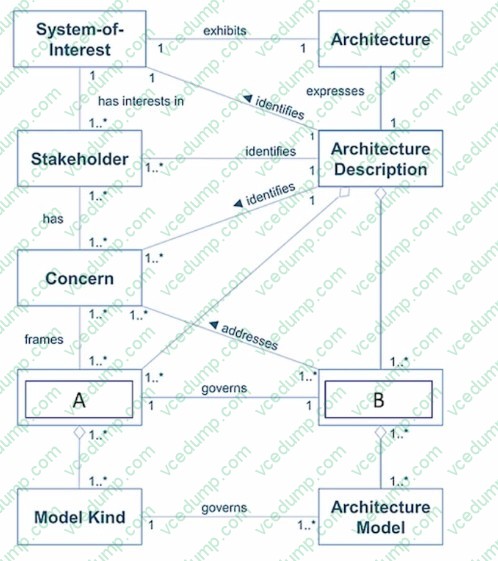
Consider the image showing basic architectural concepts. What are items A and B?
A. A-Architecture Viewpoint, B-Architecture View
B. A-Architecture Board, B-Architecture Capability
C. A-Candidate Architecture, B-Trade-off
D. A-Requirement. B-Candidate Architecture -
Question 117:
Which of the following best describes the purpose of the Architecture Requirements Specification?
A. It contains an assessment of the current architecture requirements
B. It provides a set of statements that outline what a project must do to comply with the architecture
C. It is sent from the sponsor and triggers the start of an architecture development cycle
D. It defines the scope and approach to complete an architecture project -
Question 118:
Which one of the following classes of information within the Architecture Repository would typically contain a list of the applications in use within the enterprise?
A. Reference Library
B. Architecture Metamodel
C. Architecture Landscape
D. Governance Log -
Question 119:
Please read this scenario prior to answering the question
Your role is that of a consultant to the Lead Enterprise Architect to an international supplier of engineering services and automated manufacturing systems. It has three manufacturing plants where it assembles both standard and customized products for industrial production automation. Each of these plants has been operating its own planning and production scheduling systems, as well as applications and control systems that drive the automated production line.
The Enterprise Architecture department has been operating for several years and has mature, well-developed architecture governance and development processes that are based on the TOGAF Standard. The CIO sponsors the Enterprise Architecture.
During a recent management meeting, a senior Vice-President highlighted an interview where a competitor company's CIO is reported as saying that their production efficiency had been improved by replacing multiple planning and scheduling systems with a common Enterprise Resource Planning (ERP) system located in a central data center. Some discussion followed, with the CIO responding that the situations are not comparable, and the current architecture is already optimized.
In response, the Architecture Board approved a Request for Architecture Work covering the investigations to determine if such an architecture transformation would lead to improvements in efficiency. You have been assigned to support the architecture team working on this project.
A well-known concern of the plant managers is about the security and reliability of driving their planning and production scheduling from a remote centralized system. Any chosen system would also need to support the current supply chain network consisting of local partners at each of the plants. Refer to the scenario You have been asked to explain how you will initiate the architecture project.
Based on the TOGAF Standard, which of the following is the best answer?
A. You would research vendor literature and conduct a series of briefings with vendorsthat are on the current approved supplier list. Based on the findings from theresearch, you would define a preliminary Architecture Vision including summaryviews, high-level requirements, and high-level definitions of the baseline and targetenvironments from a business, information systems, and technology perspective. Youwould then use that to build consensus among the key stakeholders.
B. You would conduct a pilot project that will enable vendors to demonstrate potentialoff- the-shelf solutions that address the concerns of the stakeholders. Running a pilotproject will save time and money later in the process. Based on the findings of thatpilot project, a complete set of requirements can then be developed that will drive theevolution of the architecture. Once the requirements are completed, a formalstakeholder review should be held, and permission sought to proceed to develop thetarget architecture.
C. You would hold a series of interviews at each of the manufacturing plants using thebusiness scenarios technique. This will allow you to understand the systems andintegrations with local partners. You would use stakeholder analysis to identify keyplayers in the engagement, and to understand their concerns. You will then identifyand document the key high-level stakeholder requirements for the architecture. Youwill then generate high level definitions of the baseline and target architectures.
D. You would develop baseline and target Architectures for each of the manufacturingplants, ensuring that the views corresponding to selected viewpoints address keyconcerns of the stakeholders. A business case, together with performance metricsand measures should be defined to ensure the architecture meets the businessneeds. A consolidated gap analysis between the architectures will then validate theapproach and determine the capability increments needed to achieve the target state. -
Question 120:
What does the TOGAF ADM recommend for use in developing an Architecture Vision document?
A. Requirements Management
B. Architecture Principles
C. Gap Analysis
D. Business Scenarios
Related Exams:
-
OG0-021
ArchiMate 2 Part 1 -
OG0-023
ArchiMate 2 Combined Part 1 and Part 2 -
OG0-061
IT4IT Part 1 -
OG0-091
TOGAF 9 Part 1 -
OG0-092
TOGAF 9 Part 2 -
OG0-093
TOGAF 9 Combined Part 1 and Part 2 -
OGA-031
ArchiMate 3 Part 1 -
OGA-032
ArchiMate 3 Part 2 -
OGB-001
TOGAF Business Architecture Part 1 -
OGBA-101
TOGAF Business Architecture Foundation
Tips on How to Prepare for the Exams
Nowadays, the certification exams become more and more important and required by more and more enterprises when applying for a job. But how to prepare for the exam effectively? How to prepare for the exam in a short time with less efforts? How to get a ideal result and how to find the most reliable resources? Here on Vcedump.com, you will find all the answers. Vcedump.com provide not only The Open Group exam questions, answers and explanations but also complete assistance on your exam preparation and certification application. If you are confused on your OGEA-103 exam preparations and The Open Group certification application, do not hesitate to visit our Vcedump.com to find your solutions here.