OGEA-103 Exam Details

  • Exam Code
    :OGEA-103
  • Exam Name
    :TOGAF Enterprise Architecture Combined Part 1 and Part 2
  • Certification
    :The Open Group Certifications
  • Vendor
    :The Open Group
  • Total Questions
    :125 Q&As
  • Last Updated
    :Jul 12, 2026

The Open Group OGEA-103 Online Questions & Answers

  • Question 1:

    Complete the following sentence:

    Presenting different_________and_________to stakeholders helps architects to extract hidden agendas principles and requirements that could impact the final Target

    A. Alternatives Trade-offs
    B. Solutions Applications
    C. Architecture Views Architecture Viewpoints
    D. Business Scenarios Business Models

  • Question 2:

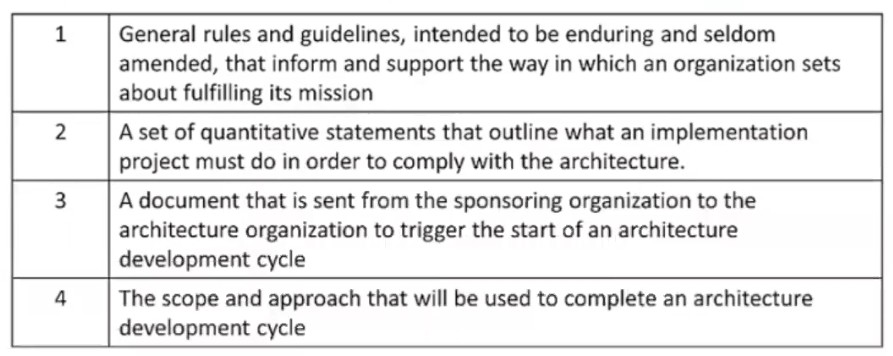
    Consider the following descriptions of deliverables consumed and produced across the TOGAF ADM cycle.

    General rules and guidelines, intended to be enduring and seldom amended, that inform and support the way in which an organization sets about fulfilling its mission

    The joint agreements between development partners and sponsors on the deliverables, quality, and fitness-for-purpose of an architecture.

    A document that is sent from the sponsoring organization to the architecture organization to trigger the start of an architecture development cycle

    A set of quantitative statements that outline what an implementation project must do in order to comply with the architecture.

    Which deliverables match these descriptions?

    A. Architecture Principles -2 Architecture Contracts - 3 Request for Architecture Work - 4 Architecture Requirements Specification
    B. Architecture Contracts - 2 Architecture Requirements Specification - 3 Architecture Vision - 4 Architecture Principles
    C. Architecture Requirements Specification -2 Architecture Principles - 3 Architecture Vision - 4 Architecture Contracts
    D. 1 Architecture Principles -2 Architecture Contracts - 3 Architecture Requirements Specification-4 Request for Architecture Work

  • Question 3:

    Which of the following supports the need to govern Enterprise Architecture?

    A. The Architecture Project mandates the governance of the target architecture
    B. The TOGAF standard cannot be used without executive governance
    C. Best practice governance enables the organization to control value realization
    D. The Stakeholders preferences may go beyond the architecture project scope and needs control

  • Question 4:

    Complete the sentence. Business Transformation Readiness Assessment is ________.

    A. a way to put building blocks into context, thereby supporting re-usable solutions
    B. widely used to validate an architecture that is being developed
    C. a joint effort between corporate staff, lines of business, and IT planners
    D. to ensure the active support of powerful stakeholders

  • Question 5:

    Consider the following ADM phases objectives.

    Objective:

    1.Develop the Target Data Architecture that enables the Business Architecture and the Architecture Vision

    2.Develop the Target Business Architecture that describes how the enterprise needs to operate to achieve the business goals

    3.Develop a high-level aspirational vision of the capabilities and business value to be delivered as a result of the proposed Enterprise Architecture

    4.Identify candidate Architecture Roadmap components based upon gaps between the Baseline and Target Technology Architectures

    Which phase does each objective match?

    A. 1B-2D-3A-4C
    B. 1C-2D-3B-4A
    C. 1C-2B-3A-4D
    D. 1A-2B-3C-4D

  • Question 6:

    Complete the sentence The TOGAF standard covers the development of four architecture domains. Business. Data, Technology and__________________.

    A. Segment
    B. Transition
    C. Capability
    D. Application

  • Question 7:

    Consider the illustration.

    What are the items labelled A, B and C?

    A. A-Enterprise Architecture, B-Architecture Building Blocks, C-Solutions Building Blocks
    B. A-Enterprise Strategic Architecture, B-Segment Architecture, C-Solutions Architecture
    C. A-Enterprise Continuum, B-Architecture Continuum, C-Solutions Continuum
    D. A-Architecture Vision, B-Business Architecture, C-Information Systems Architecture

  • Question 8:

    Which of the following are interests important to the stakeholders in a system?

    A. Requirements
    B. Principles
    C. Concerns
    D. Architecture views

  • Question 9:

    Please read this scenario prior to answering the question

    You are the Chief Enterprise Architect at a large food service company specializing in sales to trade and wholesale, for example, restaurants and other food retailers.

    One of your company's competitors has launched a revolutionary product range and is running a very aggressive marketing campaign. Your company's resellers are successively announcing that they are not interested in your company's products and will sell your competitor's.

    The CEO has stated there must be significant change to address the situation. He has made it clear that new markets must be found for the company's products, and that the business needs to pivot, and address the retail market as well as the existing wholesale market.

    A consideration is the company's ability and willingness to change its business model, and if it is a temporary or permanent change. An additional risk factor is one of culture. The company has been used to a stable business with a reasonably well known and settled client base - all with its own local understandings and practices. The CEO is the sponsor of the EA program within the company. You have been engaged with the sales, logistics, production, and marketing teams, enabling the architecture activity to start. An Architecture Vision, Architecture Principles, and Requirements have all been agreed. As you move forward to develop a possible Target Architecture you have identified that some of the key stakeholders' preferences are incompatible. The incompatibilities are focused primarily on time-to-market, cost savings, and the need to bring out a fully featured product range, but there are additional factors.

    Refer to the scenario

    You have been asked how you will address the incompatibilities between key stakeholder preferences.

    Based on the TOGAF standard which of the following is the best answer?

    A. You would seek to understand value preferences and priorities of the stakeholders. You woulddevelop alternative Target Architectures, highlighting the gaps between current state and thealternatives. You would consider combining features from one or more alternatives in collaborationwith the stakeholders. A formal stakeholder review should then be held to decidewhich alternative isfit for purpose and should be moved forward with. You will then secure the funding required.
    B. You recommend that since the CEO has stated that the company must pivot, it is better tocompromise on a full product range rather than time-to-market. You would develop just enough of theTarget Architecture to demonstrate fitness of the proposed approach. You would limit the descriptionto just where there is a gap between the current baseline. You would seek approval by thestakeholders to move forward with developing the Target Architecture in detail.
    C. You would use the Architecture Vision, Principles, and Requirements to define a set of criteria foralternatives and create a set of architecture views to illustrate the impact of the alternative TargetArchitectures. You would identify the impact on planned projects. You would understand the strengthsand weaknesses of the alternatives. You would conduct a formal stakeholder review to decide whichalternative to move forward with. You will determine the funding required.
    D. You would review the Stakeholder Map and ensure that you have addressed and represented theconcerns of all department heads. You will involve them in resolving the incompatibilities. TheCommunications Plan should include a report that summarizes the key features of the architecturewith and how incompatibilities were resolved to reflects the stakeholders' requirements. You willcheck with each key stakeholder they are satisfied with how the incompatibilities have been resolved.

  • Question 10:

    Consider the diagram showing a classification model for Architecture Landscapes.

    What are the items labelled A, B and C?

    A. A-Corporate Capability, B-Portfolio Capability, C-Project Capability
    B. A-Architecture Vision, B-Business Architecture, C-Architecture Development
    C. A-Strategy Architecture, B-Tactic Architecture, C-Operational Architecture
    D. A-Capability Architecture, B-Segment Architecture, C-Enterprise Strategic Architecture

Tips on How to Prepare for the Exams

Nowadays, the certification exams become more and more important and required by more and more enterprises when applying for a job. But how to prepare for the exam effectively? How to prepare for the exam in a short time with less efforts? How to get a ideal result and how to find the most reliable resources? Here on Vcedump.com, you will find all the answers. Vcedump.com provide not only The Open Group exam questions, answers and explanations but also complete assistance on your exam preparation and certification application. If you are confused on your OGEA-103 exam preparations and The Open Group certification application, do not hesitate to visit our Vcedump.com to find your solutions here.