OG0-093 Exam Details
-
Exam Code
:OG0-093 -
Exam Name
:TOGAF 9 Combined Part 1 and Part 2 -
Certification
:The Open Group Certifications -
Vendor
:The Open Group -
Total Questions
:420 Q&As -
Last Updated
:May 29, 2026
The Open Group OG0-093 Online Questions & Answers
-
Question 281:
A key step in validating a proposed target architecture is to consider what may have been forgotten. What technique does TOGAF recommend to address this issue?
A. Business Transformation Readiness Assessment
B. Business Value Assessment Technique
C. Capability-Based Planning
D. Communications and Stakeholder Management
E. Gap Analysis -
Question 282:
Please read this scenario prior to answering the question
Your role is consultant to the Lead Architect within a multinational company. The company is organized into independent operational divisions on a national basis. The company adapts its marketing messaging to fit each culture group, with
the adaptation of product offerings and manufacturing processes in each market.
The company has a mature Enterprise Architecture (EA) practice and uses the TOGAF standard as the basis of its architecture framework. In addition to the EA program, the company has several management frameworks in use, including
business planning, portfolio/project management, and operations management. The EA program is sponsored by the CIO.
A strategic architecture has been approved that includes consolidation of multiple applications that have been operating in the production facilities across the divisions.
The goal is to replace the functionality of the existing applications with a new application running as a single instance in the company's primary data center.
Each division has completed the Architecture Definition documentation required to integrate the new application to meet its own specific manufacturing requirements.
The key corporate change attributes and implementation constraints have been confirmed. A consolidated gap analysis has been completed which has identified the gaps across the Business, Data, Application, and Technology domains.
Using the gap analysis results, a review of the consolidated requirements, dependencies, and interoperability requirements needed to integrate the new application has been completed. The Business Transformation Readiness Assessment
started in Phase A has been completed. A risk assessment has been completed.
The implementation process is estimated to take four years. Because of the risks posed by the complexity of the current environment, a phased approach is needed to implement the target architectures. The Implementation and Migration
Plan v0.1, the draft Architecture Roadmap, and the Capability Assessment deliverables are now complete.
Refer to the Scenario
You have been asked to recommend the next steps to prepare the final
Implementation and Migration Plan.
Based on the TOGAF Standard, Version 9.2, which of the following is the best answer?
A. You would assess how the plan impacts the other frameworks in use in the organization. If the plan impacts them, then coordination will be required. You would then assign a business value to each work package, and identify projects for the plan, considering available resources and priorities for the projects. You would then gather the details for the plan, and generate the final Implementation and Migration Plan.
B. You would review the migration planning outputs, and produce recommendations for the solution development. You would identify the priorities, high-level migration strategy, and resources needed for the development team. You would document the requirements for monitoring tools, and the performance targets for the implementation. All this information should be gathered, and the final Implementation and Migration Plan generated.
C. You would use business value to prioritize the implementation projects and project increments. This should focus on the return-on-investment criteria set by the stakeholders, and the performance evaluation criteria used to monitor the progress of the architecture transformation. You would confirm the Transition Architecture phases using an Architecture Definition Increments Table to list the projects. You would then document the lessons learned and generate the final Implementation and Migration plan.
D. You would place the finalized strategic Architecture Definition Documents and Transition Architectures under configuration control as part of the ongoing architecture development cycle. This will ensure that the architecture remains relevant and responsive to the needs of the enterprise. You would then produce an Implementation Governance Model to manage the lessons learned prior to finalizing the plan. You recommend that lessons learned be accepted by the Architecture Board as changes to the architecture. The final Implementation and Migration Plan should then be generated. -
Question 283:
Consider the following ADM phases objectives.
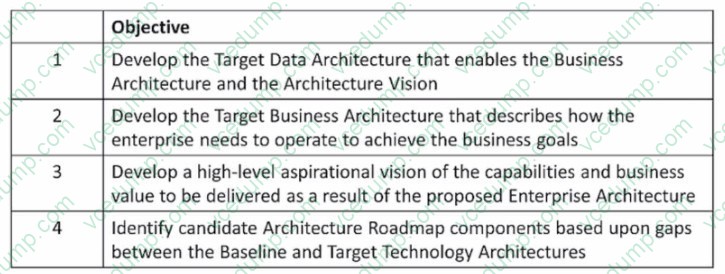
Which phase does each objective match?
A. 1C-2B-3A-4D
B. 1A-2B-3C-4D
C. 1B-2D-3A-4C
D. 1C-2D-3B-4A -
Question 284:
Scenario
Please read this scenario prior to answering the Question
You are serving as the Lead Architect for a chain of convenience stores. The stores operate 24 hours a day and 7 days a week and use cloud-based point-of-sale (POS) technology to manage their sales and inventory. Cloud-based POS
systems store all user data, including sales and inventory in a remote server.
The cloud-based systems collect real-time data to support ordering and product selection decisions including the tailoring of product assortment based on sales history, customer demographics as well as the next day's weather forecast. In
many cases, several stores are located in neighboring areas. This strategy makes distribution to each store cheaper, as well as making multiple deliveries per day possible. The stores also act as self-service delivery locations for a large online retailer which further increases the number of potential customers entering the stores. An Enterprise Architecture practice exists within the company, with the CEO and CIO as joint sponsors. They have decided to adopt TOGAF standard within the practice and the first project is to restructure the Enterprise Architecture so that it
can better support the existing environment and accommodate future changes of strategy within the company.
The CIO has stated that the following issues need to be addressed in the restructuring:
They need to address problems with data quality and inconsistent data in order to support better decision making and analysis. The architecture should focus on the needs of the business, not technology To remain competitive, new products
and promotions must undergo market trials and if these are successful, deployed across the retail chain. Information systems must be able to manage changes and updates without undue delays.
Refer to the Scenario
[Note: You should assume that the company has adopted the example set of principles that are listed and defined in TOGAF, Section 23.6. You may need to refer to Chapter 23 of the reference text in order to answer this question.]
You have been asked to identify the most relevant architecture principles for the current situation.
Based on TOGAF, which of the following is the best answer? [Note: The ordering of the principles listed in each answer is not significant.]
A. Interoperability, Data is Accessible, Data is Shared, Requirements Based Change, Control Technical Diversity
B. Requirements Based Change, Business Continuity, Common Vocabulary and Data Definitions, Data Trustee, Responsive Change Management
C. IT Responsibility, Data Security, Ease of Use, Service Orientation, Common Use Applications
D. Interoperability, Maximize Benefit to the Enterprise, Data Trustee, Data is an Asset, Responsive Change Management -
Question 285:
Complete the sentence. According to TOGAF, a view is used to describe how the _____ of a stakeholder are being met.
A. concerns
B. constraints
C. interests
D. perspective
E. requirements -
Question 286:
Scenario
Please read this scenario prior to answering the Question
You are serving as the Lead Architect for an enterprise architecture project team within a leading multinational pharmaceutical and medical devices manufacturer. Its brands include numerous household names for medications and first aid supplies.
The company has a long history of innovating new treatments for many common illnesses and diseases. Prior to launching a new treatment, the company has to demonstrate Its effectiveness and safety in a set of clinical trials that satisfy the regulatory requirements of the countries in the target markets. All clinical trials are undertaken by its research laboratories, which employ over 10,000 people at separate facilities in the United Kingdom, United States, Sweden, France, Canada, India, China and Japan. In addition to internal research and development activities the company is also involved in publicly funded collaborative research projects, with other industrial and academic partners. The Enterprise Architecture group within the company has been engaged in an architecture development project to create a secure networked collaboration system that will allow researchers at its product development laboratories worldwide to share information about their clinical trials. This system will also connect with external partners.
The Enterprise Architecture group within the company has been engaged in an architecture development project to create a secure networked collaboration system that will allow researchers at its product development laboratories worldwide to share information about their clinical trials. This system will also connect with external partners.
The Enterprise Architecture group is a mature organization. They use the TOGAF 9 ADM with extensions required to support current good manufacturing practices and good laboratory practices in their target markets. Due to the highly sensitive nature of the information that is managed, special care was taken to ensure that each architecture domain included an examination of the security and privacy issues that are relevant.
The Executive Vice President for Clinical Research is the sponsor of the Enterprise Architecture activity. She has stated that the changes to the enterprise architecture for the new system will need to be rolled out in stages on a regional basis that minimizes disruptions to ongoing clinical trials.
Refer to the Scenario
You have been asked to recommend the approach to identify the work packages that will be included in the Transition Architecture(s).
Based on TOGAF, which of the following is the best answer?
A. Determine the set of Solution Building Blocks required by identifying which Solution Building Blocks need to be developed and which need to be procured. Eliminate any duplicate building blocks. Group the remaining Solution Building Blocks together to create the work packages using a CRUD matrix. Rank the work packages in terms of cost and select the most cost-effective options for inclusion in a series of Transition Architectures. Schedule the roll out of the work packages to be sequential across the geographic regions.
B. Create an Implementation Factor Assessment and Deduction Matrix and a Consolidated Gaps, Solutions and Dependencies Matrix. For each gap, identify a proposed solution and classify it as new development, purchased solution, or based on an existing product. Group similar solutions together to form work packages. Identify dependencies between work packages factoring in the clinical trial schedules. Regroup the packages into a set of Capability Increments scheduled into a series of Transition Architectures.
C. Group the Solution Building Blocks from a Consolidated Gaps, Solutions and Dependencies Matrix into a set of work packages. Using the matrix as a planning tool, regroup the work packages to account for dependencies. Sequence the work packages into the Capability Increments needed to achieve the Target Architecture. Schedule the rollout one region at a time. Document the progression of the enterprise architecture using a state evolution table.
D. Use a Consolidated Gaps, Solutions and Dependencies Matrix as a planning tool. For each gap classify whether the solution is either a new development, purchased solution, or based on an existing product. Group the similar solutions together to define the work packages. Regroup the work packages into a set of Capability Increments to transition to the Target Architecture taking into account the schedule for clinical trials. -
Question 287:
Which one of the following statements best describes why the ADM should be adapted?
A. To align it closer to the business
B. To make the use more realistic
C. To move through the cycle faster
D. To suit the specific needs of the enterprise -
Question 288:
Scenario:
Please read this scenario prior to answering the Question
You are serving as the Lead Enterprise Architect at a major supplier in the automotive industry. The company is headquartered in Cleveland, Ohio with manufacturing plants across the United States, Brazil, Germany, Japan and South Korea. Each of these plants has been operating its own planning and production scheduling systems, as well as custom developed applications that drive the automated production equipment at each plant.
The company is implementing lean manufacturing principles to minimize waste and improve the efficiency of all of its production operations. During a recent exercise held for internal quality improvement, it was determined that a significant reduction in process waste could be achieved by replacing the current planning and scheduling systems with a common Enterprise Resource Planning (ERP) system located in the Cleveland data center. This central system would provide support to each of the plants replacing the functionality in the existing systems. It would also eliminate the need for full data centers at each of the plant facilities. A reduced number of IT staff could support the remaining applications. In some cases, a third-party contractor could provide those staff.
The Enterprise Architecture department has been operating for several years and has mature, well-developed architecture governance and development processes that are strongly based on TOGAF 9.
At a recent meeting, the Architecture Board approved a Request for Architecture Work sponsored by the Chief Engineer of Global Manufacturing Operations. The request covered the initial architectural investigations and the development of a
comprehensive architecture to plan the transformation.
The Common ERP Deployment architecture project team has now been formed, and the project team has been asked to develop an Architecture Vision that will achieve the desired outcomes and benefits. Some of the plant managers have
expressed concern about the security and reliability of diving their planning and production scheduling from a remote centralized system. The Chief Engineer wants to know how these concerns can be addressed.
Refer to the Scenario
During the initial meeting of the Common ERP Deployment architecture project team, a number of alternative recommendations for how to proceed are put forward by members of the team.
You have been asked to select the most appropriate recommendation to ensure that the team evaluates different approaches to the problem and clarifies the requirements for the architecture.
Based on TOGAF 9, which of the following is the best answer?
A. The team should develop Baseline and Target Architectures for each of the manufacturing plants, ensuring that the views corresponding to selected viewpoints address key concerns of the stakeholders. A consolidated gap analysis between the architectures will then be used to validate the approach, and determine the capability increments needed to achieve the target state.
B. The team should exercise due diligence and carefully research vendor literature and conduct a series of briefings with vendors that are on the current approved supplier list. Based on the findings from the research, the team should define a preliminary Architecture Vision. The team should then use that model to build consensus among the key stakeholders.
C. The team should use stakeholder analysis to understand who has concerns about the initiative. The team should then hold a series of interviews at each of the manufacturing plants using the business scenario technique. This will then enable them to identify and document the key high-level stakeholder requirements for the architecture.
D. The team should conduct a pilot project that will enable vendors on the short list to demonstrate potential solutions that will address the concerns of the stakeholders. Based on the findings of that pilot project, a complete set of retirements will be developed that will drive the evolution of the architecture. -
Question 289:
What are the four dimensions used to scope an architecture?
A. Strategy, Portfolio, Project, Solution Delivery
B. Strategy, Segment, Capability, Budget
C. Business, Data, Application, Technology
D. Breadth. Depth, Time Period, Architecture Domains -
Question 290:
Which of the following best describes a purpose of the Gap Analysis technique?
A. To validate non-functional requirements
B. To establish quality metres for the architecture
C. To determine service levels for the architecture
D. To identify missing functions
Related Exams:
-
OG0-021
ArchiMate 2 Part 1 -
OG0-023
ArchiMate 2 Combined Part 1 and Part 2 -
OG0-061
IT4IT Part 1 -
OG0-091
TOGAF 9 Part 1 -
OG0-092
TOGAF 9 Part 2 -
OG0-093
TOGAF 9 Combined Part 1 and Part 2 -
OGA-031
ArchiMate 3 Part 1 -
OGA-032
ArchiMate 3 Part 2 -
OGB-001
TOGAF Business Architecture Part 1 -
OGBA-101
TOGAF Business Architecture Foundation
Tips on How to Prepare for the Exams
Nowadays, the certification exams become more and more important and required by more and more enterprises when applying for a job. But how to prepare for the exam effectively? How to prepare for the exam in a short time with less efforts? How to get a ideal result and how to find the most reliable resources? Here on Vcedump.com, you will find all the answers. Vcedump.com provide not only The Open Group exam questions, answers and explanations but also complete assistance on your exam preparation and certification application. If you are confused on your OG0-093 exam preparations and The Open Group certification application, do not hesitate to visit our Vcedump.com to find your solutions here.