OG0-093 Exam Details
-
Exam Code
:OG0-093 -
Exam Name
:TOGAF 9 Combined Part 1 and Part 2 -
Certification
:The Open Group Certifications -
Vendor
:The Open Group -
Total Questions
:420 Q&As -
Last Updated
:May 29, 2026
The Open Group OG0-093 Online Questions & Answers
-
Question 251:
According to TOGAF, where should architecture governance artifacts be stored?
A. In the Integrated Information Infrastructure Reference Model
B. In the Standards Information Base
C. In the Foundation Architecture
D. In the Architecture Repository -
Question 252:
Scenario
Please read this scenario prior to answering the Question
You are serving as the Lead Architect for the enterprise architecture team at a multinational company. The company has grown rapidly by acquisition and has inherited numerous supply chain processes and related IT systems. Several supply chain processes have had problems related to the timing of purchases, which has led to excess inventory. The Vice President in charge of Supply Chain Management has made the decision to consolidate and reduce redundant processes and systems. The company will move to a "Just-in-time" supply chain management system so as to keep inventory costs low.
The TOGAF standard is used for internal Enterprise Architecture activities. This project is using an iterative approach for executing the Architecture Development Method (ADM).
At present, there are no particularly useful architectural assets in the Architecture Repository related to this initiative. All assets will need to be acquired, customized, or created.The company prefers to implement commercial off the shelf package applications with little customization. The CIO, who is the project sponsor, has stated that she is not concerned about preserving the existing supply chain management processes or systems.
The architecture development project has completed Phase A and has started a number of iteration cycles to develop the Architecture. As a packaged application is being considered, the next iteration will include both the Business, Application and Data Architectures. Key stakeholder concerns that should be addressed by these architectures include:
1.What groups of people should be involved in supply chain management-related business processes?
2.What non-supply chain management applications will need to be integrated with the new supply chain management applications?
3.What data will need to be shared?
Refer to the Scenario
[Note: You may need to refer to Chapter 35 of the reference text in order to answer this question.] You have been asked to identify the most appropriate catalogs, matrices, and diagrams to support the next iteration of Architecture development.
Based on TOGAF, which of the following is the best answer?
A. In the next iteration of Architecture development, you would describe the Baseline Business Architecture with a Value Chain diagram and a Baseline Business Process catalog. You would describe the Baseline Data Architecture with a Data diagram. You would describe the Baseline Application Architecture with an Environment and Location diagram.
B. In the next iteration of Architecture development, you would describe the Target Business Architecture with an Organization/Actor catalog, a Business Service/Function catalog and Data Lifecycle diagrams. You would describe the Target Application Architecture with an Application Interaction matrix and Application Communications diagrams.
C. You would describe the Baseline Business Architecture with a Business Service/Function catalog, an Organization/Actor catalog and a Data Entity/Business Function matrix. You would describe the Baseline Data Architecture using a Data Entity/Data Component catalog. You would describe the Baseline Application Architecture with an Application/Function matrix.
D. You would describe the Target Business Architecture with a Business Service/Function catalog, and a Business Interaction matrix. You would describe the Target Data Architecture with a Data Entity/Business Function matrix and an Application/Data matrix. You would describe the Target Application Architecture with Application Communication diagrams and an Application Interaction matrix. -
Question 253:
Which phase of the ADM ensures that implementation projects conform to the defined architecture?
A. Requirements Management
B. Phase D
C. Phase F
D. Phase G
E. Phase H -
Question 254:
Scenario
Please read this scenario prior to answering the Question
Your role is consultant to the Lead Architect within a multinational semiconductor and software design company. Its largest business is in processors, although it also designs system-on-a-chip infrastructure and manufactures memory chips. A characteristic feature of its processors is their low electric power consumption, which makes them particularly suitable for use in portable devices. As well as licensing its technology, the company has several manufacturing divisions.
The company has a mature enterprise architecture practice and uses TOGAF 9 for the basis of its architecture framework. In addition to the EA program, the company has a number of management frameworks in use, including business planning, portfolio/project management, and operations management. The EA program is sponsored by the CIO.
The company has defined a strategic architecture to improve its ability to meet customer demand and improve its ability to manage its supply chain. The strategic architecture called for the consolidation of multiple Enterprise Resource Planning (ERP) applications that have been operating independently in the divisions' production facilities. The goal is to replace the functionality of the existing applications with a new ERP product running as a single instance in the company's primary data center.
Each division has completed the Architecture Definition documentation required to tailor and configure the environment to meet its own specific manufacturing requirements.
The enterprise architects have analyzed the key corporate change attributes and implementation constraints. A consolidated gap analysis has been completed which has identified the gaps across the Business, Data, Application, and Technology domains. Based on the results of the gap analysis, the architects have reviewed the requirements, dependencies and interoperability requirements needed to integrate the new ERP environment into the existing environment. The architects have completed the Business Transformation Readiness Assessment started in Phase A. Based on all of these factors they have produced a risk assessment. They have also completed the Implementation and Migration Plan v0.1,
the draft Architecture Roadmap, and the Capability Assessment deliverables.
Because of the risks posed by the complexity of the current environment, it has been determined that a phased approach is needed to implement the target architectures. The overall implementation process is estimated to take several years.
Refer to the Scenario
You have been asked to recommend the next steps to prepare the final Implementation and Migration Plan.
Based on TOGAF, which of the following is the best answer?
A. You recommend that the enterprise architects apply the Business Value Assessment Technique to prioritize the implementation projects and project increments. The assessment should focus on return on investment and performance evaluation criteria that can be used to monitor the progress of the architecture transformation. They should confirm the Transition Architecture phases using an Architecture Definition Increments Table to list the projects. They should then document the lessons learned and generate the final Implementation and Migration Plan.
B. You recommend that the enterprise architects conduct a series of Compliance Assessments to ensure that the architecture is being implemented according to the contract. The Compliance Assessment should verify that the implementation team is using the proper development methodology. It should include deployment of monitoring tools and ensure that performance targets are being met. If they are not met, then changes to performance requirements should be identified and updated in the Implementation and Migration Plan.
C. You recommend that the enterprise architects assess how the plan impacts the other frameworks in use in the organization. Minimally, the plan should be coordinated with the business planning, portfolio/project management and operations management frameworks. They should then assign a business value to each project, taking into account available resources and priorities for the projects. Finally, they should generate the Implementation and Migration Plan.
D. You recommend that the enterprise architects place the Architecture Definition Document under configuration control. This will ensure that the architecture remains relevant and responsive to the needs of the enterprise. They should then produce an Implementation Governance Model to manage the lessons learned prior to finalizing the plan. You recommend that lessons learned be applied as changes to the architecture without review. -
Question 255:
Which of the following supports the need to govern Enterprise Architecture?
A. The TOGAF standard cannot be used without executive governance.
B. The Stakeholders preferences may go beyond the architecture project scope and needs control.
C. The Architecture Project mandates the governance of the target architecture.
D. Best practice governance enables the organization to control value realization. -
Question 256:
Please read this scenario prior to answering the question
You are serving as the Lead Enterprise Architect for a life insurance, annuities, and pensions company, which has been formed through the merger of three companies.
The company consists of three divisions with the same names and division headquarters as their predecessors.
The lack of integration between the three divisions has increasingly caused problems in the handling of customer and financial information. At present, each division maintains its own applications. Despite an earlier initiative to install a
common application to manage customer, products, and claims information, each division has different ways of defining its data elements and has customized the common application to the point where the ability to exchange information is
error-prone.
The Chief Information Officer (CIO) has formed an Enterprise Architecture department, and one of the primary goals in its charter is to coordinate efforts between the teams in each division. The CIO has also formed a cross-functional
Architecture Board to oversee and perform governance. The TOGAF standard is used as the basis for the core framework of the Enterprise Architecture program. The company has an existing team of security architects.
The company has made the decision to introduce a common web portal, contact center software suite, and document management system. Also the company has selected a single enterprise-wide customer relationship management (CRM)
application to consolidate information from several applications that exist across the divisions. The application will be used by each of the divisions and accessed by third party partners through well-defined interfaces.
The CIO is concerned that the new application must be able to manage and safeguard customer information in a secure manner that meets or exceeds the legal requirements of the countries in which the company operates. This will be an
increasingly important capability as the company expands its online services in cooperation with its external partners.
Refer to the Scenario
As part of the process for initiating the Enterprise Architecture project to rollout the new application, you are developing a set of architecture principles.
You need to recommend the best approach for this work.
Based on the TOGAF Standard, Version 9.2, which of the following is the best answer?
A. You would define a set of principles that support the preferred best practices embodied in the Enterprise Architecture department charter. You would publish the principles on the corporate intranet to ensure widespread acceptance and compliance within the company. You would then schedule regular periodic Compliance Assessments with each of the divisions to check that they have made satisfactory progress toward meeting the objectives and conditions embodied in the principles.
B. You would analyze the mission statements for the company and each of its divisions, together with the corporate business goals. Based on that analysis, you would define a set of architecture principles and review them with the CIO. When developing the principles, you would ensure that they actively promote the alignment of IT with the business strategies and initiatives of the company. You would then seek the endorsement of the CIO and senior management.
C. You would review the mission statements for the company and its divisions, together with the corporate business goals and business drivers. Based on that review, you would work closely with the key stakeholders and the Architecture Board to define the architecture principles. You would ensure that they actively promote the alignment of IT with the corporate business strategies. You would then hold review meetings with the relevant stakeholders, including senior management, ensuring their support.
D. You would gather information from credible industry sources in the insurance business. Based on that information, you would assess current trends and apply them to defining a set of principles that embody industry best practices. You would select architecture principles that do not conflict with each other, that are consistent, and those that are stable. You would ensure that all the principles are realistic and avoid including principles that are too obvious. -
Question 257:
According to TOGAF, which one of the following best describes an enterprise architecture?
A. An architecture of a commercial organization
B. An architecture that consists of more than one subsidiary company ActualTests.com
C. An architecture that crosses multiple systems, and multiple functional groups within the enterprise
D. The highest level of architecture that can be achieved in a given organization -
Question 258:
Which of the following does the TOGAF document define as the representation of a related set of concerns?
A. Catalog
B. Matrix
C. Diagram
D. View
E. Viewpoint -
Question 259:
Consider the following ADM phases objectives.
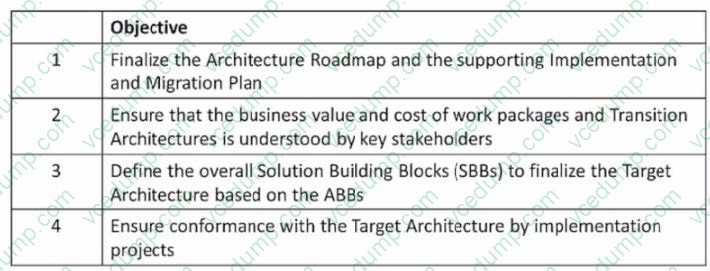
Which phase does each objective match?
A. 1G-2E-3F-4E
B. 1F-2F-3E-4G
C. 1F-2G-3F-4F
D. 1E-2F-3E-4G -
Question 260:
Complete the following sentence. In the ADM, documents which are under development and have not undergone any formal review and approval process are
A. invalid
B. in between phases
C. called "draft"
D. known as "Version 0.1"
Related Exams:
-
OG0-021
ArchiMate 2 Part 1 -
OG0-023
ArchiMate 2 Combined Part 1 and Part 2 -
OG0-061
IT4IT Part 1 -
OG0-091
TOGAF 9 Part 1 -
OG0-092
TOGAF 9 Part 2 -
OG0-093
TOGAF 9 Combined Part 1 and Part 2 -
OGA-031
ArchiMate 3 Part 1 -
OGA-032
ArchiMate 3 Part 2 -
OGB-001
TOGAF Business Architecture Part 1 -
OGBA-101
TOGAF Business Architecture Foundation
Tips on How to Prepare for the Exams
Nowadays, the certification exams become more and more important and required by more and more enterprises when applying for a job. But how to prepare for the exam effectively? How to prepare for the exam in a short time with less efforts? How to get a ideal result and how to find the most reliable resources? Here on Vcedump.com, you will find all the answers. Vcedump.com provide not only The Open Group exam questions, answers and explanations but also complete assistance on your exam preparation and certification application. If you are confused on your OG0-093 exam preparations and The Open Group certification application, do not hesitate to visit our Vcedump.com to find your solutions here.