MULESOFT-INTEGRATION-ARCHITECT-I Exam Details
-
Exam Code
:MULESOFT-INTEGRATION-ARCHITECT-I -
Exam Name
:Salesforce Certified MuleSoft Platform Integration Architect (Mule-Arch-202) -
Certification
:Salesforce Certifications -
Vendor
:Salesforce -
Total Questions
:273 Q&As -
Last Updated
:May 29, 2026
Salesforce MULESOFT-INTEGRATION-ARCHITECT-I Online Questions & Answers
-
Question 201:
According to the National Institute of Standards and Technology (NIST), which cloud computing deployment model describes a composition of two or more distinct clouds that support data and application portability?
A. Private cloud
B. Hybrid cloud 4
C. Public cloud
D. Community cloud -
Question 202:
An organization plans to migrate all its Mule applications to Runtime Fabric (RTF). Currently, all Mule applications have been deployed to CloudHub using automated CI/CD scripts.
What steps should be taken to properly migrate the applications from CloudHub to RTF, while keeping the same automated CI/CD deployment strategy?
A. A runtimefabric dependency should be added as a mule-plugin to the pom.xml file in all the Mule applications.
B. runtimeFabric command-line parameter should be added to the CI/CD deployment scripts.
C. A runtimefFabricDeployment profile should be added to Mule configuration properties YAML files in all the Mule applications. CI/CD scripts must be modified to use the new configuration properties.
D. runtimefabricDeployment profile should be added to the pom.xml file in all the Mule applications. CI/CD scripts must be modified to use the new RTF profile.
E. The pom.xml and Mule configuration YAML files can remain unchanged in each Mule application. A --runtimeFabric command-line parameter should be added to the CI/CD deployment scripts -
Question 203:
What Anypoint Connectors support transactions?
A. Database, JMS, VM
B. Database, 3MS, HTTP
C. Database, JMS, VM, SFTP
D. Database, VM, File -
Question 204:
An organization is building a test suite for their applications using m-unit. The integration architect has recommended using test recorder in studio to record the processing flows and then configure unit tests based on the capture events
What are the two considerations that must be kept in mind while using test recorder
(Choose two answers)
A. Tests for flows cannot be created with Mule errors raised inside the flow or already existing in the incoming event
B. Recorder supports smoking a message before or inside a ForEach processor
C. The recorder support loops where the structure of the data been tested changes inside the iteration
D. A recorded flow execution ends successfully but the result does not reach its destination because the application is killed
E. Mocking values resulting from parallel processes are possible and will not affect the execution of the processes that follow in the test -
Question 205:
A Mule application is running on a customer-hosted Mule runtime in an organization's network. The Mule application acts as a producer of asynchronous Mule events. Each Mule event must be broadcast to all interested external consumers outside the Mule application. The Mule events should be published in a way that is guaranteed in normal situations and also minimizes duplicate delivery in less frequent failure scenarios.
The organizational firewall is configured to only allow outbound traffic on ports 80 and 443. Some external event consumers are within the organizational network, while others are located outside the firewall.
What Anypoint Platform service is most idiomatic (used for its intended purpose) for publishing these Mule events to all external consumers while addressing the desired reliability goals?
A. CloudHub VM queues
B. Anypoint MQ
C. Anypoint Exchange
D. CloudHub Shared Load Balancer -
Question 206:
Refer to the exhibit.
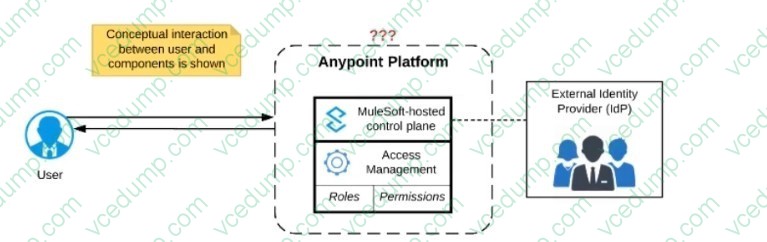
Anypoint Platform supports role-based access control (RBAC) to features of the platform. An organization has configured an external Identity Provider for identity management with Anypoint Platform.
What aspects of RBAC must ALWAYS be controlled from the Anypoint Platform control plane and CANNOT be controlled via the external Identity Provider?
A. Controlling the business group within Anypoint Platform to which the user belongs
B. Assigning Anypoint Platform permissions to a role
C. Assigning Anypoint Platform role(s) to a user
D. Removing a user's access to Anypoint Platform when they no longer work for the organization -
Question 207:
An auto mobile company want to share inventory updates with dealers Dl and D2 asynchronously and concurrently via queues Q1 and Q2. Dealer Dl must consume the message from the queue Q1 and dealer D2 to must consume a message from the queue Q2.
Dealer D1 has implemented a retry mechanism to reprocess the transaction in case of any errors while processing the inventers updates. Dealer D2 has not implemented any retry mechanism.
How should the dealers acknowledge the message to avoid message loss and minimize impact on the current implementation?
A. Dealer D1 must use auto acknowledgement and dealer D2 can use manual acknowledgement and acknowledge the message after successful processing
B. Dealer D1 can use auto acknowledgement and dealer D2 can use IMMEDIATE acknowledgement and acknowledge the message of successful processing
C. Dealer D1 and dealer D2 must use AUTO acknowledgement and acknowledge the message after successful processing
D. Dealer D1 can use AUTO acknowledgement and dealer D2 must use manual acknowledgement and acknowledge the message after successful processing -
Question 208:
What are two reasons why a typical MuleSoft customer favors a MuleSoft-hosted Anypoint Platform runtime plane over a customer-hosted runtime for its Mule application deployments? (Choose two.)
A. Reduced application latency
B. Increased application isolation
C. Reduced time-to-market for the first application
D. Increased application throughput
E. Reduced IT operations effort -
Question 209:
A new upstream API Is being designed to offer an SLA of 500 ms median and 800 ms maximum (99th percentile) response time. The corresponding API implementation needs to sequentially invoke 3 downstream APIs of very similar complexity. The first of these downstream APIs offers the following SLA for its response time: median: 100 ms, 80th percentile: 500 ms, 95th percentile: 1000 ms. If possible, how can a timeout be set in the upstream API for the invocation of the first downstream API to meet the new upstream API's desired SLA?
A. Set a timeout of 100 ms; that leaves 400 ms for the other two downstream APIs to complete
B. Do not set a timeout; the Invocation of this API Is mandatory and so we must wait until it responds
C. Set a timeout of 50 ms; this times out more invocations of that API but gives additional room for retries
D. No timeout is possible to meet the upstream API's desired SLA; a different SLA must be negotiated with the first downstream API or invoke an alternative API -
Question 210:
What is required before an API implemented using the components of Anypoint Platform can be managed and governed (by applying API policies) on Anypoint Platform?
A. The API must be published to Anypoint Exchange and a corresponding API instance ID must be obtained from API Manager to be used in the API implementation
B. The API implementation source code must be committed to a source control management system (such as GitHub)
C. A RAML definition of the API must be created in API designer so it can then be published to Anypoint Exchange
D. The API must be shared with the potential developers through an API portal so API consumers can interact with the API
Related Exams:
-
201-COMMERCIAL-BANKING-FUNCTIONAL
Salesforce enCino 201 Commercial Banking Functional -
ADM-201
Salesforce Certified Platform Administrator (Plat-Admn-201) -
ADM-211
Administration Essentials for Experienced Admin (ADM-211) -
ADM-261
Service Cloud Administration (SU24) -
ADVANCED-ADMINISTRATOR
Salesforce Certified Advanced Administrator -
ADVANCED-CROSS-CHANNEL
Marketing Cloud Advanced Cross Channel Accredited Professional -
ADX-201
Administrative Essentials for New Admins in Lightning Experience -
ADX-271
Salesforce Certified Community Cloud Consultant (ADX-271) -
AGENTFORCE-SPECIALIST
Salesforce Certified Agentforce Specialist (AI-201) -
ALS-CON-201
Salesforce Certified Agentforce Life Sciences Consultant
Tips on How to Prepare for the Exams
Nowadays, the certification exams become more and more important and required by more and more enterprises when applying for a job. But how to prepare for the exam effectively? How to prepare for the exam in a short time with less efforts? How to get a ideal result and how to find the most reliable resources? Here on Vcedump.com, you will find all the answers. Vcedump.com provide not only Salesforce exam questions, answers and explanations but also complete assistance on your exam preparation and certification application. If you are confused on your MULESOFT-INTEGRATION-ARCHITECT-I exam preparations and Salesforce certification application, do not hesitate to visit our Vcedump.com to find your solutions here.