MULESOFT-INTEGRATION-ARCHITECT-I Exam Details
-
Exam Code
:MULESOFT-INTEGRATION-ARCHITECT-I -
Exam Name
:Salesforce Certified MuleSoft Platform Integration Architect (Mule-Arch-202) -
Certification
:Salesforce Certifications -
Vendor
:Salesforce -
Total Questions
:273 Q&As -
Last Updated
:May 29, 2026
Salesforce MULESOFT-INTEGRATION-ARCHITECT-I Online Questions & Answers
-
Question 191:
An organization plans to migrate its deployment environment from an onpremises cluster to a Runtime Fabric (RTF) cluster. The on-premises Mule applications are currently configured with persistent object stores.
There is a requirement to enable Mule applications deployed to the RTF cluster to store and share data across application replicas and through restarts of the entire RTF cluster,
How can these reliability requirements be met?
A. Replace persistent object stores with persistent VM queues in each Mule application deployment
B. Install the Object Store pod on one of the cluster nodes
C. Configure Anypoint Object Store v2 to share data between replicas in the RTF cluster
D. Configure the Persistence Gateway in the RTF installation -
Question 192:
A payment processing company has implemented a Payment Processing API Mule application to process credit card and debit card transactions, Because the Payment Processing API handles highly sensitive information, the payment processing company requires that data must be encrypted both In-transit and at-rest.
To meet these security requirements, consumers of the Payment Processing API must create request message payloads in a JSON format specified by the API, and the message payload values must be encrypted. How can the Payment Processing API validate requests received from API consumers?
A. A Transport Layer Security (TLS) -Inbound policy can be applied in API Manager to decrypt the message payload and the Mule application implementation can then use the JSON Validation module to validate the JSON data
B. The Mule application implementation can use the APIkit module to decrypt and then validate the JSON data
C. The Mule application implementation can use the Validation module to decrypt and then validate the JSON data
D. The Mule application implementation can use DataWeave to decrypt the message payload and then use the JSON Scheme Validation module to validate the JSON data -
Question 193:
A Mule application is built to support a local transaction for a series of operations on a single database. The Mule application has a Scatter-Gather that participates in the local transaction.
What is the behavior of the Scatter-Gather when running within this local transaction?
A. Execution of each route within the Scatter-Gather occurs sequentially Any error that occurs inside the Scatter-Gather will result in a rollback of all the database operations
B. Execution of all routes within the Scatter-Gather occurs in parallel Any error that occurs inside the Scatter-Gather will result in a rollback of all the database operations
C. Execution of each route within the Scatter-Gather occurs sequentially Any error that occurs inside the Scatter-Gather will NOT result in a rollback of any of the database operations
D. Execution of each route within the Scatter-Gather occurs in parallel Any error that occurs inside the Scatter-Gather will NOT result in a rollback of any of the database operations -
Question 194:
A mule application must periodically process a large dataset which varies from 6 GB lo 8 GB from a back-end database and write transform data lo an FTPS server using a properly configured bad job scope.
The performance requirements of an application are approved to run in the cloud hub 0.2 vCore with 8 GB storage capacity and currency requirements are met.
How can the high rate of records be effectively managed in this application?
A. Use streaming with a file storage repeatable strategy for reading records from the database and batch aggregator with streaming to write to FTPS
B. Use streaming with an in-memory reputable store strategy for reading records from the database and batch aggregator with streaming to write to FTPS
C. Use streaming with a file store repeatable strategy for reading records from the database and batch aggregator with an optimal size
D. Use streaming with a file store repeatable strategy reading records from the database and batch aggregator without any required configuration -
Question 195:
The implementation of a Process API must change. What is a valid approach that minimizes the impact of this change on API clients?
A. Implement required changes to the Process API implementation so that whenever possible, the Process API's RAML definition remains unchanged
B. Update the RAML definition of the current Process API and notify API client developers by sending them links to the updated RAML definition
C. Postpone changes until API consumers acknowledge they are ready to migrate to a new Process API or API version
D. Implement the Process API changes in a new API implementation, and have the old API implementation return an HTTP status code 301 -Moved Permanently to inform API clients they should be calling the new API implementation -
Question 196:
In Anypoint Platform, a company wants to configure multiple identity providers (IdPs) for multiple lines of business (LOBs). Multiple business groups, teams, and environments have been defined for these LOBs. What Anypoint Platform feature can use multiple IdPs across the company's business groups, teams, and environments?
A. MuleSoft-hosted (CloudHub) dedicated load balancers
B. Client (application) management
C. Virtual private clouds
D. Permissions -
Question 197:
What is an advantage that Anypoint Platform offers by providing universal API management and Integration-Platform-as-a-Service (iPaaS) capabilities in a unified platform?
A. Ability to use a single iPaaS to manage and integrate all API gateways
B. Ability to use a single connector to manage and integrate all APis
C. Ability to use a single control plane for both full-lifecycle AP] management and integration
D. Ability to use a single iPaaS to manage all API developer portals -
Question 198:
An organization is in the process of building automated deployments using a CI/CD process. As a part of automated deployments, it wants to apply policies to API Instances.
What tool can the organization use to promote and deploy API Manager policies?
A. Anypoint CLI
B. MUnit Maven plugin
C. Mule Maven plugin
D. Runtime Manager agent -
Question 199:
49 of A popular retailer is designing a public API for its numerous business partners. Each business partner will invoke the API at the URL 58. https://api.acme.com/partnefs/vl. The API implementation is estimated to require deployment to 5 CloudHub workers.
The retailer has obtained a public X.509 certificate for the name apl.acme.com, signed by a reputable CA, to be used as the server certificate.
Where and how should the X.509 certificate and Mule applications be used to configure load balancing among the 5 CloudHub workers, and what DNS entries should be configured in order for the retailer to support its numerous business partners?
A. Add the X.509 certificate to the Mule application's deployable archive, then configure a CloudHub Dedicated Load Balancer (DLB) for each of the Mule application's CloudHub workers Create a CNAME for api.acme.com pointing to the DLB's A record
B. Add the X.509 certificate to the CloudHub Shared Load Balancer (SLB), not to the Mule application Create a CNAME for api.acme.com pointing to the SLB's A record
C. Add the X.509 certificate to a CloudHub Dedicated Load Balancer (DLB), not to the Mule application Create a CNAME for api.acme.com pointing to the DLB's A record
D. Add the x.509 certificate to the Mule application's deployable archive, then configure the CloudHub Shared Load Balancer (SLB) for each of the Mule application's CloudHub workers Create a CNAME for api.acme.com pointing to the SLB's A record -
Question 200:
Refer to the exhibit.
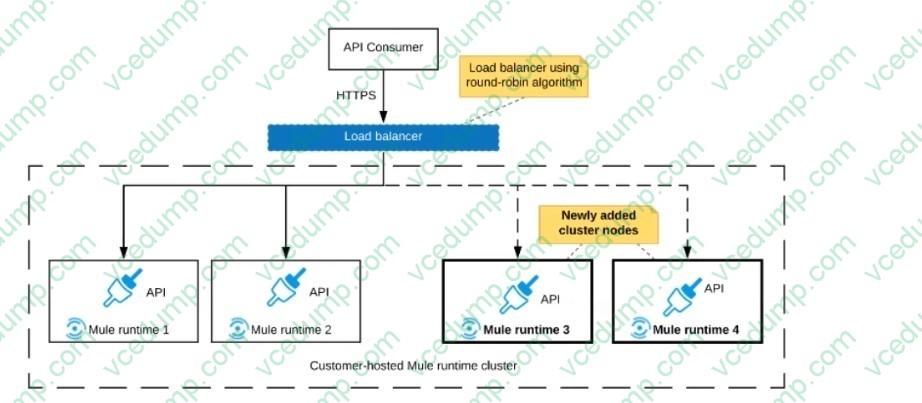
An organization uses a 2-node Mute runtime cluster to host one stateless API implementation. The API is accessed over HTTPS through a load balancer that uses round-robin for load distribution.
Two additional nodes have been added to the cluster and the load balancer has been configured to recognize the new nodes with no other change to the load balancer.
What average performance change is guaranteed to happen, assuming all cluster nodes are fully operational?
A. 50% reduction in the response time of the API
B. 100% increase in the throughput of the API
C. 50% reduction In the JVM heap memory consumed by each node
D. 50% reduction In the number of requests being received by each node
Related Exams:
-
201-COMMERCIAL-BANKING-FUNCTIONAL
Salesforce enCino 201 Commercial Banking Functional -
ADM-201
Salesforce Certified Platform Administrator (Plat-Admn-201) -
ADM-211
Administration Essentials for Experienced Admin (ADM-211) -
ADM-261
Service Cloud Administration (SU24) -
ADVANCED-ADMINISTRATOR
Salesforce Certified Advanced Administrator -
ADVANCED-CROSS-CHANNEL
Marketing Cloud Advanced Cross Channel Accredited Professional -
ADX-201
Administrative Essentials for New Admins in Lightning Experience -
ADX-271
Salesforce Certified Community Cloud Consultant (ADX-271) -
AGENTFORCE-SPECIALIST
Salesforce Certified Agentforce Specialist (AI-201) -
ALS-CON-201
Salesforce Certified Agentforce Life Sciences Consultant
Tips on How to Prepare for the Exams
Nowadays, the certification exams become more and more important and required by more and more enterprises when applying for a job. But how to prepare for the exam effectively? How to prepare for the exam in a short time with less efforts? How to get a ideal result and how to find the most reliable resources? Here on Vcedump.com, you will find all the answers. Vcedump.com provide not only Salesforce exam questions, answers and explanations but also complete assistance on your exam preparation and certification application. If you are confused on your MULESOFT-INTEGRATION-ARCHITECT-I exam preparations and Salesforce certification application, do not hesitate to visit our Vcedump.com to find your solutions here.