MCIA-LEVEL1 Exam Details
-
Exam Code
:MCIA-LEVEL1 -
Exam Name
:MuleSoft Certified Integration Architect - Level 1 -
Certification
:Mulesoft Certifications -
Vendor
:Mulesoft -
Total Questions
:290 Q&As -
Last Updated
:May 28, 2026
Mulesoft MCIA-LEVEL1 Online Questions & Answers
-
Question 71:
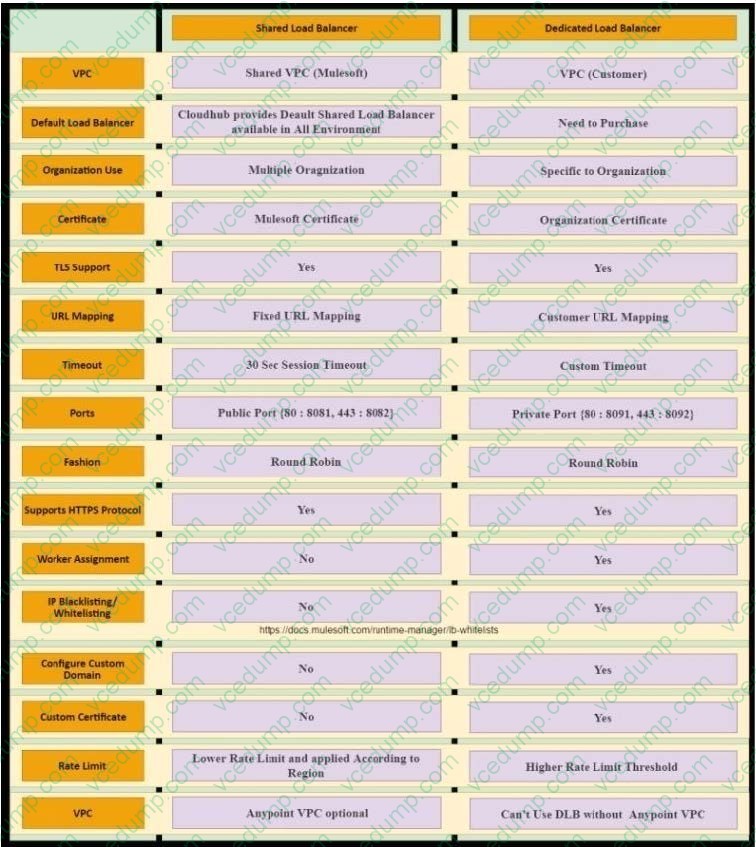
What comparison is true about a CloudHub Dedicated Load Balancer (DLB) vs. the CloudHub Shared Load Balancer (SLB)?
A. Only a DLB allows the configuration of a custom TLS server certificate
B. Only the SLB can forward HTTP traffic to the VPC-internal ports of the CloudHub workers
C. Both a DLB and the SLB allow the configuration of access control via IP whitelists
D. Both a DLB and the SLB implement load balancing by sending HTTP requests to workers with the lowest workloads -
Question 72:
An external web UI application currently accepts occasional HTTP requests from client web browsers to change (insert, update, or delete) inventory pricing information in an inventory system's database. Each inventory pricing change must be transformed and then synchronized with multiple customer experience systems in near real-time (in under 10 seconds). New customer experience systems are expected to be added in the future.
The database is used heavily and limits the number of SELECT queries that can be made to the database to 10 requests per hour per user.
What is the most scalable, idiomatic (used for its intended purpose), decoupled. reusable, and maintainable integration mechanism available to synchronize each inventory pricing change with the various customer experience systems in near real-time?
A. Write a Mule application with a Database On Table Row event source configured for the inventory pricing database, with the watermark attribute set to an appropriate database column In the same now, use a Scatter-Gather to call each customer experience system's REST API with transformed inventory-pricing records
B. Add a trigger to the inventory-pricing database table so that for each change to the inventory pricing database, a stored procedure is called that makes a REST call to a Mule application Write the Mule application to publish each Mule event as a message to an Anypoint MQ exchange Write other Mule applications to subscribe to the Anypoint MQ exchange, transform each received message, and then update the Mule application's corresponding customer experience system(s)
C. Replace the external web UI application with a Mule application to accept HTTP requests from client web browsers In the same Mule application, use a Batch Job scope to test if the database request will succeed, aggregate pricing changes within a short time window, and then update both the inventory pricing database and each customer experience system using a Parallel For Each scope
D. Write a Mule application with a Database On Table Row event source configured for the inventory pricing database, with the ID attribute set to an appropriate database column In the same flow, use a Batch Job scope to publish transformed Inventory-pricing records to an Anypoint MQ queue Write other Mule applications to subscribe to the Anypoint MQ queue, transform each received message, and then update the Mule application's corresponding customer experience system(s) -
Question 73:
An organization has deployed both Mule and non-Mule API implementations to integrate its customer and order management systems. All the APIs are available to REST clients on the public internet.
The organization wants to monitor these APIs by running health checks: for example, to determine if an API can properly accept and process requests. The organization does not have subscriptions to any external monitoring tools and also does not want to extend its IT footprint.
What Anypoint Platform feature provides the most idiomatic (used for its intended purpose) way to monitor the availability of both the Mule and the non-Mule API implementations?
A. API Functional Monitoring
B. Runtime Manager
C. API Manager
D. Anypoint Visualizer -
Question 74:
What are two reasons why a typical MuleSoft customer favors a MuleSoft-hosted Anypoint Platform runtime plane over a customer-hosted runtime for its Mule application deployments? (Choose two.)
A. Reduced application latency
B. Increased application isolation
C. Reduced time-to-market for the first application
D. Increased application throughput
E. Reduced IT operations effort -
Question 75:
A large life sciences customer plans to use the Mule Tracing module with the Mapped Diagnostic Context (MDC) logging operations to enrich logging in its Mule application and to improve tracking by providing more context in the Mule application logs. The customer also wants to improve throughput and lower the message processing latency in its Mule application flows. After installing the Mule Tracing module in the Mule application, how should logging be performed in flows in Mule applications, and what should be changed In the log4j2.xml files?
A. In the flows, add Mule Tracing module Set logging variable operations before any Core Logger components. In log4j2.xml files, change the appender's pattern layout to use %MDC and then assign the appender to a Logger or Root element.
B. In the flows, add Mule Tracing module Set logging variable operations before any Core Logger components. In log4j2.xmI files, change the appender's pattern layout to use the %MDC placeholder and then assign the appender to an AsyncLogger element.
C. In the flows, add Mule Tracing module Set logging variable operations before any Core Logger components.
D. In log4j2.xmI files, change the appender''s pattern layout to use %asyncLogger placeholder and then assign the appender to an AsyncLogger element.
E. In the flows, wrap Logger components in Async scopes. In log4j2.xmI files, change the appender's pattern layout to use the %asyncLogger placeholder and then assign the appender to a Logger or Root element. -
Question 76:
An organization is designing a mule application to support an all or nothing transaction between serval database operations and some other connectors so that they all roll back if there is a problem with any of the connectors Besides the database connector , what other connector can be used in the transaction.
A. VM
B. Anypoint MQ
C. SFTP
D. ObjectStore -
Question 77:
A rale limiting policy has been applied to a soap VI.2 API published in Clondhub. The API implementation catches errors in a global error handler on error propagate in the main flow for HTTP: RETRY_EXHAUSTED with HTTP status set to 429 and any with the HTTP status set to 500. What is the expected H1TP status when the client exceeds the quota of the API calls?
A. HTTP status 429 as defined in the HTTP:RETRY EXHAUSTED error handler in the API
B. HTTP status 500 as defined in the ANY error handler in the API since an API:RETRY_EXHAUSTED will be generated
C. HTTP status 401 unauthorized for policy violation
D. HTTP status 400 from the rate-limiting policy violation since the call does not reach the back-end -
Question 78:
How are the API implementation , API client, and API consumer combined to invoke and process an API ?
A. The API consumer creates an API implementation , which receives API invocations from an API such that they are processed for an API client
B. The API consumer creates an API client which sends API invocations to an API such that they are processed by an API implementation
C. An API client creates an API consumer, which receives API invocation from an API such that they are processed for an API implementation
D. The API client creates an API consumer which sends API invocations to an API such that they are processed by API implementation -
Question 79:
Refer to the exhibit.

A customer is running Mule applications on Runtime Fabric for Self-Managed Kubernetes (RTF-BYOKS) in a multi-cloud environment. Based on this configuration, how do Agents and Runtime Manager communicate, and what Is exchanged between them?
A. BLOCKING_IO, UBER
B. UBER, Dedicated NIO Selector Pool
C. CPU_LITE, CPU_INTENSIVE
D. Shared NIO Selector Pool, CPU_LITE -
Question 80:
A company is planning to migrate its deployment environment from on-premises cluster to a Runtime Fabric (RTF) cluster. It also has a requirement to enable Mule applications deployed to a Mule runtime instance to store and share data across application replicas and restarts.
How can these requirements be met?
A. Anypoint object store V2 to share data between replicas in the RTF cluster
B. Install the object store pod on one of the cluster nodes
C. Configure Persistence Gateway in any of the servers using Mule Object Store
D. Configure Persistent Gateway at the RTF
Related Exams:
-
MCD-ASSOC
MuleSoft Certified Developer - Integration and API Associate (Mule 3) -
MCD-LEVEL1
MuleSoft Certified Developer - Level 1 (Mule 4) -
MCD-LEVEL1-DELTA
MuleSoft Certified Developer - Level 1 (Mule 4) DELTA -
MCD-LEVEL2
MuleSoft Certified Developer - Level 2 (Mule 4) -
MCIA-LEVEL1
MuleSoft Certified Integration Architect - Level 1 -
MCIA-LEVEL1-MAINTENANCE
MuleSoft Certified Integration Architect - Level 1 MAINTENANCE -
MCPA-LEVEL1
MuleSoft Certified Platform Architect - Level 1 -
MCPA-LEVEL1-MAINTENANCE
MuleSoft Certified Platform Architect - Level 1 MAINTENANCE
Tips on How to Prepare for the Exams
Nowadays, the certification exams become more and more important and required by more and more enterprises when applying for a job. But how to prepare for the exam effectively? How to prepare for the exam in a short time with less efforts? How to get a ideal result and how to find the most reliable resources? Here on Vcedump.com, you will find all the answers. Vcedump.com provide not only Mulesoft exam questions, answers and explanations but also complete assistance on your exam preparation and certification application. If you are confused on your MCIA-LEVEL1 exam preparations and Mulesoft certification application, do not hesitate to visit our Vcedump.com to find your solutions here.