LSAT-TEST Exam Details
-
Exam Code
:LSAT-TEST -
Exam Name
:Law School Admission Test: Logical Reasoning, Reading Comprehension, Analytical Reasoning -
Certification
:LSAC Certifications -
Vendor
:LSAC -
Total Questions
:746 Q&As -
Last Updated
:Jul 12, 2026
LSAC LSAT-TEST Online Questions & Answers
-
Question 401:
On each of exactly seven consecutive days (day 1 through day 7), a pet shop features exactly one of three breeds of kitten -- Himalayan, Manx, Siamese -- and exactly one of three breeds of puppy -- Greyhound, Newfoundland, Rottweiler.
The following conditions must apply:
Greyhounds are featured on day 1.
No breed is featured on any two consecutive days.
Any breed featured on day 1 is not featured on day 7.
Himalayans are featured on exactly three days, but not on day 1.
Rottweilers are not featured on day 7, nor on any day that features Himalayans.
Which one of the following could be the order in which the breeds of kitten are featured in the pet shop, from day 1 through day 7?
A. Himalayan, Manx, Siamese, Himalayan, Manx,Himalayan, Siamese
B. Manx, Himalayan, Siamese, Himalayan, Manx,Himalayan, Manx
C. Manx, Himalayan, Manx, Himalayan, Siamese,Manx, Siamese
D. Siamese, Himalayan, Manx, Himalayan, Siamese,Siamese, Himalayan
E. Siamese, Himalayan, Siamese, Himalayan, Manx,Siamese, Himalayan -
Question 402:
Notice to subscribers: In order for us to provide you with efficient and reliable newspaper service, please note the following policies. You will be billed for home delivery every four weeks, in advance. If you do not receive delivery, call us promptly to receive a replacement copy. Credit can be given only if the missed copy is reported to us within twenty-four hours and only if a replacement copy is unavailable. Request for temporary nondelivery must be made at least three days prior to the first day on which delivery is to stop. No subscription will be canceled unless the subscriber explicitly requests the cancellation beforehand and in writing. The Daily Gazette
If The Daily Gazette denies each of the following subscriber's requests, each of the denials could be justified solely on the basis of the policy stated above EXCEPT:
A. Mr. Rathanan did not send in his advance payment two weeks ago; he states that his inaction was intended as cancellation and requests that he not be charged for the past two weeks of delivery of The Daily Gazette.
B. Dr. Broder called The Daily Gazette Monday morning to report that her Sunday edition had not been delivered; she requests credit instead of the offered replacement copy.
C. The Daily Gazette was delivered to Ms. Herrera during her one-week vacation even though she called on a Wednesday to stop delivery the following Monday for the entire week; she requests credit for the full week's delivery.
D. Although Ms. Jackson telephoned The Daily Gazette at the beginning of June requesting that her subscription be canceled on June 30, delivery was continued until July 3 when she called to complain; she requests that she not be charged for the papers delivered in July.
E. Ms. Silverman was out of town on Sunday and Monday and when she returned on Tuesday she found that her Sunday edition had not been delivered; she called The Daily Gazette on Tuesday afternoon requesting credit for the undelivered copy. -
Question 403:
Passage
(1)
[1] Positive thinking sounds useful on the surface. [2] But "positive thinking" is also a soft and fluffy term that is easy to dismiss. [3] But those views may be changing. [4] Research is beginning to reveal that positive thinking is about much more than just being happy or displaying an upbeat attitude. [5] Positive thoughts can actually create real value in your life and help you build skills that last much longer than a smile. [6] The impact of positive thinking on your work, your health, and your life is being studied by researchers, one of whom is Barbara Fredrickson. [7] Fredrickson is a positive psychology researcher at the University of North Carolina, and she published a landmark paper that provides surprising insights about positive thinking and its impact on your skills. [8] Her work is among the most referenced and cited in her field, and it is surprisingly useful in everyday life.
(2)
[9] What do negative thoughts do to your brain? [10] Let's say that you're walking through the forest and suddenly a tiger steps onto the path ahead of you. [11] When this happens, your brain registers a negative emotion ?in this case, fear.
[12] Researchers have long known that negative emotions program your brain to do a specific action. [13] When that tiger crosses your path, for example, you run. [14] The rest of the world doesn't matter. [15] You are focused entirely on the tiger, the fear it creates, and how you can get away from it. [16] In other words, negative emotions narrow your mind and focus your thoughts. [17] At that same moment, you might have the option to climb a tree, pick up a leaf, or grab a stick ?but your brain ignores all of those options because they seem irrelevant when a tiger is standing in front of you.
(3)
[18] This is a useful instinct if you're trying to save life and limb, but in our modern society, we don't have to worry about stumbling across tigers in the wilderness. [19] The problem is that your brain is still programmed to respond to negative emotions in the same way ?by shutting off the outside world and limiting the options, you see around you. [20] For example, when you're in a fight with someone, your anger and emotion might consume you to the point where you can't think about anything else. [21] Or, when you are stressed out about everything you have to get done today, you may find it hard to actually start anything because you're paralyzed by how long your to-do list has become. [22] In each case, your brain closes off from the outside world and focuses on the negative emotions of fear, anger, and stress ?just like it did with the tiger. [23] Negative emotions prevent your brain from seeing the other options and choices that surround you. [24] It's your survival instinct.
(4)
[25] Now, let's compare this to what positive emotions do to your brain. [26] This is where Barbara Fredrickson returns to the story. [27] Fredrickson tested the impact of positive emotions on the brain by setting up a little experiment. [28] During this experiment, she divided her research subjects into five groups and showed each group different film clips. [29] The first two groups were shown clips that created positive emotions. [30] Group 1 saw images that created feelings of joy. [31] Group 2 saw images that created feelings of contentment. [32] Group 3 was the control group. [33] They saw images that were neutral and produced no significant emotion. [34] The last two groups were shown clips that created negative emotions. [35] Group 4 saw images that created feelings of fear. [36] Group 5 saw images that created feelings of anger. [37] Afterward, each participant was asked to imagine themselves in a situation where similar feelings would arise and to write down what they would do. [38] Each participant was handed a piece of paper with 20 blank lines that started with the phrase, "I would like to..." Participants who saw images of fear and anger wrote down the fewest responses. [39] Meanwhile, the participants who saw images of joy and contentment, wrote down a significantly higher number of actions that they would take, even when compared to the neutral group.
(5)
[40] In other words, when you are experiencing positive emotions like joy, contentment, and love, you will see more possibilities in your life. [41] These findings were among the first that suggested positive emotions broaden your sense of possibility and open your mind up to more options. [42] But that was just the beginning. [43] The benefits of positive emotions don't stop after a few minutes of good feelings subside. [44] In fact, the biggest benefit that positive emotions provide is an enhanced ability to build skills and develop resources for use later in life. [45] Let's consider a real-world example. [46] A child who runs around outside, swinging on branches and playing with friends, develops the ability to move athletically (physical skills), the ability to play with others and communicate with a team (social skills), and the ability to explore and examine the world around them (creative skills). [47] In this way, the positive emotions of play and joy prompt the child to build skills that are useful and valuable in everyday life. [48] These skills last much longer than the emotions that initiated them. [49] Years later, that foundation of athletic movement might develop into a scholarship as a college athlete or the communication skills may blossom into a job offer as a business manager. [50] The happiness that promoted the exploration and creation of new skills has long since ended, but the skills themselves live on. [51] Fredrickson refers to this as the "broaden and build" theory because positive emotions broaden your sense of possibilities and open your mind, which in turn allows you to build new skills and resources that can provide value in other areas of your life.
(6)
[52] All of this research begs the most important question of all: If positive thinking is so useful for developing valuable skills and appreciating the big picture of life, how do you actually get yourself to be positive? [53] Recent research by Fredrickson and her colleagues has revealed that people who meditate daily display more positive emotions that those who do not. [54] As expected, people who meditated also built valuable long-term skills. [55] For example, three months after the experiment was over, the people who meditated daily continued to display increased mindfulness, purpose in life, social support, and decreased illness symptoms.
(7)
[56] Secondly, a study published in the Journal of Research in Personality examined a group of 90 undergraduate students who were split into two groups. [57] The first group wrote about an intensely positive experience each day for three consecutive days. [58] The second group wrote about a control topic. [59] Three months later, the students who wrote about positive experiences had better mood levels, fewer visits to the health center, and experienced fewer illnesses.
(8)
[60] Positive thinking isn't just a soft and fluffy feel-good term. [61] Yes, it's great to simply "be happy," but those moments of happiness are also critical for opening your mind to explore and build the skills that become so valuable in other areas of your life. [62] Periods of positive emotion and unhindered exploration are when you see the possibilities for how your past experiences fit into your future life, when you begin to develop skills that blossom into useful talents later on, and when you spark the urge for further exploration and adventure.
The passage provides information that most helps to answer all of the following questions EXCEPT?
A. What practices can make a person develop the habit of positive thinking?
B. What kind of physical illnesses people with negative thinking suffer from?
C. In what manner do negative emotions affect the brain of a person?
D. What kind of skills can a person with positive emotions develop?
E. Whether the benefits of positive thinking are ephemeral or long-lasting? -
Question 404:
Until about 1970, anyone who wanted to write a comprehensive history of medieval English law as it actually affected women would have found a dearth of published books or articles concerned with specific legal topics relating to women and derived from extensive research in actual court records. This is a serious deficiency, since court records are of vital importance in discovering how the law actually affected women, as opposed to how the law was intended to affect them or thought to affect them.
These latter questions can be answered by consulting such sources as treatises, commentaries, and statutes; such texts were what most scholars of the nineteenth and early twentieth centuries concentrated on whenever they did write about medieval law. But these sources are of little help in determining, for example, how often women's special statutory privileges were thwarted by intimidation or harassment, or how often women managed to evade special statutory limitations. And quite apart from provisions designed to apply only, or especially, to women, they cannot tell us how general law affected the female half of the population ?how women defendants and plaintiffs were treated in the courts in practice when they tried to exercise the rights they shared with men. Only quantitative studies of large numbers of cases would allow even a guess at the answers to these questions, and this scholarly work has been attempted by few.
One can easily imagine why. Most medieval English court records are written in Latin or Anglo-Norman French and have never been published. The sheer volume of material to be sifted is daunting: there are over 27,500 parchment pages in the common plea rolls of the thirteenth century alone, every page nearly three feet long, and written often front and back in highly stylized court hand. But the difficulty of the sources, while it might appear to explain why the relevant scholarship has not been undertaken, seems actually to have deterred few: the fact is that few historians have wanted to write anything approaching women's legal history in the first place. Most modern legal historians who have written on one aspect or another of special laws pertaining to women have begun with an interest in a legal idea or event or institution, not with a concern for how it affected women. Very few legal historians have started with an interest in women's history that they might have elected to pursue through various areas of general law. And the result of all this is that the current state of our scholarly knowledge relating to law and the medieval Englishwoman is still fragmentary at best, though the situation is slowly improving.
Which one of the following best describes the organization of the first paragraph of the passage?
A. The preparations necessary for the production of a particular kind of study are discussed, and reasons are given for why such preparations have not been undertaken until recently.
B. A problem is described, a taxonomy of various kinds of questions relevant to its solution is proposed, and an evaluation regarding which of those questions would be most useful to answer is made.
C. An example suggesting the nature of present conditions in a discipline is given, past conditions in that discipline are described, and a prediction is made regarding the future of the discipline.
D. A deficiency is described, the specific nature of the deficiency is discussed, and a particular kind of remedy is asserted to be the sole possible means of correcting that deficiency.
E. The resources necessary to the carrying out of a task are described, the inherent limitations of those resources are suggested by means of a list of questions, and a suggestion is made for overcoming these limitations. -
Question 405:
Most scientists who study the physiological effects of alcoholic beverages have assumed that wine, like beer or distilled spirits, is a drink whose only active ingredient is alcohol. Because of this assumption, these scientists have rarely investigated the effects of wine as distinct from other forms of alcoholic beverages. Nevertheless, unlike other alcoholic beverages, wine has for centuries been thought to have healthful effects that these scientists ?who not only make no distinction among wine, beer, and distilled spirits but also study only the excessive or abusive intake of these beverages ?have obscured.
Recently, a small group of researchers has questioned this assumption and investigated the effects of moderate wine consumption. While alcohol has been shown conclusively to have negative physiological effects ?for example, alcohol strongly affects the body's processing of lipids (fats and other substances including cholesterol), causing dangerous increases in the levels of these substances in the blood, increases that are a large contributing factor in the development of premature heart disease ?the researchers found that absorption of alcohol into the bloodstream occurs much more slowly when subjects drink wine than when they drink distilled spirits. More remarkably, it was discovered that deaths due to premature heart disease in the populations of several European countries decreased dramatically as the incidence of moderate wine consumption increased. One preliminary study linked this effect to red wine, but subsequent research has shown identical results whether the wine was white or red. What could explain such apparently healthful effects?
For one thing, the studies show increased activity of a natural clot-breaking compound used by doctors to restore blood flow through blocked vessels in victims of heart disease. In addition, the studies of wine drinkers indicate increased levels of certain compounds that may help to prevent damage from high lipid levels. And although the link between lipid processing and premature heart disease is one of the most important discoveries in modern medicine, in the past 20 years researchers have found several additional important contributing factors. We now know that endothelial cell reactivity (which affects the thickness of the innermost walls of blood vessels) and platelet adhesiveness (which influences the degree to which platelets cause blood to clot) are each linked to the development of premature heart disease. Studies show that wine appears to have ameliorating effects on both of these factors: it decreases the thickness of the innermost walls of blood vessels, and it reduces platelet adhesiveness. One study demonstrated a decrease in platelet adhesiveness among individuals who drank large amounts of grape juice. This finding may be the first step in confirming speculation that the potentially healthful effects of moderate wine intake may derive from the concentration of certain natural compounds found in grapes and not present in other alcoholic beverages.
In the passage, the author is primarily concerned with doing which one of the following?
A. advocating a particular method of treatment
B. criticizing popular opinion
C. correcting a scientific misconception
D. questioning the relevance of newly discovered evidence
E. countering a revolutionary hypothesis -
Question 406:
The village of Vestmannaeyjar, in the far northern country of Iceland, is as bright and clean and up-to-date as any American or Canadian suburb. It is located on the island of Heimaey, just off the mainland. One January night in 1973, however, householders were shocked from their sleep. In some backyards red-hot liquid was spurting from the ground. Flaming "skyrockets" shot up and over the houses. The island's volcano, Helgafell, silent for seven thousand years, was violently erupting! Luckily, the island's fishing fleet was in port, and within twenty-four hours almost everyone was ferried to the mainland. But then the agony of the island began in earnest. As in a nightmare, fountains of burning lava spurted three hundred feet high. Black, baseball-size cinders rained down. An evil-smelling, eye-burning, throat-searing cloud of smoke and gas erupted into the air, and a river of lava flowed down the mountain. The constant shriek of escaping steam was punctuated by ear-splitting explosions. As time went on, the once pleasant village of Vestmannaeyjar took on a weird aspect. Its street lamps still burning against the long Arctic night, the town lay under a thick blanket of cinders. All that could be seen above the ten-foot black drifts were the tips of street signs. Some houses had collapsed under the weight of cinders; others had burst into flames as the heat ignited their oil storage tanks. Lighting the whole lurid scene, fire continued to shoot from the mouth of the looming volcano.
The eruption continued for six months. Scientists and reporters arrived from around the world to observe the awesome natural event. But the town did not die that easily. In July, when the eruption ceased, the people of Heimaey Island returned to assess the chances of rebuilding their homes and lives. They found tons of ash covering the ground. The Icelanders are a tough people, however, accustomed to the strange and violent nature of their Arctic land. They dug out their homes. They even used the cinders to build new roads and airport runways. Now the new homes of Heimaey are warmed from water pipes heated by molten lava.
Black cinders fell that were the size of ________
A. baseballs
B. pebbles
C. golf balls
D. footballs
E. hail-stones -
Question 407:
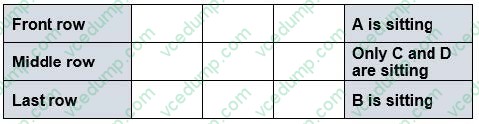
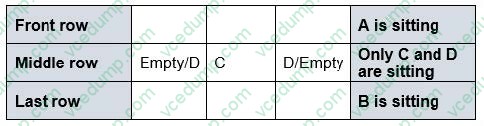
Seven friends, Abe, Bob, Chad, Dolly, Elisa, Frank, and Gregory sit in a VIP enclosure of a stadium to watch a football match. The seats in the enclosure form a 3 x 3 matrix, i.e. 3 rows (front, middle and last) with 3 seats in each row. The following information is known: Chad sits immediately beside Dolly Dolly sits in a row immediately behind the row in which Abe is sitting There is no one sitting on one side of Chad None of Elisa or Gregory sits immediately beside Abe Bob sits in the last row
Who could be the respective persons sitting in the middle of the first and last rows?
I. Bob and Gregory
II. Frank and Gregory
III.
Abe and Elisa
A. Only I
B. Only II
C. Only I and II
D. Only II and III
E. All of I, II and III
I. Bob and Gregory II. Frank and Gregory III. Abe and Elisa -
Question 408:
Read the following passage and answer the question below:
Politician: The funding for the new nationwide health-awareness campaign should come from an increase in taxes on cigarettes. It is well established that cigarette smoking causes many serious health problems, and it is only reasonable that
people whose unhealthful habits cause so many health problems should bear the costs of that campaign.
Smoker: But it is equally well established that regularly eating high-fat, high-cholesterol foods causes as many serious health problems as does smoking, yet it would be manifestly unreasonable to force those who purchase such foods to bear
the burden of financing this campaign.
Which one of the following is the point at issue between the politician and the smoker?
A. whether the politician's proposal for financing the health-awareness campaign is an unreasonable one
B. whether smokers are more aware of the harmful effects of their habit than are people who regularly eat high-fat, high-cholesterol foods
C. whether the effects of smoking constitute a greater health hazard than do the effects of regularly eating high-fat, high-cholesterol foods
D. whether it is unreasonable to require people who do not benefit from certain governmental programs to share the costs of those programs
E. whether the proposed increase on cigarette taxes is an efficient means of financing the health-awareness campaign -
Question 409:
Always read the meter dials from the right to the left. This procedure is much easier, especially if any of the dial hands are near the zero mark. If the meter has two dials, and one is smaller than the other, it is not imperative to read the smaller dial since it only registers a small amount. Read the dial at the right first. As the dial turns clockwise, always record the figure the pointer has just passed. Read the next dial to the left and record the figure it has just passed. Continue recording the figures on the dials from right to left. When finished, mark off the number of units recorded. Dials on water and gas meters usually indicate the amount each dial records.
Always read the meter dials
A. from top to bottom
B. from right to left
C. from left to right
D. from the small to the large dial
E. from the large dial to the small dial -
Question 410:
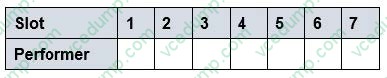
In a school function ceremony, seven students, Amy, Bob, Chad, Dom, Elisa, Fischer, and Grant have to deliver their performances in seven consecutive slots, not necessarily in the order of their given names. The following information is known about the order in which the students perform: Chad performs immediately before Dom Grant performs sometime after Chad There are exactly two performances made between the performances of Amy and Elisa
In which of the following slots can Grant not perform?
A. Second
B. Third
C. Fourth
D. Fifth
E. Sixth



Tips on How to Prepare for the Exams
Nowadays, the certification exams become more and more important and required by more and more enterprises when applying for a job. But how to prepare for the exam effectively? How to prepare for the exam in a short time with less efforts? How to get a ideal result and how to find the most reliable resources? Here on Vcedump.com, you will find all the answers. Vcedump.com provide not only LSAC exam questions, answers and explanations but also complete assistance on your exam preparation and certification application. If you are confused on your LSAT-TEST exam preparations and LSAC certification application, do not hesitate to visit our Vcedump.com to find your solutions here.