LSAT-TEST Exam Details
-
Exam Code
:LSAT-TEST -
Exam Name
:Law School Admission Test: Logical Reasoning, Reading Comprehension, Analytical Reasoning -
Certification
:LSAC Certifications -
Vendor
:LSAC -
Total Questions
:746 Q&As -
Last Updated
:Jul 12, 2026
LSAC LSAT-TEST Online Questions & Answers
-
Question 31:
If the flowers Drew received today had been sent by someone who knows Drew well, that person would have known that Drew prefers violets to roses. Yet Drew received roses. On the other hand, if the flowers had been sent by someone who does not know Drew well, then that person would have sent a signed card with the flowers. Yet Drew received no card. Therefore, the florist must have made some sort of mistake: either Drew was supposed to receive violets, or a card, or these flowers were intended for someone else.
Which one of the following statements, if true, most weakens the argument?
A. Most people send roses when they send flowers.
B. Some people send flowers for a reason other than the desire to please.
C. Someone who does not know Drew well would be unlikely to send Drew flowers.
D. The florist has never delivered the wrong flowers to Drew before.
E. Some people who know Drew well have sent Drew cards along with flowers. -
Question 32:
In studying the autobiographies of Native Americans, most scholars have focused on as-told-to life histories that were solicited, translated, recorded, and edited by non-Native American collaborators ?that emerged from";bicultural composite authorship." Limiting their studies to such written documents, these scholars have overlooked traditional, preliterate modes of communicating personal history. In addition, they have failed to address the cultural constructs of the highly diverse Native American peoples, who prior to contact with non indigenous cultures did not share with Europeans the same assumptions about self, life, and writing that underlie the concept of an autobiography ?that indeed constitute the English word's root meaning.
The idea of self was, in a number of pre-contact Native American cultures, markedly inclusive: identity was not merely individual, but also relational to a society, a specific landscape, and the cosmos. Within these cultures, the expression of life experiences tended to be oriented toward current events: with the participation of fellow tribal members, an individual person would articulate, reenact, or record important experiences as the person lived them, a mode of autobiography seemingly more fragmented than the European custom of writing down the recollections of a lifetime. Moreover, expression itself was not a matter of writing but of language, which can include speech and signs. Oral autobiography comprised songs, chants, stories, and even the process whereby one repeatedly took on new names to reflect important events and deeds in one's life. Dance and drama could convey personal history; for example, the advent of a vision to one person might require the enactment of that vision in the form of a tribal pageant. One can view as autobiographical the elaborate tattoos that symbolized a warrior's valorous deeds, and such artifacts as a decorated shield that communicated the accomplishments and aspirations of its maker, or a robe that was emblazoned with the pictographic history of the wearer's battles and was sometimes used in reenactments. Also autobiographical, and indicative of high status within the tribe, would have been a tepee painted with symbolic designs to record the achievements and display the dreams or visions of its owner, who was often assisted in the painting by other tribal members.
A tribe would, then, have contributed to the individual's narrative not merely passively, by its social codes and expectations, but actively by joining in the expression of that narrative. Such intracultural collaboration may seem alien to the European style of autobiography, yet any autobiography is shaped by its creator's ideas about the audience for which it is intended; in this sense, autobiography is justly called a simultaneous individual story and cultural narrative. Autobiographical expressions by early Native Americans may additionally have been shaped by the cultural perspectives of the people who transmitted them.
Which one of the following most accurately expresses the main conclusion of the passage?
A. Scholars have tended to overlook the nuances of concepts about identity that existed in some of the early Native American cultures.
B. As demonstrated by early Native Americans, autobiography can exist in a variety of media other than written documents.
C. The Native American life histories collected and recorded by non-Native American writers differ from European-style autobiographies in their depictions of an individual's relation to society.
D. Early Native Americans created autobiographies with forms and underlying assumptions that frequently differ from those of European-style autobiographies.
E. The autobiographical forms traditionally used by Native Americans are more fragmented than European forms and thus less easily recognizable as personal history. -
Question 33:
Opponent of offshore oil drilling: The projected benefits of drilling new oil wells in certain areas in the outer continental shelf are not worth the risk of environmental disaster. The oil already being extracted from these areas currently provides
only 4 percent of our country's daily oil requirement, and the new wells would only add one-half of 1 percent.
Proponent of offshore oil drilling: Don't be ridiculous! You might just as well argue that new farms should not be allowed, since no new farm could supply the total food needs of our country for more than a few minutes.
Which one of the following, if true, most weakens the drilling proponent's reply?
A. New farms do not involve a risk analogous to that run by new offshore oil drilling.
B. Many of the largest oil deposits are located under land that is Unsuitable for farming.
C. Unlike oil, common agricultural products fulfill nutritional needs rather than fuel requirements.
D. Legislation governing new oil drilling has been much more thoroughly articulated than has that governing new farms.
E. The country under discussion imports a higher proportion of the farm products it needs than it does of the oil it needs. -
Question 34:
Some philosophers find the traditional, subjective approach to studying the mind outdated and ineffectual. For them, the attempt to describe the sensation of pain or anger, for example, or the awareness that one is aware, has been surpassed by advances in fields such as psychology, neuroscience, and cognitive science. Scientists, they claim, do not concern themselves with how a phenomenon feels from the inside; instead of investigating private evidence perceivable only to a particular individual, scientists pursue hard data ?such as the study of how nerves transmit impulses to the brain ?which is externally observable and can be described without reference to any particular point of view. With respect to features of the universe such as those investigated by chemistry, biology, and physics, this objective approach has been remarkably successful in yielding knowledge. Why, these philosophers ask, should we suppose the mind to be any different?
But philosophers loyal to subjectivity are not persuaded by appeals to science when such appeals conflict with the data gathered by introspection. Knowledge, they argue, relies on the data of experience, which includes subjective experience. Why should philosophy ally itself with scientists who would reduce the sources of knowledge to only those data that can be discerned objectively?
On the face of it, it seems unlikely that these two approaches to studying the mind could be reconciled. Because philosophy, unlike science, does not progress inexorably toward a single truth, disputes concerning the nature of the mind are bound to continue. But what is particularly distressing about the present debate is that genuine communication between the two sides is virtually impossible. For reasoned discourse to occur, there must be shared assumptions or beliefs. Starting from radically divergent perspectives, subjectivists and objectivists lack a common context in which to consider evidence presented from each other's perspectives. The situation may be likened to a debate between adherents of different religions about the creation of the universe. While each religion may be confident that its cosmology is firmly grounded in its respective sacred text, there is little hope that conflicts between their competing cosmologies could be resolved by recourse to the texts alone. Only further investigation into the authority of the texts themselves would be sufficient.
What would be required to resolve the debate between the philosophers of mind, then, is an investigation into the authority of their differing perspectives. How rational is it to take scientific description as the ideal way to understand the nature of consciousness? Conversely, how useful is it to rely solely on introspection for one's knowledge about the workings of the mind? Are there alternative ways of gaining such knowledge? In this debate, epistemology ?the study of knowledge ? may itself lead to the discovery of new forms of knowledge about how the mind works.
Which one of the following most likely reflects the author's belief about the current impasse between subjectivists and objectivists?
A. It cannot be overcome because of the radically different conceptions of evidence favored by each of the two sides.
B. It is resolvable only if the two sides can find common ground from which to assess their competing conceptions of evidence.
C. It is unavoidable unless both sides recognize that an accurate understanding of the mind requires both types of evidence.
D. It is based on an easily correctable misunderstanding between the two sides about the nature of evidence.
E. It will prevent further progress until alternate ways of gaining knowledge about the mind are discovered. -
Question 35:
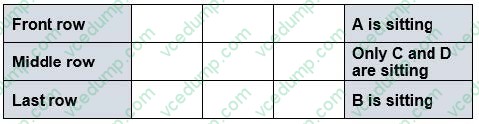
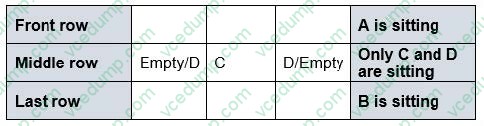
Seven friends, Abe, Bob, Chad, Dolly, Elisa, Frank, and Gregory sit in a VIP enclosure of a stadium to watch a football match. The seats in the enclosure form a 3 x 3 matrix, i.e. 3 rows (front, middle and last) with 3 seats in each row. The following information is known: Chad sits immediately beside Dolly Dolly sits in a row immediately behind the row in which Abe is sitting There is no one sitting on one side of Chad None of Elisa or Gregory sits immediately beside Abe Bob sits in the last row
If the row in which Frank sits has only 2 persons sitting, which of the following must be true?
A. Frank sits in the last row
B. Frank sits in the front row
C. Bob and Elisa sit beside one another
D. Bob and Frank sit beside one another
E. Elisa and Gregory sit beside one another -
Question 36:
Most scientists who study the physiological effects of alcoholic beverages have assumed that wine, like beer or distilled spirits, is a drink whose only active ingredient is alcohol. Because of this assumption, these scientists have rarely investigated the effects of wine as distinct from other forms of alcoholic beverages. Nevertheless, unlike other alcoholic beverages, wine has for centuries been thought to have healthful effects that these scientists ?who not only make no distinction among wine, beer, and distilled spirits but also study only the excessive or abusive intake of these beverages ?have obscured.
Recently, a small group of researchers has questioned this assumption and investigated the effects of moderate wine consumption. While alcohol has been shown conclusively to have negative physiological effects ?for example, alcohol strongly affects the body's processing of lipids (fats and other substances including cholesterol), causing dangerous increases in the levels of these substances in the blood, increases that are a large contributing factor in the development of premature heart disease ?the researchers found that absorption of alcohol into the bloodstream occurs much more slowly when subjects drink wine than when they drink distilled spirits. More remarkably, it was discovered that deaths due to premature heart disease in the populations of several European countries decreased dramatically as the incidence of moderate wine consumption increased. One preliminary study linked this effect to red wine, but subsequent research has shown identical results whether the wine was white or red. What could explain such apparently healthful effects?
For one thing, the studies show increased activity of a natural clot-breaking compound used by doctors to restore blood flow through blocked vessels in victims of heart disease. In addition, the studies of wine drinkers indicate increased levels of certain compounds that may help to prevent damage from high lipid levels. And although the link between lipid processing and premature heart disease is one of the most important discoveries in modern medicine, in the past 20 years' researchers have found several additional important contributing factors. We now know that endothelial cell reactivity (which affects the thickness of the innermost walls of blood vessels) and platelet adhesiveness (which influences the degree to which platelets cause blood to clot) are each linked to the development of premature heart disease. Studies show that wine appears to have ameliorating effects on both of these factors: it decreases the thickness of the innermost walls of blood vessels, and it reduces platelet adhesiveness. One study demonstrated a decrease in platelet adhesiveness among individuals who drank large amounts of grape juice. This finding may be the first step in confirming speculation that the potentially healthful effects of moderate wine intake may derive from the concentration of certain natural compounds found in grapes and not present in other alcoholic beverages.
Based on the passage, the author's attitude toward the scientists discussed in the first paragraph can most accurately be described as
A. highly enthusiastic
B. tacitly approving
C. grudgingly accepting
D. overtly critical
E. clearly outraged -
Question 37:
Five racing drivers, Alan, Bob, Chris, Don, and Eugene, enter into a contest that consists of 6 races. The results of all six races are listed below: Bob always finishes ahead of Chris. Alan finishes either first or last. Eugene finishes either first
or last. There are no ties in any race.
Every driver finishes each race. In each race, two points are awarded for a fifth place finish, four points for fourth, six points for third, eight points for second, and ten points for first.
If Alan finishes first only once, and Don finishes second exactly twice, the lowest total number of points that Bob can earn in the race is:
A. 32 points.
B. 38 points.
C. 40 points.
D. 44 points.
E. 48 points. -
Question 38:
Passage
(1)
[1] Positive thinking sounds useful on the surface. [2] But "positive thinking" is also a soft and fluffy term that is easy to dismiss. [3] But those views may be changing. [4] Research is beginning to reveal that positive thinking is about much more than just being happy or displaying an upbeat attitude. [5] Positive thoughts can actually create real value in your life and help you build skills that last much longer than a smile. [6] The impact of positive thinking on your work, your health, and your life is being studied by researchers, one of whom is Barbara Fredrickson. [7] Fredrickson is a positive psychology researcher at the University of North Carolina, and she published a landmark paper that provides surprising insights about positive thinking and its impact on your skills. [8] Her work is among the most referenced and cited in her field, and it is surprisingly useful in everyday life.
(2)
[9] What do negative thoughts do to your brain? [10] Let's say that you're walking through the forest and suddenly a tiger steps onto the path ahead of you. [11] When this happens, your brain registers a negative emotion ?in this case, fear.
[12] Researchers have long known that negative emotions program your brain to do a specific action. [13] When that tiger crosses your path, for example, you run. [14] The rest of the world doesn't matter. [15] You are focused entirely on the tiger, the fear it creates, and how you can get away from it. [16] In other words, negative emotions narrow your mind and focus your thoughts. [17] At that same moment, you might have the option to climb a tree, pick up a leaf, or grab a stick ?but your brain ignores all of those options because they seem irrelevant when a tiger is standing in front of you.
(3)
[18] This is a useful instinct if you're trying to save life and limb, but in our modern society, we don't have to worry about stumbling across tigers in the wilderness. [19] The problem is that your brain is still programmed to respond to negative emotions in the same way ?by shutting off the outside world and limiting the options, you see around you. [20] For example, when you're in a fight with someone, your anger and emotion might consume you to the point where you can't think about anything else. [21] Or, when you are stressed out about everything you have to get done today, you may find it hard to actually start anything because you're paralyzed by how long your to-do list has become. [22] In each case, your brain closes off from the outside world and focuses on the negative emotions of fear, anger, and stress ?just like it did with the tiger. [23] Negative emotions prevent your brain from seeing the other options and choices that surround you. [24] It's your survival instinct.
(4)
[25] Now, let's compare this to what positive emotions do to your brain. [26] This is where Barbara Fredrickson returns to the story. [27] Fredrickson tested the impact of positive emotions on the brain by setting up a little experiment. [28] During this experiment, she divided her research subjects into five groups and showed each group different film clips. [29] The first two groups were shown clips that created positive emotions. [30] Group 1 saw images that created feelings of joy. [31] Group 2 saw images that created feelings of contentment. [32] Group 3 was the control group. [33] They saw images that were neutral and produced no significant emotion. [34] The last two groups were shown clips that created negative emotions. [35] Group 4 saw images that created feelings of fear. [36] Group 5 saw images that created feelings of anger. [37] Afterward, each participant was asked to imagine themselves in a situation where similar feelings would arise and to write down what they would do. [38] Each participant was handed a piece of paper with 20 blank lines that started with the phrase, "I would like to..." Participants who saw images of fear and anger wrote down the fewest responses. [39] Meanwhile, the participants who saw images of joy and contentment, wrote down a significantly higher number of actions that they would take, even when compared to the neutral group.
(5)
[40] In other words, when you are experiencing positive emotions like joy, contentment, and love, you will see more possibilities in your life. [41] These findings were among the first that suggested positive emotions broaden your sense of possibility and open your mind up to more options. [42] But that was just the beginning. [43] The benefits of positive emotions don't stop after a few minutes of good feelings subside. [44] In fact, the biggest benefit that positive emotions provide is an enhanced ability to build skills and develop resources for use later in life. [45] Let's consider a real-world example. [46] A child who runs around outside, swinging on branches and playing with friends, develops the ability to move athletically (physical skills), the ability to play with others and communicate with a team (social skills), and the ability to explore and examine the world around them (creative skills). [47] In this way, the positive emotions of play and joy prompt the child to build skills that are useful and valuable in everyday life. [48] These skills last much longer than the emotions that initiated them. [49] Years later, that foundation of athletic movement might develop into a scholarship as a college athlete or the communication skills may blossom into a job offer as a business manager. [50] The happiness that promoted the exploration and creation of new skills has long since ended, but the skills themselves live on. [51] Fredrickson refers to this as the "broaden and build" theory because positive emotions broaden your sense of possibilities and open your mind, which in turn allows you to build new skills and resources that can provide value in other areas of your life.
(6)
[52] All of this research begs the most important question of all: If positive thinking is so useful for developing valuable skills and appreciating the big picture of life, how do you actually get yourself to be positive? [53] Recent research by Fredrickson and her colleagues has revealed that people who meditate daily display more positive emotions that those who do not. [54] As expected, people who meditated also built valuable long-term skills. [55] For example, three months after the experiment was over, the people who meditated daily continued to display increased mindfulness, purpose in life, social support, and decreased illness symptoms.
(7)
[56] Secondly, a study published in the Journal of Research in Personality examined a group of 90 undergraduate students who were split into two groups. [57] The first group wrote about an intensely positive experience each day for three consecutive days. [58] The second group wrote about a control topic. [59] Three months later, the students who wrote about positive experiences had better mood levels, fewer visits to the health center, and experienced fewer illnesses.
(8)
[60] Positive thinking isn't just a soft and fluffy feel-good term. [61] Yes, it's great to simply "be happy," but those moments of happiness are also critical for opening your mind to explore and build the skills that become so valuable in other areas of your life. [62] Periods of positive emotion and unhindered exploration are when you see the possibilities for how your past experiences fit into your future life, when you begin to develop skills that blossom into useful talents later on, and when you spark the urge for further exploration and adventure.
Which one of the following most accurately summarizes the content of the passage?
A. Factual data about both, positive and negative emotions are presented. The importance of positive thinking is emphasized and negative emotions are ridiculed. Finally, methods to keep negative thoughts at bay are discussed.
B. A personal anecdote to illustrate the benefits of positive thinking is mentioned. A study to reinforce the importance of positive emotions is presented. Finally, methods to develop positive emotions are stated.
C. The impact of both, positive and negative emotions is stated. An experiment to support the impact of these emotions is discussed. Further, methods of inculcating positive emotions are presented.
D. The pros and cons of both, positive and negative emotions are discussed. A research experiment to reinforce the benefits of two emotions is mentioned. Finally, methods to develop positive emotions are stated.
E. A study to demonstrate the benefits of positive thinking is discussed. The merits and demerits of positive and negative thinking and stated. Further, the results of the absence of positive thinking in a person are demonstrated. -
Question 39:
Attacks on an opponent's character should be avoided in political debates. Such attacks do not confront the opponent's argument; instead they attempt to cast doubt on the opponent's moral right to be in the debate at all.
Which one of the following principles, if valid, most helps to justify the reasoning above?
A. Attacks on an opponent's character result from an inability to confront the opponent's argument properly.
B. Attacks on an opponent's character should not impress those watching a political debate.
C. Debating techniques that do not confront every argument should be avoided.
D. Attacking the character of one's opponent does nothing to preserve one's moral right to enter into further political debates.
E. Questions of character should be raised in political debate if they are relevant to the opponent's argument. -
Question 40:
Passage
The Marshmallow Test for Grownups
(1)
Originally conducted by psychologist Walter Mischel in the late 1960s, the Stanford marshmallow test has become a touchstone of developmental psychology. Children at Stanford's Bing Nursery School, aged four to six, were placed in a
room furnished only with a table and chair. A single treat, selected by the child, was placed on the table. Each child was told if they waited for 15 minutes before eating the treat, they would be given a second treat. Then they were left alone in
the room. Follow-up studies with the children later in adolescence showed a correlation between an ability to wait long enough to obtain a second treat and various forms of life success. And a 2011 fMRI study conducted on 59 original
participants ?now in their 40s ?by Cornell's B.J. Casey showed higher levels of brain activity in the prefrontal cortex among those participants who delayed immediate gratification in favor of a greater reward later on. This finding is important
because of the research that's emerged on the critical role played by the prefrontal cortex in directing our attention and managing our emotions.
(2)
As adults, we face a version of the marshmallow test nearly every waking minute of every day. We're not tempted by sugary treats, but by our browser tabs, phones, and tablets ?all the devices that connect us to the global delivery system for
those blips of information that do to us what marshmallows do to preschoolers.
(3)
Sugary treats tempt us into unhealthy eating habits because the agricultural and commercial systems that meet our nutritional needs today are so vastly different from the environment in which we evolved as a species. Early humans lived in a
calorie-poor world, and something like a piece of fruit was both rare and valuable. Our brains developed a response mechanism to these treats that reflected their value ?a surge of interest and excitement, a feeling of reward and
satisfaction ?which we find tremendously pleasurable. But as we've reshaped the world around us, radically diminishing the cost and effort involved in obtaining calories, we still have the same brains we evolved thousands of years ago. This
mismatch is at the heart of why so many of us struggle to resist tempting foods that we know we shouldn't eat.
(4)
A similar process is at work in our response to information. Our formative environment as a species was information-poor as well as calorie-poor. The features of that environment ?specifically the members of our immediate community and
our interactions with them ?typically changed rarely and gradually. New information in the form of new community members or new ways of interacting were unusual and notable events that typically signified something of great importance.
Just as our brains developed a response mechanism that prized sugary treats, we evolved to pay close attention to new information about the people around us and our interactions with them. But just as the development of industrial
agriculture and mass commerce has profoundly altered our caloric environment, global connectivity has profoundly altered our information environment. We are now ceaselessly bombarded with new information about the people around us ?
and the definition of "people around us" has fundamentally changed, putting us in touch with more people in an hour than early humans met in their entire lives. All of this poses a critical challenge to our brains ?the adult version of the
marshmallow test.
(5)
Not only are we constantly interrupted by alerts, beeps, and buzzes that tell us some new information has arrived, we constantly interrupt ourselves to seek out new information. We pull out our phones while we're in the middle of a
conversation with someone. We check our email while we're engaged in a complex task that requires our full concentration. We scan our feeds even though we just checked them a minute ago. There's increasing evidence suggesting that
these disruptions make it difficult to do our best work, diminish our productivity, and contribute to a feeling of overwhelm.
(6)
The agricultural and commercial revolutions were clearly net gains for humanity, making it possible for more people to live better lives than ever before. It would be both wrongheaded and fruitless to suggest that we should turn back the clock
on these advances. Similarly, the information revolution is helping us to make great strides as a species. But just as we need to be more thoughtful about our caloric consumption, delaying gratification of our impulsive urges in order to eat
more nutritiously, we need to be more thoughtful about our information consumption, resisting the allure of the mental equivalent of "junk food" in order to allocate our time and attention most effectively. (This article has been picked from
hbr.org and has been edited for use.)
The author of the passage is primarily concerned with doing which one of the following?
A. Comparing two different analysis
B. Chronicling certain historical developments
C. Discussing the causes and adverse impact of a phenomenon
D. Recommending varied solutions to a problem
E. Developing a chronological series of events
Tips on How to Prepare for the Exams
Nowadays, the certification exams become more and more important and required by more and more enterprises when applying for a job. But how to prepare for the exam effectively? How to prepare for the exam in a short time with less efforts? How to get a ideal result and how to find the most reliable resources? Here on Vcedump.com, you will find all the answers. Vcedump.com provide not only LSAC exam questions, answers and explanations but also complete assistance on your exam preparation and certification application. If you are confused on your LSAT-TEST exam preparations and LSAC certification application, do not hesitate to visit our Vcedump.com to find your solutions here.