LSAT-TEST Exam Details
-
Exam Code
:LSAT-TEST -
Exam Name
:Law School Admission Test: Logical Reasoning, Reading Comprehension, Analytical Reasoning -
Certification
:LSAC Certifications -
Vendor
:LSAC -
Total Questions
:746 Q&As -
Last Updated
:Jul 12, 2026
LSAC LSAT-TEST Online Questions & Answers
-
Question 161:
Passage
The Marshmallow Test for Grownups
(1)
Originally conducted by psychologist Walter Mischel in the late 1960s, the Stanford marshmallow test has become a touchstone of developmental psychology. Children at Stanford's Bing Nursery School, aged four to six, were placed in a
room furnished only with a table and chair. A single treat, selected by the child, was placed on the table. Each child was told if they waited for 15 minutes before eating the treat, they would be given a second treat. Then they were left alone in
the room. Follow-up studies with the children later in adolescence showed a correlation between an ability to wait long enough to obtain a second treat and various forms of life success. And a 2011 fMRI study conducted on 59 original
participants ?now in their 40s ?by Cornell's B.J. Casey showed higher levels of brain activity in the prefrontal cortex among those participants who delayed immediate gratification in favor of a greater reward later on. This finding is important
because of the research that's emerged on the critical role played by the prefrontal cortex in directing our attention and managing our emotions.
(2)
As adults, we face a version of the marshmallow test nearly every waking minute of every day. We're not tempted by sugary treats, but by our browser tabs, phones, and tablets ?all the devices that connect us to the global delivery system for
those blips of information that do to us what marshmallows do to preschoolers.
(3)
Sugary treats tempt us into unhealthy eating habits because the agricultural and commercial systems that meet our nutritional needs today are so vastly different from the environment in which we evolved as a species. Early humans lived in a
calorie-poor world, and something like a piece of fruit was both rare and valuable. Our brains developed a response mechanism to these treats that reflected their value ?a surge of interest and excitement, a feeling of reward and
satisfaction ?which we find tremendously pleasurable. But as we've reshaped the world around us, radically diminishing the cost and effort involved in obtaining calories, we still have the same brains we evolved thousands of years ago. This
mismatch is at the heart of why so many of us struggle to resist tempting foods that we know we shouldn't eat.
(4)
A similar process is at work in our response to information. Our formative environment as a species was information-poor as well as calorie-poor. The features of that environment ?specifically the members of our immediate community and
our interactions with them ?typically changed rarely and gradually. New information in the form of new community members or new ways of interacting were unusual and notable events that typically signified something of great importance.
Just as our brains developed a response mechanism that prized sugary treats, we evolved to pay close attention to new information about the people around us and our interactions with them. But just as the development of industrial
agriculture and mass commerce has profoundly altered our caloric environment, global connectivity has profoundly altered our information environment. We are now ceaselessly bombarded with new information about the people around us ?
and the definition of "people around us" has fundamentally changed, putting us in touch with more people in an hour than early humans met in their entire lives. All of this poses a critical challenge to our brains ?the adult version of the
marshmallow test.
(5)
Not only are we constantly interrupted by alerts, beeps, and buzzes that tell us some new information has arrived, we constantly interrupt ourselves to seek out new information. We pull out our phones while we're in the middle of a
conversation with someone. We check our email while we're engaged in a complex task that requires our full concentration. We scan our feeds even though we just checked them a minute ago. There's increasing evidence suggesting that
these disruptions make it difficult to do our best work, diminish our productivity, and contribute to a feeling of overwhelm.
(6)
The agricultural and commercial revolutions were clearly net gains for humanity, making it possible for more people to live better lives than ever before. It would be both wrongheaded and fruitless to suggest that we should turn back the clock
on these advances. Similarly, the information revolution is helping us to make great strides as a species. But just as we need to be more thoughtful about our caloric consumption, delaying gratification of our impulsive urges in order to eat
more nutritiously, we need to be more thoughtful about our information consumption, resisting the allure of the mental equivalent of "junk food" in order to allocate our time and attention most effectively. (This article has been picked from
hbr.org and has been edited for use.)
Which one of the following best describes the organization of the passage?
A. A study is presented, its results are discussed, an analogy of the study is presented with respect to another age group, a new hypothesis that undermines the study is shown.
B. A recently observed phenomenon is contrasted with a research study, justifications for the occurrence of the phenomenon are given, recommendations to overcome the inconveniences created by the phenomenon are described.
C. A study is presented and its results are discussed, its relevance with respect to another age group is discussed, justifications are given for why the extrapolation is plausible.
D. A research and the assumptions on which it is based are described, a contradicting study is presented, validity of both the studies are questioned.
E. A research study is presented, conclusions drawn from it are presented, evidence that undermines the validity of the study is described, an evaluation of the evidence is presented. -
Question 162:
The autobiographical narrative Incidents in the Life of a Slave Girl, Written by Herself (1and61), by Harriet A. Jacobs, a stave of African descent, not only recounts an individual life but also provides, implicitly and explicitly, a perspective on the larger United States culture from the viewpoint of one denied access to it. Jacobs, as a woman and a slave, faced the stigmas to which those statuses were subject. Jacobs crafted her narrative, in accordance with the mainstream literary genre of the sentimental domestic novel, as an embodiment of cherished cultural values such as the desirability of marriage and the sanctity of personal identity, home, and family. She did so because she was writing to the free women of her day ?the principal readers of domestic novels ?in the hopes that they would sympathize with and come to understand her unique predicament as a female slave. By applying these conventions of the genre to her situation, Jacobs demonstrates to her readers that family and domesticity are no less prized by those forced into slavery, thus leading her free readers to perceive those values within a broader social context.
Some critics have argued that, by conforming to convention, Jacobs shortchanged her own experiences; one critic, for example, claims that in Jacobs's work the purposes of the domestic novel overshadow those of the typical slave narrative. But the relationship between the two genres is more complex: Jacobs's attempt to frame her story as a domestic novel creates a tension between the usual portrayal of women in this genre and her actual experience, often calling into question the applicability of the hierarchy of values espoused by the domestic novel to those who are in her situation. Unlike the traditional romantic episodes in domestic novels in which a man and woman meet, fall in love, encounter various obstacles but eventually marry, Jacobs's protagonist must send her lover, a slave, away in order to protect him from the wrath of her jealous master. In addition, by the end of the narrative, Jacobs's protagonist achieves her freedom by escaping to the north, but she does not achieve the domestic novel's ideal of a stable home complete with family, as the price she has had to pay for her freedom is separation from most of her family, including one of her own children. Jacobs points out that, slave women view certain events and actions from a perspective different from that of free women, and that they must make difficult choices that free women need not. Her narrative thus becomes an antidomestic novel, for Jacobs accepts readily the goals of the genre, but demonstrates that its hierarchy of values does not apply when examined from the perspective of a female slave, suggesting thereby that her experience, and that of any female slave, cannot be fully understood without shedding conventional perspectives.
Which one of the following principles most likely governs the author's evaluation of Jacobs's narrative?
A. Those autobiographical narratives that capture the mood of a particular period are thereby more valuable.
B. Those autobiographical narratives that focus on accurately depicting the events in the individual's life are thereby more valuable.
C. Those autobiographical narratives that force readers to view certain familiar cultural values in a wider context are thereby more valuable.
D. Those autobiographical narratives that are written from a perspective familiar to the majority of their readers are thereby more valuable,
E. Those autobiographical narratives that employ the conventions of another literary genre are thereby more valuable. -
Question 163:
Only a very small percentage of people from the service professions ever become board members of the 600 largest North American corporations. This shows that people from the service professions are underrepresented in the most important corporate boardrooms in North America.
Which one of the following points out a flaw committed in the argument?
A. Six hundred is too small a sample on which to base so sweeping a conclusion about the representation of people from the service professions.
B. The percentage of people from the service professions who serve on the boards of the 600 largest North American corporations reveals little about the percentage of the members of these boards who are from the service professions.
C. It is a mistake to take the 600 largest North American corporations to be typical of corporate boardrooms generally.
D. It is irrelevant to smaller corporations whether the largest corporations in North America would agree to have significant numbers of workers from the service professions on the boards of the largest corporations.
E. The presence of people from the service professions on a corporate board does not necessarily imply that that corporation will be more socially responsible than it has been in the past -
Question 164:
When the goalie has been chosen, the Smalltown Bluebirds hockey team has a starting lineup that is selected from two groups:
First Group: John, Dexter, Bart, Erwin
Second Group: Leanne, Roger, George, Marlene, Patricia
When deciding on the players in the lineup, the coach considers the following requirements:
Two players are always chosen from the first group, while three are chosen from the second group.
George will only start if Bart also starts. Dexter and Bart will not start together.
If George starts, Marlene won't start.
The 4 fastest players are: John, Bart, George and Patricia 3 of the 4 fastest players will always be chosen.
If George is in the starting lineup, who must also start?
A. Marlene or John
B. Dexter or Leanne
C. Dexter or John
D. John or Patricia
E. Marlene or Roger -
Question 165:
In 1975, the U.S. Supreme Court ruled that the federal government has exclusive rights to any oil and gas resources on the Atlantic Outer Shelf beyond the three-mile limit. Which one of the following must be true in order for this ruling to be logical?
A. The U.S. Supreme Court has met recently.
B. The Atlantic Outer Shelf may possibly contain oil and gas resources.
C. No oil and gas resources exist within the three-mile limit.
D. In 1977, the Court reversed this ruling.
E. Oil and gas on the Atlantic Shelf has not been explored for in the past three years. -
Question 166:
Zoos have served both as educational resources and as entertainment. Unfortunately, removing animals from their natural habitats to stock the earliest zoos reduced certain species' populations, endangering their survival. Today most new zoo animals are obtained from captive breeding programs, and many zoos now maintain breeding stocks for continued propagation of various species. This makes possible efforts to reestablish endangered species in the wild.
Which one of the following statements is most strongly supported by the information above?
A. Zoos have played an essential role in educating the public about endangered species.
B. Some specimens of endangered species are born and bred in zoos.
C. No zoos exploit wild animals or endanger the survival of species.
D. Nearly all of the animals in zoos today were born in captivity.
E. The main purpose of zoos has shifted from entertainment to education. -
Question 167:
Because addictive drugs are physically harmful, their use by athletes is never justified. Purists, however, claim that taking massive doses of even such nonaddictive drugs as aspirin and vitamins before competing should also be prohibited because they are unnatural. This is ridiculous; almost everything in sports is unnatural, from high-tech running shoes to padded boxing gloves to highly-specialized bodybuilding machines. Yet, none of these is prohibited on the basis of its being unnatural. Furthermore, we should be attending to far more serious problems that plague modern sports and result in unnecessary deaths and injuries. Therefore, the use of nonaddictive drugs by athletes should not be prohibited.
Which one of the following statements, if true, would be the strongest challenge to the author's conclusion?
A. Massive doses of aspirin and vitamins enhance athletic performance.
B. Addictive drugs are just as unnatural as nonaddictive drugs like aspirin and vitamins.
C. Unnecessary deaths and injuries occur in other walks of life besides modern sports.
D. There would be more unnecessary deaths and injuries if it were not for running shoes, boxing gloves, and bodybuilding machines.
E. Taking massive doses of aspirin or vitamins can be physically harmful. -
Question 168:
For some years before the outbreak of World War I, a number of painters in different European countries developed works of art that some have described as prophetic: paintings that by challenging viewers' habitual ways of perceiving the world of the present are thus said to anticipate a future world that would be very different. The artistic styles that they brought into being varied widely, but all these styles had in common a very important break with traditions of representational art that stretched back to the Renaissance.
So fundamental is this break with tradition that it is not surprising to discover that these artists ?among them Picasso and Braque in France, Kandinsky in Germany, and Malevich in Russia ?are often credited with having anticipated not just subsequent developments in the arts, but also the political and social disruptions and upheavals of the modern world that came into being during and after the war. One art critic even goes so far as to claim that it is the very prophetic power of these artworks, and not their break with traditional artistic techniques, that constitutes their chief interest and value.
No one will deny that an artist may, just as much as a writer or a politician, speculate about the future and then try to express a vision of that future through making use of a particular style or choice of imagery; speculation about the possibility of war in Europe was certainly widespread during the early years of the twentieth century. But the forward-looking quality attributed to these artists should instead be credited to their exceptional aesthetic innovations rather than to any power to make clever guesses about political or social trends. For example, the clear impression we get of Picasso and Braque, the joint founders of cubism, from their contemporaries as well as from later statements made by the artists themselves, is that they were primarily concerned with problems of representation and form and with efforts to create a far more "real" reality than the one that was accessible only to the eye. The reformation of society was of no interest to them as artists.
It is also important to remember that not all decisive changes in art are quickly followed by dramatic events in the world outside art. The case of Delacroix, the nineteenth-century French painter, is revealing. His stylistic innovations startled his contemporaries ?and still retain that power over modern viewers ?but most art historians have decided that Delacroix adjusted himself to new social conditions that were already coming into being as a result of political upheavals that had occurred in 1830, as opposed to other artists who supposedly told of changes still to come.
According to the author, the work of the pre-World War I painters described in the passage contains an example of each of the following EXCEPT:
A. an interest in issues of representation and form
B. a stylistic break with traditional art
C. the introduction of new artistic techniques
D. the ability to anticipate later artists
E. the power to predict social changes -
Question 169:
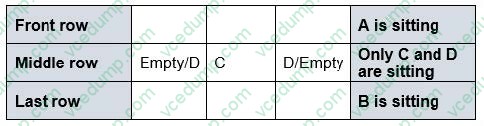
Seven friends, Abe, Bob, Chad, Dolly, Elisa, Frank, and Gregory sit in a VIP enclosure of a stadium to watch a football match. The seats in the enclosure form a 3 x 3 matrix, i.e. 3 rows (front, middle and last) with 3 seats in each row. The following information is known: Chad sits immediately beside Dolly Dolly sits in a row immediately behind the row in which Abe is sitting There is no one sitting on one side of Chad None of Elisa or Gregory sits immediately beside Abe Bob sits in the last row
Who sits in the middle seat of the middle row?
A. Chad
B. Dolly
C. Either Chad or Dolly
D. Any among Chad, Dolly or Elisa
E. The seat is vacant -
Question 170:
Town councillor: The only reason for the town to have ordinances restricting where skateboarding can be done would be to protect children from danger. Skateboarding in the town's River Park is undoubtedly dangerous, but we should not pass an ordinance prohibiting it. If children cannot skateboard in the park, they will most certainly skateboard in the streets. And skateboarding in the streets is more dangerous than skateboarding in the park.
The pattern of reasoning in which one of the following is most similar to that in the town councilor's argument
A. The reason for requiring environmental reviews is to ensure that projected developments do not harm the natural environment. Currently, environmental concerns are less compelling than economic concerns, but in the long run, the environment must be protected. Therefore, the requirement for environmental reviews should not be waived.
B. Insecticides are designed to protect crops against insect damage. Aphids damage tomato crops, but using insecticides against aphids kills wasps that prey on insecticide-resistant pests. Since aphids damage tomato crops less than the insecticide-resistant pests do, insecticides should not be used against aphids on tomato crops.
C. The purpose of compulsory vaccination for schoolchildren was to protect both the children themselves and others in the community against smallpox. Smallpox was indeed a dreadful disease, but it has now been eliminated from the world's population. So children should not be vaccinated against it.
D. The function of a sealer on wood siding is to retard deterioration caused by weather. However, cedar is a wood that is naturally resistant to weather-related damage and thus does not need additional protection. Sealers, therefore, should not be applied to cedar siding.
E. Traffic patterns that involve one-way streets are meant to accelerate the flow of traffic in otherwise congested areas. However, it would be detrimental to the South Main Street area to have traffic move faster. So traffic patterns involving one-way streets should not be implemented there.

Tips on How to Prepare for the Exams
Nowadays, the certification exams become more and more important and required by more and more enterprises when applying for a job. But how to prepare for the exam effectively? How to prepare for the exam in a short time with less efforts? How to get a ideal result and how to find the most reliable resources? Here on Vcedump.com, you will find all the answers. Vcedump.com provide not only LSAC exam questions, answers and explanations but also complete assistance on your exam preparation and certification application. If you are confused on your LSAT-TEST exam preparations and LSAC certification application, do not hesitate to visit our Vcedump.com to find your solutions here.