JN0-664 Exam Details
-
Exam Code
:JN0-664 -
Exam Name
:Service Provider Routing and Switching, Professional (JNCIP-SP) -
Certification
:Juniper Certifications -
Vendor
:Juniper -
Total Questions
:96 Q&As -
Last Updated
:Jul 10, 2026
Juniper JN0-664 Online Questions & Answers
-
Question 81:
When building an interprovider VPN, you notice on the PE router that you have hidden routes which are received from your BGP peer with family inet labeled-unica3t configured.
Which parameter must you configure to solve this problem?
A. Under the family inet labeled-unicast hierarchy, add the explicit null parameter.
B. Under the protocols ospf hierarchy, add the traffic-engineering parameter.
C. Under the family inet labeled-unicast hierarchy, add the resolve-vpn parameter.
D. Under the protocols mpls hierarchy, add the traffic-engineering parameter -
Question 82:
Which two statements are correct about the customer interface in an LDP-signaled pseudowire? (Choose two)
A. When the encapsulation is vlan-ccc or extended-vlan-ccc, the configured VLAN tag is not included in the control plane LDP advertisement
B. When the encapsulation is ethernet-ccc, only frames without a VLAN tag are accepted in the data plane
C. When the encapsulation is vLan-ccc or extended-vlan-ccc, the configured VLAN tag is included in the control plane LDP advertisement
D. When the encapsulation is ethemet-ccc, tagged and untagged frames are both accepted in the data plane. -
Question 83:
Referring to the exhibit
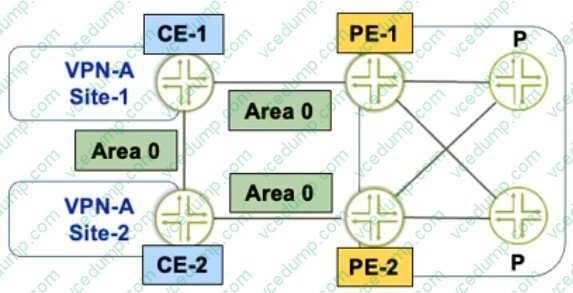
The PE-to-CE protocol being used is OSPF for the L3VPN. Also, there is an OSPF neighborship between CE-1 and CE-2. Which statement is correct in this situation?
A. You must set a high metric on the CE-1 to PE-1 link for hosts at Site-1 to use the CE-1 to CE-2 link to reach hosts at Site-2
B. You must set a high metric on the CE-1 to CE-2 link for hosts at Site-1 to use the L3VPN to reach hosts at Site-2.
C. Hosts at Site-1 will reach hosts at Site-2 through the CE-1 and CE-2 link by default.
D. Hosts at Site-1 will reach hosts at Site-2 through the L3VPN by default. -
Question 84:
You want to ensure that L1 IS-IS routers have only the most specific routes available from L2 IS-IS routers. Which action accomplishes this task?
A. Configure the ignore-attached-bit parameter on all L2 routers.
B. Configure all routers to allow wide metrics.
C. Configure all routers to be L1.
D. Configure the ignore-attached-bit parameter on all L1 routers -
Question 85:
Referring to the exhibit Click the Exhibit button.
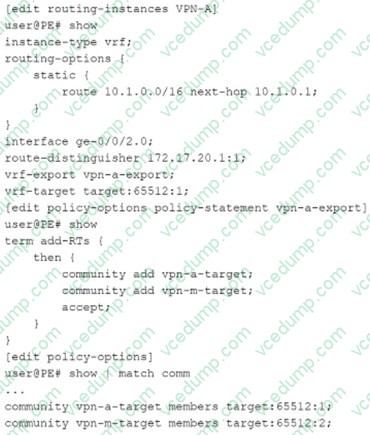
Which statement is correct?
A. VPN routes are exported with the target:65512:1 and target:65512:2 route targets.
B. You cannot use the vrf-target and vrf-export statements in the same VRF.
C. VPN routes with the target:65512:1 and target:65512:2 route targets are imported.
D. VPN routes are exported with only the target:65512:1 route target -
Question 86:
Referring to the exhibit.
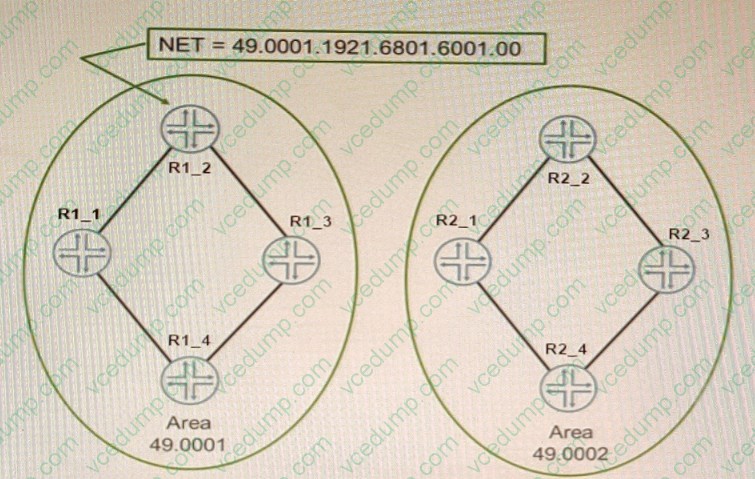
The network shown in the exhibit is based on IS-IS
Which statement is correct in this scenario?
A. The NSEL byte for Area 0001 is 00.
B. The area address is two bytes.
C. The routers are using unnumbered interfaces
D. The system IDofR1_2 is 192.168.16.1 -
Question 87:
Referring to the exhibit.
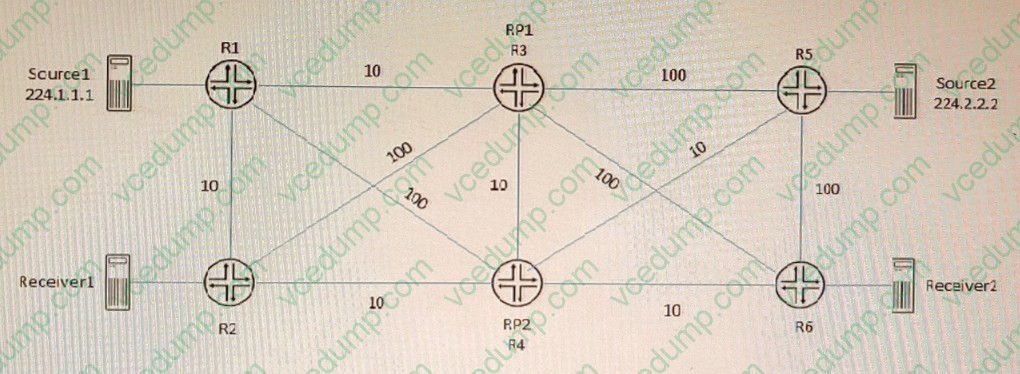
PIM-SM is configured on all routers, and Anycast-RP with Anycast- PIM is used for the discovery mechanism on RP1 and RP2. The interface metric values are shown for the OSPF area. In this scenario, which two statements are correct about which RP is used? (Choose two.)
A. Source2 will use RP2 and Received2 will use RP2 for group 224.2.2.2.
B. Source2 will use RP1 and Receiver2 will use RP1 for group 224.2.2.2.
C. Source1 will use RP1 and Receiver1 will use RP1 for group 224.1.1.1.
D. Source1 will use RP1 and Receiver1 will use RP2 for group 224.1 1 1 -
Question 88:
Referring to the exhibit,
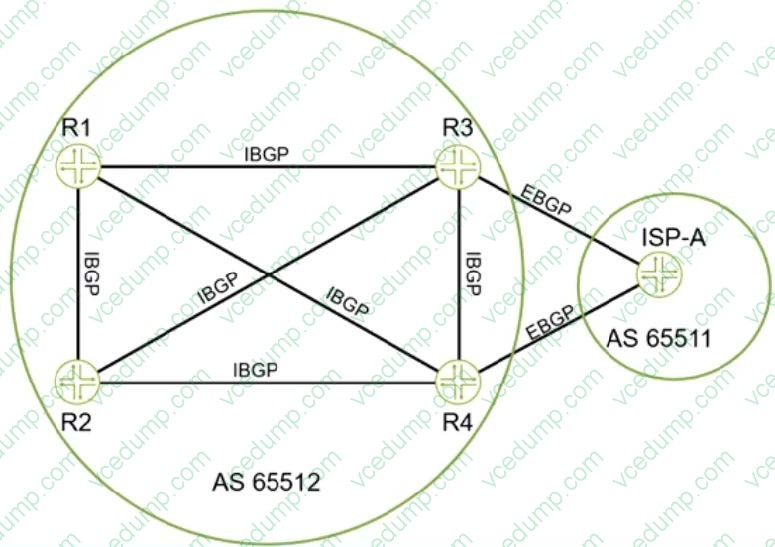
Click the Exhibit button-Referring to the exhibit, which two statements are correct about BGP routes on R3 that are learned from the ISP-A neighbor? (Choose two.)
A. By default, the next-hop value for these routes is not changed by R3 before being sent to R1.
B. By default, the next-hop value for these routes is changed by R3 before being sent to R1.
C. By default, the BGP local-preference value that is assigned on R3 is advertised to R1.
D. By default, all BGP attributes values must be removed before advertising the routes to R1. -
Question 89:
A router running IS-IS is configured with an ISO address of 49.0001.00a0.c96b.c490.00. Which part of this address is the system ID?
A. c96b.c490 is the system identifier.
B. c490 is the system identifier.
C. 00a0.c96b.c490 is the system identifier.
D. 0001.00a0.c96b.c490 is the system identifier. -
Question 90:
Your network is receiving the 203.0.113.0/24 network using EBGP from AS 64500 and AS 64501. Both of these advertisements have identical local-preference values, AS-path lengths, and BGP origin codes. You want to infiuence the way your AS sends trahe 203.0.113.0/24 network.
In this scenario, which attribute would you consider next when selecting the best path?
A. router ID
B. MED value
C. peer IP address
D. IGP metric
Related Exams:
-
JN0-102
Internet Associate, Junos(JNCIA-Junos) -
JN0-104
Junos, Associate (JNCIA-Junos) -
JN0-105
Junos, Associate (JNCIA-Junos) -
JN0-106
Junos - Associate (JNCIA-Junos) Junos OS 21.2 -
JN0-1101
Juniper Networks Certified Design Associate (JNCDA) -
JN0-1103
Design, Associate (JNCIA-Design) -
JN0-130
Juniper networks Certified internet specialist.e(jncis-e) -
JN0-1301
Data Center Design, Specialist (JNCDS-DC) -
JN0-1302
Data Center Design Specialist (JNCDS-DC) -
JN0-1331
Security Design, Specialist (JNCDS-SEC)
Tips on How to Prepare for the Exams
Nowadays, the certification exams become more and more important and required by more and more enterprises when applying for a job. But how to prepare for the exam effectively? How to prepare for the exam in a short time with less efforts? How to get a ideal result and how to find the most reliable resources? Here on Vcedump.com, you will find all the answers. Vcedump.com provide not only Juniper exam questions, answers and explanations but also complete assistance on your exam preparation and certification application. If you are confused on your JN0-664 exam preparations and Juniper certification application, do not hesitate to visit our Vcedump.com to find your solutions here.