JN0-664 Exam Details
-
Exam Code
:JN0-664 -
Exam Name
:Service Provider Routing and Switching, Professional (JNCIP-SP) -
Certification
:Juniper Certifications -
Vendor
:Juniper -
Total Questions
:96 Q&As -
Last Updated
:Jul 10, 2026
Juniper JN0-664 Online Questions & Answers
-
Question 61:
Referring to the exhibit
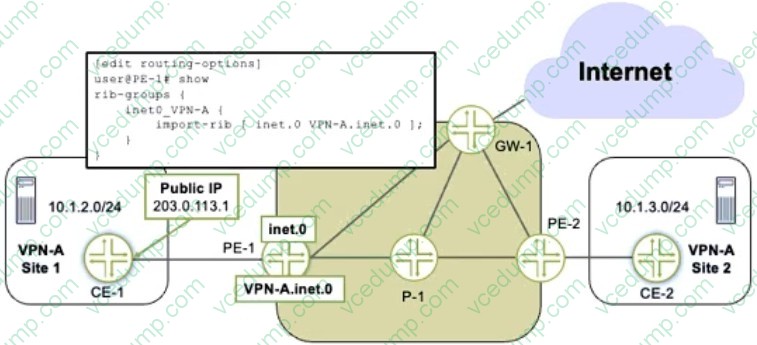
You must provide VRF Internet access over a single connection for VPN-A Site 1, which connects to PE-1. Which two statements are correct in this scenario? (Choose two.)
A. You must use the RIB group to move interface routes from the inet.0 table to the VPN-A.inet.0 table.
B. You must use the RIB group to move a default route, which is learned through BGP, from the inet.0 table to the VPN-A.inet.0 table.
C. You do not need to use the RIB group to move interface routes from the inet.0 table to the VPN-A.inet.0 table.
D. You do not need to use the RIB group default route, which is learned through BGP, from the inet.0 table to the VPN-A.inet.0 table. -
Question 62:
You have an L2VPN connecting two CEs across a provider network. The CEs and provider network are conU setting.
You use the ping command from one CE to the other CE with a size of 1500 bytes.
In this scenario, which statement is correct when using the ping command?
A. You expect an ICMP message too long error.
B. You expect an echo reply.
C. You expect a silent discard.
D. You expect the ping results to be fragmented. -
Question 63:
You are responding to an RFP for a new MPLS VPN implementation. The solution must use LDP for signaling and support Layer 2 connectivity without using BGP The solution must be scalable and support multiple VPN connections over a single MPLS LSP The customer wants to maintain all routing for their Private network
In this scenario, which solution do you propose?
A. circuit cross-connect
B. BGP Layer 2 VPN
C. LDP Layer 2 circuit
D. translational cross-connect -
Question 64:
Referring to the exhibit
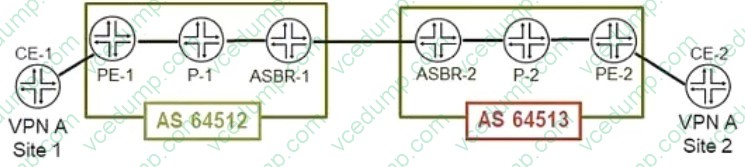
You are con guring an interprovider Option C Layer 3 VPN to connect two customer sites.
Which three statements are correct? (Choose three.)
A. ASBR routers maintain the internal routes from its own AS, the loopback address from the other AS PEs, and the L3VPN routes.
B. ASBR routers maintain the internal routes from its own AS and the loopback addresses from the other AS PEs.
C. P routers maintain the internal routes from its own AS and the loopback address from the other AS PEs.
D. P routers only maintain the internal routes from their own AS.
E. PE routers maintain the internal routes from its own AS, the loopback address from the other AS Pes, and the L3VPN routes. -
Question 65:
Referring to the exhibit.
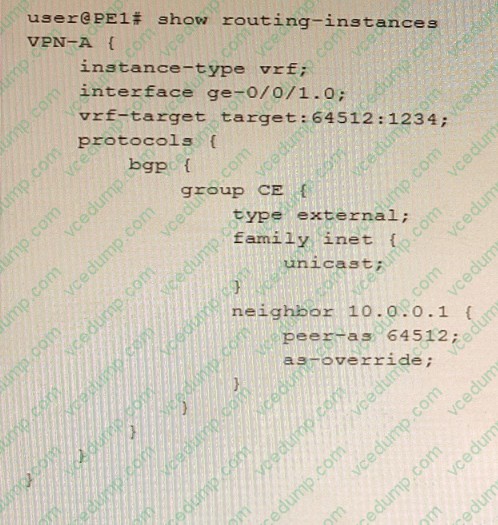
Which two statements about the configuration shown in the exhibit are correct? (Choose two.)
A. This VPN connects customer sites that use different AS numbers.
B. This VPN connects customer sites that use the same AS number
C. A Layer 2 VPN is configured.
D. A Layer 3 VPN is configured. -
Question 66:
Referring to the exhibit
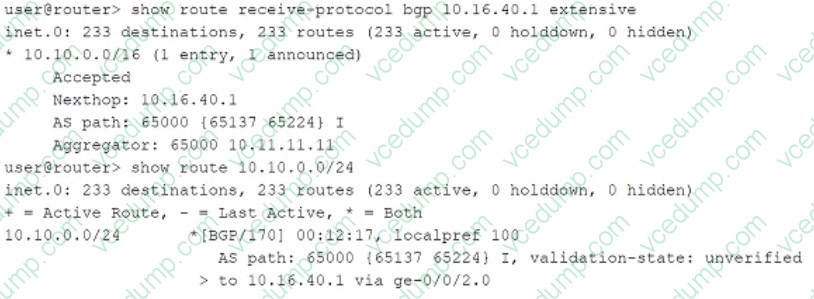
You are troubleshooting an issue for a customer site that uses 10.10.0.0/24 in AS 65224, but you see another AS in the AS path. What is the cause of the problem?
A. AS 65000 is pre-pending AS 65137 to route advertisements.
B. The local AS is in the process of withdrawing the route from AS 65137.
C. AS 65137 is advertising the 10.10.0.0/24 prefix.
D. The local AS is receiving two equal cost routes to 10.10.0.0/24. -
Question 67:
Which three statements about IS-IS in a multi-area network are correct? (Choose three.)
A. Internal L1 PDUs are flooded to all L1 routers in other areas.
B. External L2 PDUs are only flooded to the local area's L2 routers.
C. Internal L1 PDUs are flooded to the local area's L2 routers.
D. External L2 PDUs are flooded to all L2 routers in other areas.
E. Internal L1 PDUs are only flooded to the local area's L1 routers. -
Question 68:
Which two statements about IS-IS are correct? (Choose two.)
A. CSNPs are used to request a missing LSP.
B. PSNPs are used to acknowledge a received LSP.
C. PSNPs are used to request a missing LSP.
D. CSNPs are used to acknowledge a received LSP. -
Question 69:
Referring to the exhibit.
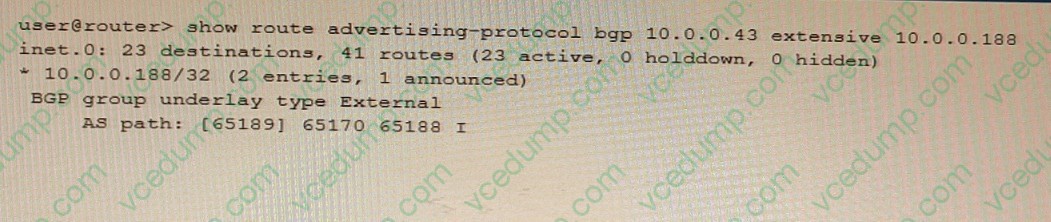
What do the brackets [ ] in the AS path identify?
A. They identify the local AS number associated with the AS path if configured on the router, or if AS path prepending is configured
B. They identify an AS set, which are groups of AS numbers in which the order does not matter
C. They identify that the autonomous system number is incomplete and awaiting more information from the BGP protocol.
D. They identify that a BGP confederation is being used to ensure that there are no routing loops. -
Question 70:
Referring to the exhibit.
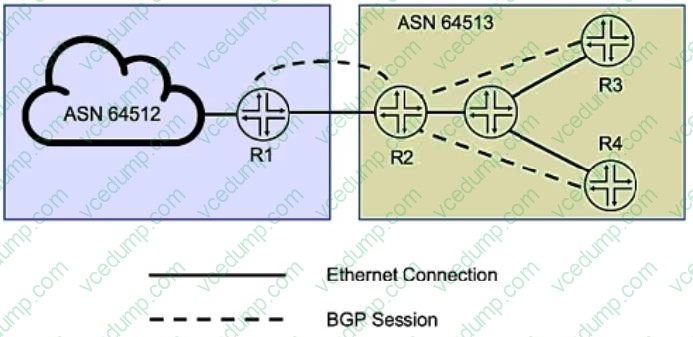
You want to implement the BGP Generalized TTL Security Mechanism (GTSM) on the network
Which three statements are correct in this scenario? (Choose three)
A. You can implement BGP GTSM between R2, R3, and R4
B. BGP GTSM requires a firewall filter to discard packets with incorrect TTL.
C. You can implement BGP GTSM between R2 and R1.
D. BGP GTSM requires a TTL of 1 to be configured between neighbors.
E. BGP GTSM requires a TTL of 255 to be configured between neighbors.
Related Exams:
-
JN0-102
Internet Associate, Junos(JNCIA-Junos) -
JN0-104
Junos, Associate (JNCIA-Junos) -
JN0-105
Junos, Associate (JNCIA-Junos) -
JN0-106
Junos - Associate (JNCIA-Junos) Junos OS 21.2 -
JN0-1101
Juniper Networks Certified Design Associate (JNCDA) -
JN0-1103
Design, Associate (JNCIA-Design) -
JN0-130
Juniper networks Certified internet specialist.e(jncis-e) -
JN0-1301
Data Center Design, Specialist (JNCDS-DC) -
JN0-1302
Data Center Design Specialist (JNCDS-DC) -
JN0-1331
Security Design, Specialist (JNCDS-SEC)
Tips on How to Prepare for the Exams
Nowadays, the certification exams become more and more important and required by more and more enterprises when applying for a job. But how to prepare for the exam effectively? How to prepare for the exam in a short time with less efforts? How to get a ideal result and how to find the most reliable resources? Here on Vcedump.com, you will find all the answers. Vcedump.com provide not only Juniper exam questions, answers and explanations but also complete assistance on your exam preparation and certification application. If you are confused on your JN0-664 exam preparations and Juniper certification application, do not hesitate to visit our Vcedump.com to find your solutions here.