JN0-664 Exam Details
-
Exam Code
:JN0-664 -
Exam Name
:Service Provider Routing and Switching, Professional (JNCIP-SP) -
Certification
:Juniper Certifications -
Vendor
:Juniper -
Total Questions
:96 Q&As -
Last Updated
:Jul 10, 2026
Juniper JN0-664 Online Questions & Answers
-
Question 11:
An interface is configured with a behavior aggregate classifier and a multifield classifier How will the packet be processed when received on this interface?
A. The packet will be discarded.
B. The packet will be processed by the BA classifier first, then the MF classifier.
C. The packet will be forwarded with no classification changes.
D. The packet will be processed by the MF classifier first, then the BA classifier. -
Question 12:
You are using a Layer 3 VPN to connect two customer sites. The VPN routes for the customer networks appear as hidden in the bgp.l3vpn.0 routing table on the PE routers. What is causing this problem?
A. The routes use overlapping IP addresses.
B. There is a routing loop in the service provider backbone.
C. There is not an established MPLS LSP between the two PE routers.
D. Route targets are not configured. -
Question 13:
You are configuring a BGP signaled Layer 2 VPN across your MPLS enabled core network.
In this scenario, which statement is correct?
A. You must assign a unique site number to each attached site's configuration.
B. This type of VPN only supports Ethernet interfaces when connecting to CE devices.
C. This type of VPN requires the support of the inet-vpn NLRI on all core BGP devices
D. You must use the same route-distinguiaher value on both PE devices. -
Question 14:
Referring to the exhibit.
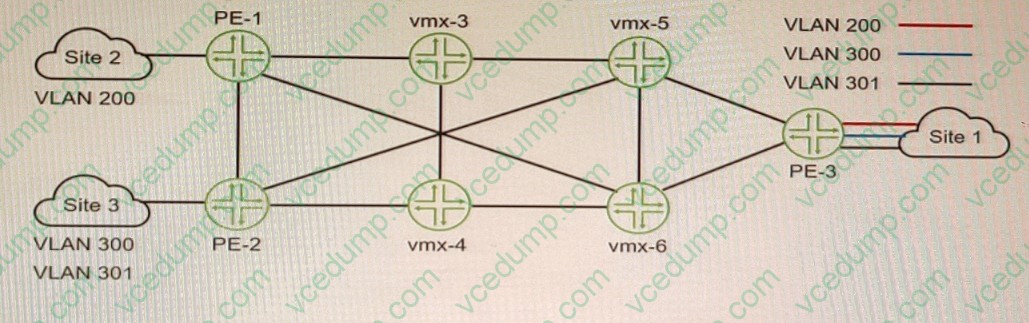
You want Site 1 to access three VLANs that are located in Site 2 and Site 3 The customer- facing interface on the PE-1 router is configured for Ethernet-VLAN encapsulation. What is the minimum number of L2VPN routing instances to be configured to accomplish this task?
A. 1
B. 3
C. 2
D. 6 -
Question 15:
Referring to the exhibit.
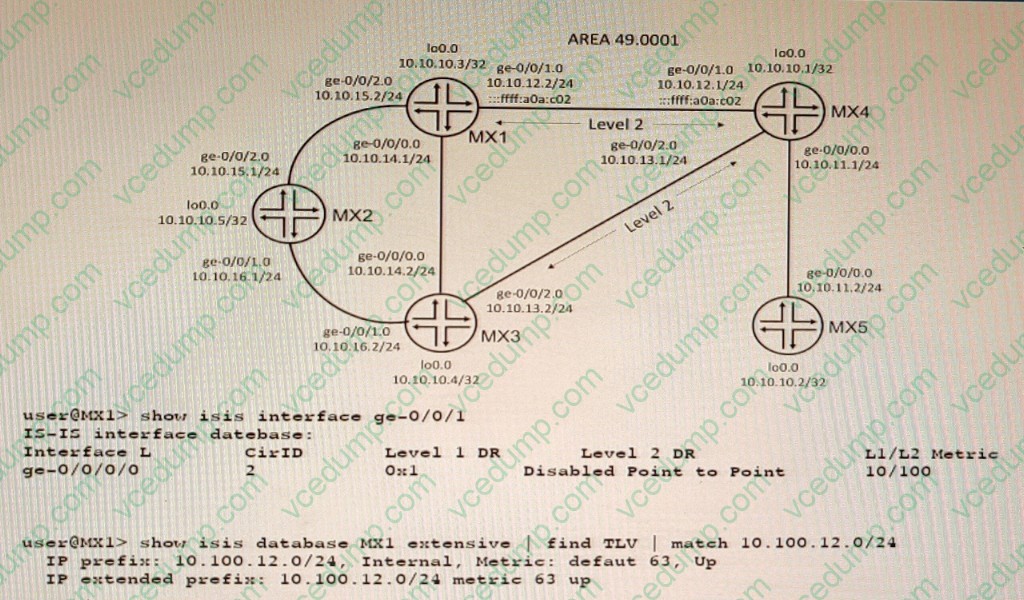
A network is using IS-IS for routing.
In this scenario, why are there two TLVs shown in the exhibit?
A. There are both narrow and wide metric devices in the topology
B. The interface specified a metric of 100 for L2.
C. Wide metrics have specifically been requested
D. Both IPv4 and IPv6 are being used in the topology -
Question 16:
Referring to the exhibit.
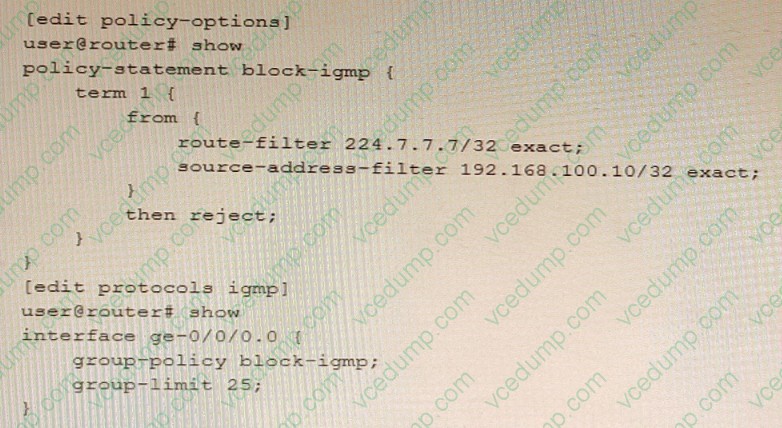
Based on the configuration contents shown in the exhibit, which statement is true?
A. Joins for group 224.7.7.7 are rejected if the source address is 192.168.100.10
B. Joins for any group are accepted if the group count value is less than 25.
C. Joins for group 224.7.7.7 are always rejected, regardless of the group count.
D. Joins for group 224.7.7.7 are accepted if the group count is less than 25 -
Question 17:
Referring to the exhibit
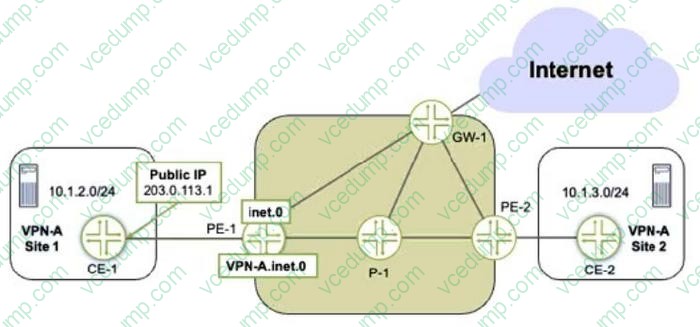
CE-1 is providing NAT services for the hosts at Site 1 and you must provide Internet access for those hosts. Which two statements are correct in this scenario? (Choose two.)
A. You must configure a static route in the main routing instance for the 10 1 2.0/24 prefix that uses the VPN-A.inet.0 table as the next hop
B. You must configure a static route in the main routing instance for the 203.0.113.1/32 prefix that uses the VPN-A.inet.0 table as the next hop.
C. You must configure a RIB group on PE-1 to leak a default route from the inet.0 table to the VPN-A.inet.0 table.
D. You must configure a RIB group on PE-1 to leak the 10 1 2.0/24 prefix from the VPN-inet.0 table to the inet.0 table. -
Question 18:
Referring to the exhibit.
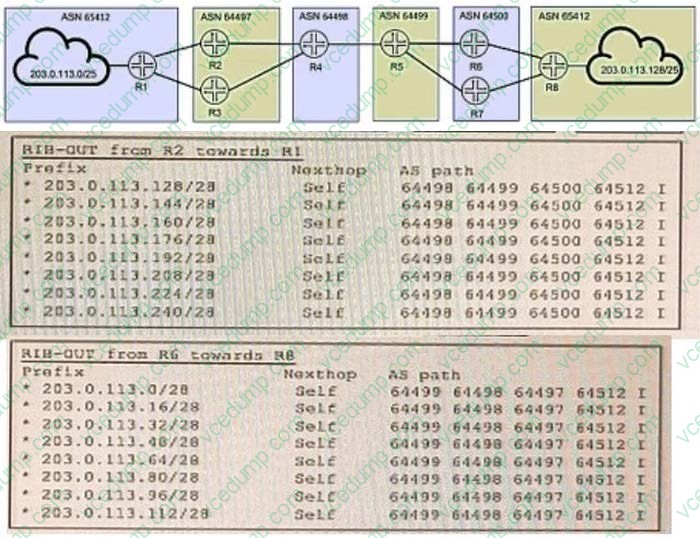
R1 and R8 are not receiving each other's routes
Referring to the exhibit, what are three configuration commands that would solve this problem? (Choose three.)
A. ConAS 64497 toward AS 64498.
B. ConAS 64500 toward AS 64512.
C. ConAS 64500 toward AS 64499.
D. Conpeer-as on routers in AS 64497 and AS 64450.
E. ConAS 65412 and advertise-peer-as on routers in AS 64498. -
Question 19:
Click the Exhibit button.
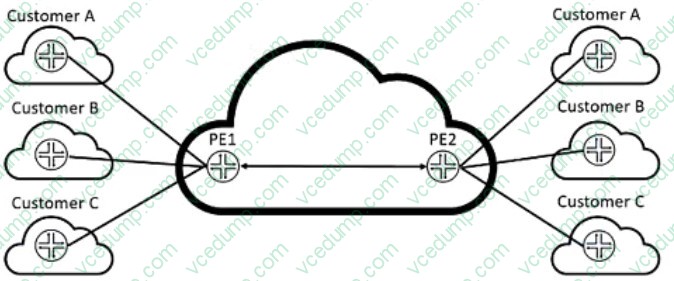
After adding Customer C to your Layer 3 VPN. you must ensure that PE2 is receiving VPN routes for all customers attached to PE1, as shown in the exhibit. Which operational command displays this information?
A. show route table inet.0
B. show route table bgp.l3vpn.0
C. show route table customer-c.inet.0
D. show route summary -
Question 20:
Referring to the exhibit.
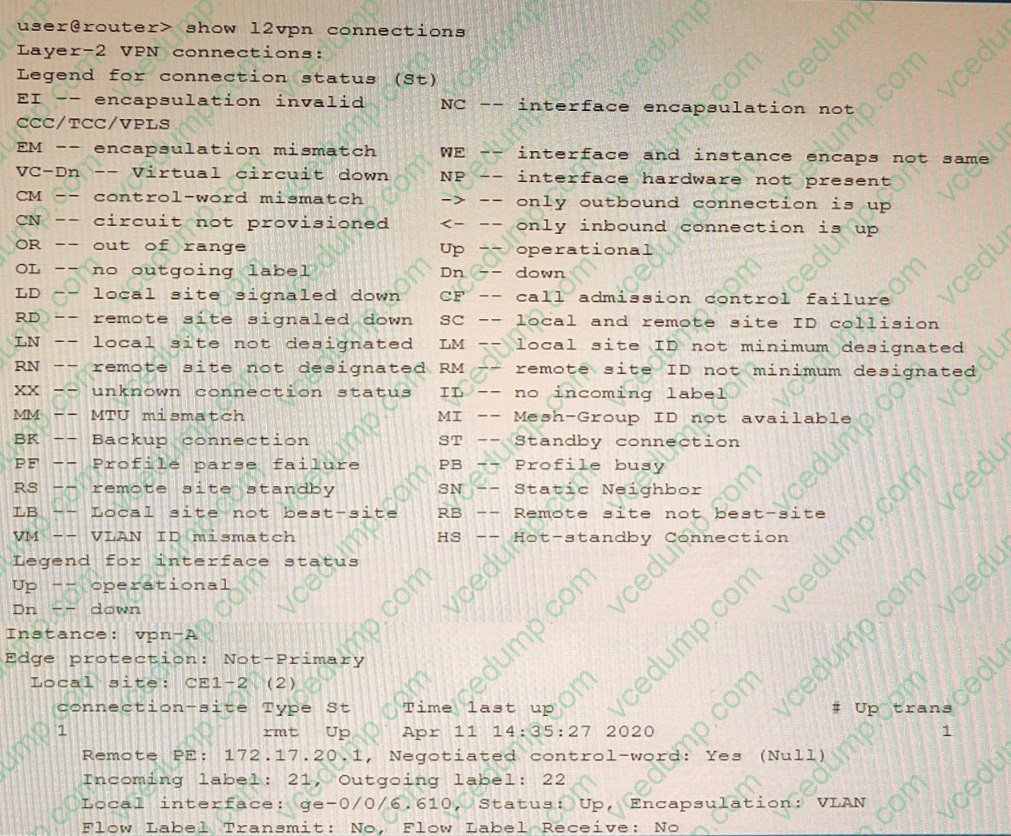
Which two statements about the output shown in the exhibit are correct? (Choose two.)
A. The PE is attached to a single local site.
B. The connection has not flapped since it was initiated.
C. There has been a VLAN ID mismatch.
D. The PE router has the capability to pop flow labels
Related Exams:
-
JN0-102
Internet Associate, Junos(JNCIA-Junos) -
JN0-104
Junos, Associate (JNCIA-Junos) -
JN0-105
Junos, Associate (JNCIA-Junos) -
JN0-106
Junos - Associate (JNCIA-Junos) Junos OS 21.2 -
JN0-1101
Juniper Networks Certified Design Associate (JNCDA) -
JN0-1103
Design, Associate (JNCIA-Design) -
JN0-130
Juniper networks Certified internet specialist.e(jncis-e) -
JN0-1301
Data Center Design, Specialist (JNCDS-DC) -
JN0-1302
Data Center Design Specialist (JNCDS-DC) -
JN0-1331
Security Design, Specialist (JNCDS-SEC)
Tips on How to Prepare for the Exams
Nowadays, the certification exams become more and more important and required by more and more enterprises when applying for a job. But how to prepare for the exam effectively? How to prepare for the exam in a short time with less efforts? How to get a ideal result and how to find the most reliable resources? Here on Vcedump.com, you will find all the answers. Vcedump.com provide not only Juniper exam questions, answers and explanations but also complete assistance on your exam preparation and certification application. If you are confused on your JN0-664 exam preparations and Juniper certification application, do not hesitate to visit our Vcedump.com to find your solutions here.