JN0-664 Exam Details
-
Exam Code
:JN0-664 -
Exam Name
:Service Provider Routing and Switching, Professional (JNCIP-SP) -
Certification
:Juniper Certifications -
Vendor
:Juniper -
Total Questions
:96 Q&As -
Last Updated
:Jul 10, 2026
Juniper JN0-664 Online Questions & Answers
-
Question 31:
Referring to the exhibit.
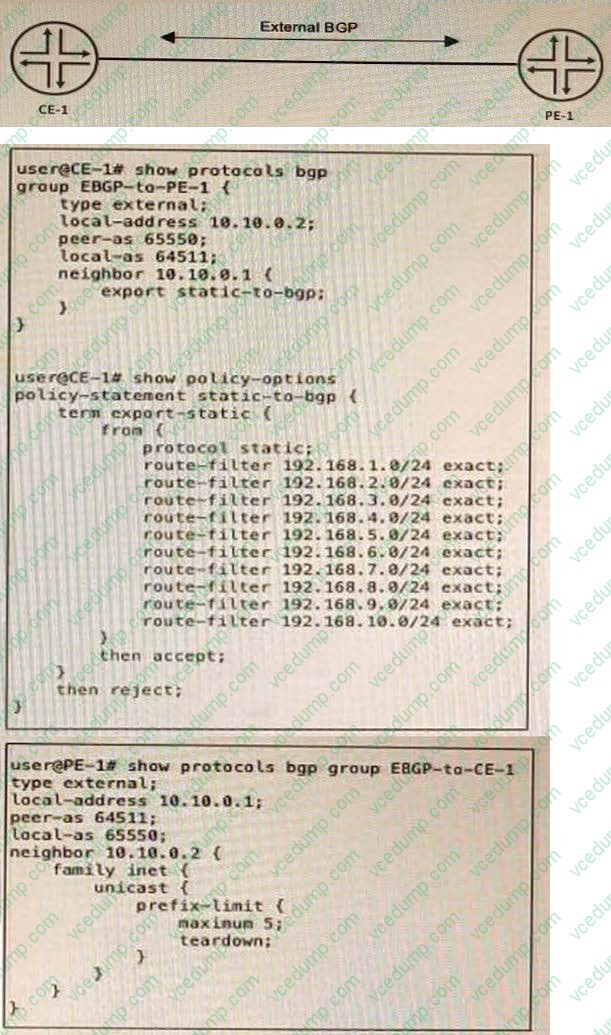
CE-1 must advertise ten subnets to PE-1 using BGP Once CE-1 starts advertising the subnets to PE-1, the BGP peering state changes to Active. Referring to the CLI output shown in the exhibit, which statement is correct?
A. CE-1 is advertising its entire routing table.
B. CE-1 is configured with an incorrect peer AS
C. The prefix limit has been reached on PE-1
D. CE-1 is unreachable -
Question 32:
Click the Exhibit button.
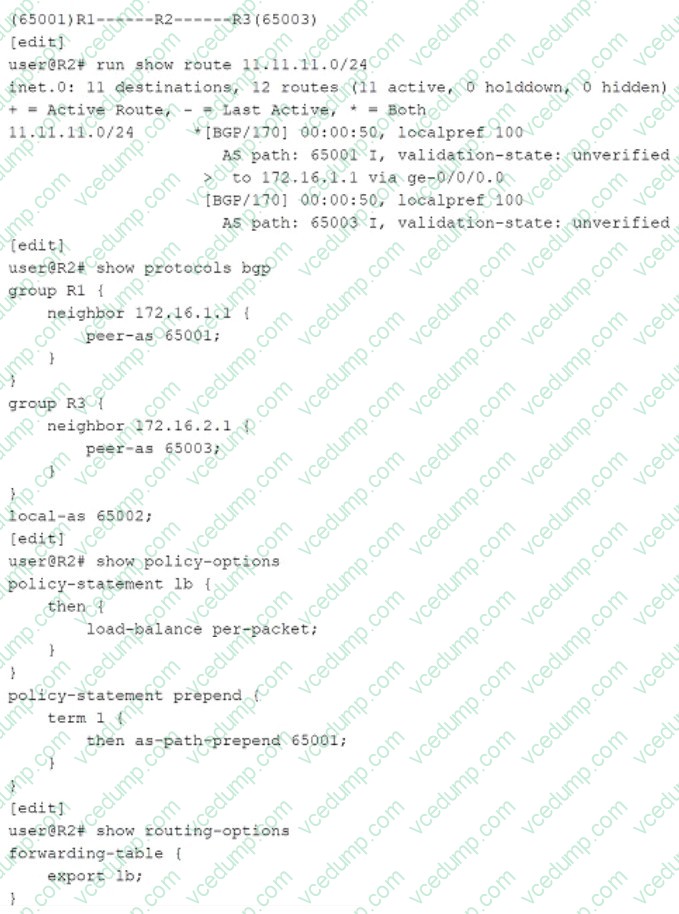
R2 is receiving the same route from R1 and R3. You must ensure that you can load balance traffic for that route. Referring to the exhibit, which configuration change will allow load balancing?
A. Configure the multipath parameter under the global BGP configuration.
B. Apply the prepend policy as an import policy under group R1.
C. Configure the multipath multiple-as parameter under the global BGP configuration.
D. Apply the prepend policy as an import policy under group R3. -
Question 33:
Referring to the exhibit.
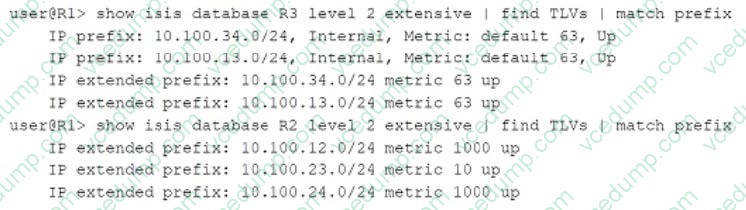
You enabled a new router (R3) in your network but all destinations using IS-IS routes are not properly load balancing over this new router. What is the problem?
A. R2 is missing internal routes for R1.
B. R1 is missing internal routes for R2.
C. R3 does not have wide-metrics enabled.
D. R1 does not have wide-metrics enabled. -
Question 34:
You are a network architect for a service provider and want to offer Layer 2 services to your customers You want to use EVPN for Layer 2 services in your existing MPLS network. Which two statements are correct in this scenario? (Choose two.)
A. Segment routing must be configured on all PE routers.
B. VXLAN must be configured on all PE routers.
C. EVPN uses Type 2 routes to advertise MAC address and IP address pairs learned using ARP snooping
D. EVPN uses Type 3 routes to join a multicast tree to flood traffic. -
Question 35:
You have an L2VPN connecting two CEs across a provider network that runs OSPF. You have OSPF configured on both CEs. Which two statements are correct in this scenario? (Choose two.)
A. OSPF neighborship is formed between the CEs and PEs.
B. OSPF neighborship is formed between the two CEs.
C. The CE and PE OSPF areas must match.
D. The CE and PE OSPF areas can be different. -
Question 36:
You are configuring anycast RP for load balancing and redundancy in your PIM-SM domain.
You want to share active sources between RPs.
In this scenario, what are two solutions that will accomplish this task? (Choose two.)
A. Configure MSDP on each RP router.
B. Configure anycast PIM with the rp-set statement on each RP router.
C. Configure anycast PIM with the rp-set statement on each source DR router.
D. Configure MSDP on each source DR router. -
Question 37:
Referring to the exhibit.
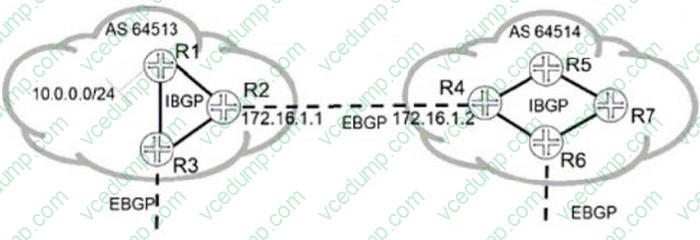
The 10.0.0.0/24 EBGP route is received on R5; however, the route is being hidden. What are two solutions that will solve this problem? (Choose two.)
A. On R4, create a policy to change the BGP next hop to itself and apply it to IBGP as an export policy
B. Add the external interface prefix to the IGP routing tables
C. Add the internal interface prefix to the BGP routing tables.
D. On R4, create a policy to change the BGP next hop to 172.16.1.1 and apply it to IBGP as an export policy -
Question 38:
Referring to the exhibit
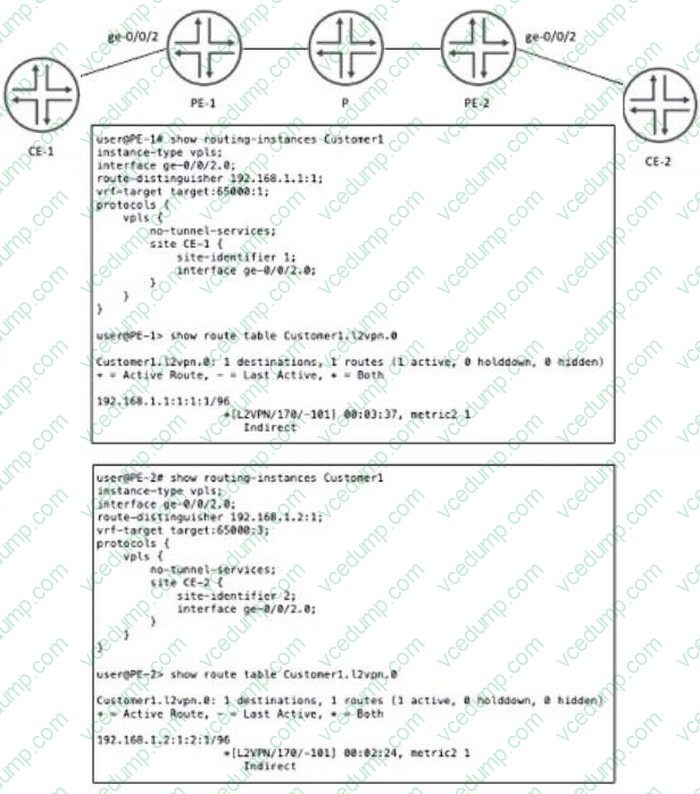
CE-1 and CE-2 are part of a VPLS called Customer1 No connectivity exists between CE-1 and CE-2. In the process of troubleshooting, you notice PE-1 is not learning any routes for this VPLS from PE-2, and PE-2 is not learning any routes for this VPLS from PE-1.
A. The route target must match on PE-1 and PE-2.
B. The route distinguisher must match on PE-1 and PE-2.
C. The instance type should be changed to I2vpn.
D. The no-tunnel-services statement should be deleted on both PEs. -
Question 39:
Which statement is true regarding BGP FlowSpec?
A. It uses a remote triggered black hole to protect a network from a denial-of-service attack.
B. It uses dynamically created routing policies to protect a network from denial-of-service attacks
C. It is used to protect a network from denial-of-service attacks dynamically
D. It verifies that the source IP of the incoming packet has a resolvable route in the routing table -
Question 40:
Referring to the exhibit, which two statements are true? (Choose two.)
A. This route is learned through EBGP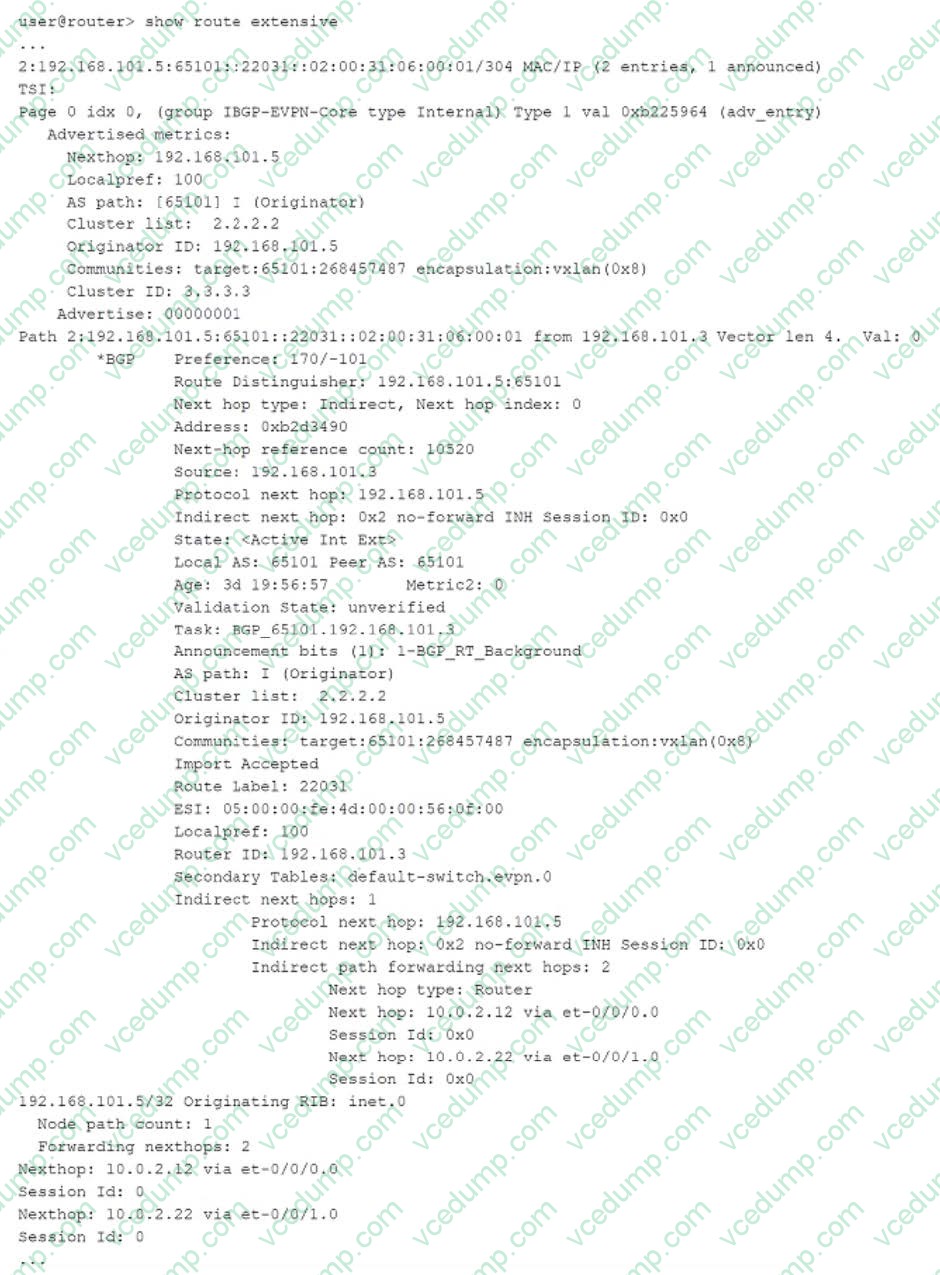
B. This is an EVPN Type-2 route.
C. The device advertising this route into EVPN is 192.168.101.5.
D. The devices advertising this route into EVPN are 10 0 2 12 and 10.0.2.22.
Related Exams:
-
JN0-102
Internet Associate, Junos(JNCIA-Junos) -
JN0-104
Junos, Associate (JNCIA-Junos) -
JN0-105
Junos, Associate (JNCIA-Junos) -
JN0-106
Junos - Associate (JNCIA-Junos) Junos OS 21.2 -
JN0-1101
Juniper Networks Certified Design Associate (JNCDA) -
JN0-1103
Design, Associate (JNCIA-Design) -
JN0-130
Juniper networks Certified internet specialist.e(jncis-e) -
JN0-1301
Data Center Design, Specialist (JNCDS-DC) -
JN0-1302
Data Center Design Specialist (JNCDS-DC) -
JN0-1331
Security Design, Specialist (JNCDS-SEC)
Tips on How to Prepare for the Exams
Nowadays, the certification exams become more and more important and required by more and more enterprises when applying for a job. But how to prepare for the exam effectively? How to prepare for the exam in a short time with less efforts? How to get a ideal result and how to find the most reliable resources? Here on Vcedump.com, you will find all the answers. Vcedump.com provide not only Juniper exam questions, answers and explanations but also complete assistance on your exam preparation and certification application. If you are confused on your JN0-664 exam preparations and Juniper certification application, do not hesitate to visit our Vcedump.com to find your solutions here.