JN0-361 Exam Details
-
Exam Code
:JN0-361 -
Exam Name
:Service Provider Routing and Switching, Specialist (JNCIS-SP) -
Certification
:Juniper Certifications -
Vendor
:Juniper -
Total Questions
:542 Q&As -
Last Updated
:May 25, 2026
Juniper JN0-361 Online Questions & Answers
-
Question 241:
What are three ways that graceful Routing Engine switchover provides redundancy? (Choose three.)
A. by preserving interface and kernel information
B. by reducing time of RE failover
C. by preserving the data plane information
D. by preserving the control plane information
E. by not restarting the PFE -
Question 242:
What is the purpose of the designated router in OSPF?
A. to connect a stub area to the backbone area
B. to connect a totally stub area to the backbone area
C. to form adjacencies with other OSPF routers in a backbone area
D. to form adjacencies with other OSPF routers in a broadcast domain -
Question 243:
By default, which two tasks does an Ethernet bridge perform in response to receiving a multicast frame? (Choose two.)
A. It learns the MAC address of any responding nodes and updates its bridge table with the source MAC address and ingress port
B. It drops the frame
C. It floods the frame out of all interfaces except the one on which it was received
D. It floods the frame out of particular interfaces based on its multicast MAC table. -
Question 244:
-- Exhibit -user@router# run show route advertising-protocol bgp 192.168.12.1
user@router# run show route
inet.0: 11 destinations, 12 routes (11 active, 0 holddown, 0 hidden)
+ = Active Route, - = Last Active, * = Both
2.2.2.2/32 *[Direct/0] 3w6d 03:57:51 > via lo0.0 192.168.12.0/24 *[Direct/0] 01:07:34 > via xe-0/0/0.0 192.168.12.2/32 *[Local/0] 01:07:34 Local via xe-0/0/0.0 200.1.0.0/16 *[Aggregate/130] 00:00:58 Reject [IS-IS/165] 00:10:57, metric 10 > to 200.1.1.2 via xe-0/0/3.0 200.1.1.0/24 *[Direct/0] 00:29:21 > via xe-0/0/3.0 200.1.1.1/32 *[Local/0] 00:29:21 Local via xe-0/0/3.0
iso.0: 1 destinations, 1 routes (1 active, 0 holddown, 0 hidden)
+ = Active Route, - = Last Active, * = Both
49.0000.0020.0200.2002/72 *[Direct/0] 3w4d 21:07:32 > via lo0.0
inet6.0: 3 destinations, 4 routes (3 active, 0 holddown, 0 hidden)
+ = Active Route, - = Last Active, * = Both
2:2:2::2/128 *[Direct/0] 3w4d 21:22:24
> via lo0.0
[edit]
user@router# show policy-options
policy-statement adv-route {
term t1 {
from {
protocol isis;
route-filter 200.1.0.0/16 exact;
}
then accept;
}
term t2 {
then reject;
}
}
[edit]
user@router# show protocols bgp
group ebgp {
type external;
export adv-route;
neighbor 192.168.12.1 {
peer-as 65000;
}
}
-- Exhibit -
Click the Exhibit button.
Referring to the exhibit, why is the 200.1.0.0/16 prefix failing to be advertised in BGP?
A. BGP needs a next-hop self policy.
B. The aggregate route is set to reject.
C. The policy works for internal BGP only.
D. The IS-IS route is less preferred than the aggregate route. -
Question 245:
A customer configures a bridge domain using a VLAN ID of 222.
Which configuration will allow for the switch to potentially look at the IP header of incoming frames tagged with a VLAN ID of 222?
A. Option A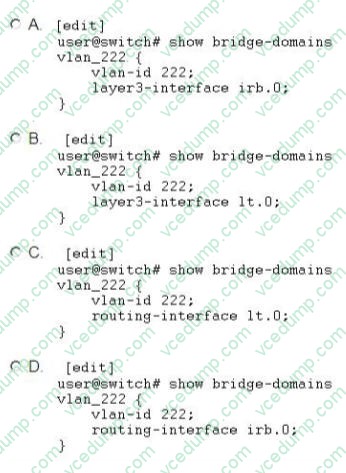
B. Option B
C. Option C
D. Option D -
Question 246:
Which Junos platform supports provider bridging?
A. T Series devices
B. SRX Series devices
C. MX Series devices
D. MAG Series devices -
Question 247:
In the Junos OS, where do you configure the area value for IS-IS?
A. [edit protocols isis level 2]
B. [edit routing-options]
C. [edit protocols isis level 1]
D. [edit interfaces lo0] -
Question 248:
You have been asked to configure an IPv6 address for a group of interfaces that could belong on different routers. If a packet is sent to that address, it should be received by all routers in the group. Which address type would be suited for these requirements?
A. Unicast
B. Multicast
C. Anycast
D. Broadcast -
Question 249:
Which protocol is used by wired Ethernet to manage frame collisions?
A. IEEE 802.3 active monitoring
B. IEEE 802.5 active monitoring
C. carrier-sense multiple access with collision avoidance
D. carrier-sense multiple access with collision detection -
Question 250:
-- Exhibit -[edit]
user@router# show protocols bgp
group ibgp {
type internal;
local-address 3.3.3.3;
family inet;
neighbor 2.2.2.2;
}
[edit]
user@router# show routing-instances
VRF {
instance-type vrf;
interface xe-0/0/1.0;
route-distinguisher 3.3.3.3:100;
vrf-target target:100:100;
vrf-table-label;
}
[edit]
user@router# show protocols mpls
interface all;
[edit]
user@router# show protocols rsvp
interface all;
-- Exhibit -
Click the Exhibit button.
Referring to the exhibit, what is missing in the configuration to make the Layer 3 VPN functional? (Choose two.)
A. a label-switched path
B. the LDP protocol configuration
C. a virtual circuit ID
D. an NLRI of family inet-vpn unicast
Related Exams:
-
JN0-102
Internet Associate, Junos(JNCIA-Junos) -
JN0-104
Junos, Associate (JNCIA-Junos) -
JN0-105
Junos, Associate (JNCIA-Junos) -
JN0-106
Junos - Associate (JNCIA-Junos) Junos OS 21.2 -
JN0-1101
Juniper Networks Certified Design Associate (JNCDA) -
JN0-1103
Design, Associate (JNCIA-Design) -
JN0-130
Juniper networks Certified internet specialist.e(jncis-e) -
JN0-1301
Data Center Design, Specialist (JNCDS-DC) -
JN0-1302
Data Center Design Specialist (JNCDS-DC) -
JN0-1331
Security Design, Specialist (JNCDS-SEC)
Tips on How to Prepare for the Exams
Nowadays, the certification exams become more and more important and required by more and more enterprises when applying for a job. But how to prepare for the exam effectively? How to prepare for the exam in a short time with less efforts? How to get a ideal result and how to find the most reliable resources? Here on Vcedump.com, you will find all the answers. Vcedump.com provide not only Juniper exam questions, answers and explanations but also complete assistance on your exam preparation and certification application. If you are confused on your JN0-361 exam preparations and Juniper certification application, do not hesitate to visit our Vcedump.com to find your solutions here.