JN0-361 Exam Details
-
Exam Code
:JN0-361 -
Exam Name
:Service Provider Routing and Switching, Specialist (JNCIS-SP) -
Certification
:Juniper Certifications -
Vendor
:Juniper -
Total Questions
:542 Q&As -
Last Updated
:May 25, 2026
Juniper JN0-361 Online Questions & Answers
-
Question 261:
-- Exhibit -[edit policy-options]
user@router# show
policy-statement load-balance {
from {
route-filter 10.243.0.0/24 exact;
route-filter 10.224.1.0/24 exact;
}
then {
load-balance per-packet;
}
}
-- Exhibit -
Click the Exhibit button.
You have been asked to configure per-packet load balancing.
Referring to the exhibit, which configuration correctly applies the load-balancing policy?
A. [edit routing-options] user@router# show forwarding-options { export load-balance; }
B. [edit routing-options] user@router# show static { export load-balance; }
C. [edit routing-options] user@router# show forwarding-table { export load-balance; }
D. [edit routing-options] user@router# show routing-table { export load-balance; } -
Question 262:
From the [edit routing-options] hierarchy, which command correctly configures an aggregate route for 64.18.128/17
A. set aggregate route 64.18.128/17
B. set summary route 64.18.128/17
C. set route aggregate 64.18.128/17
D. set route summary 64.18.128/17 -
Question 263:
Two Junos devices are trying to form an OSPF adjacency. When you issue the "show ospf neighbor" command, you see that one device is in the Loading state and the other is in the Full state. Why is one device in the Loading state?
A. The device does not know about the received LSA header and has transmitted a link-state request
B. The device has finished transmitting, but is still receiving database information
C. The device is waiting for a start event
D. The device has established bidirectional communication with its peer -
Question 264:
Which IS-IS PDU is used to request a retransmission of a missing link-state packet?
A. the complete sequence number PDU
B. the partial sequence number PDU
C. a hello PDU with a request PDU TLV specifying the missing LSP
D. a hello PDU with a refresh PDU TLV requesting all LSPs -
Question 265:
Your OSPF network design uses stub areas extensively due to 5000 external routes within the backbone and resource constraints in the nonbackbone areas. You now have a device in Area 2 that must perform as an ASBR. Which OSPF area types should you use for Area 2?
A. stub
B. non-backbone area
C. not-so-stubby-area
D. totally stubby area -
Question 266:
By default, what is the maximum metric that can be advertised for any interface in IS-IS?
A. 1
B. 10
C. 63
D. 1023 -
Question 267:
A rogue switch has been added to your network, exchanged BPDUs, and is now part of the spanning tree topology. Which feature would help prevent this from happening in the future?
A. storm control
B. BPDU control
C. root protection
D. loop protection -
Question 268:
You are asked to establish an MPLS LSP between two sites. You are required to ensure the LSP traverses specific routers within your network. Which solution is correct?
A. Enable traffic engineering within LDP and define the explicit route the LSP must follow.
B. Implement RSVP and define the explicit route the LSP must follow.
C. Enable traffic engineering within RSVP and define the explicit route the LSP must follow.
D. Implement LDP and define the explicit route the LSP must follow. -
Question 269:
-- Exhibit ?
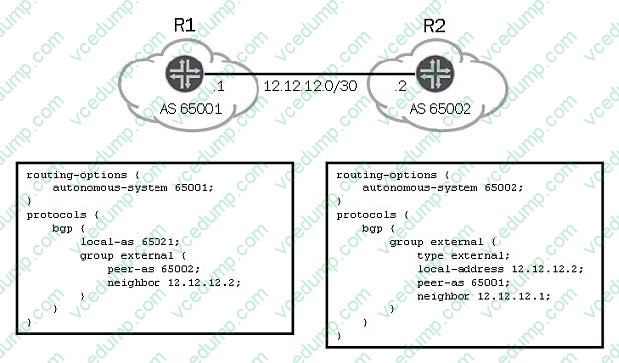
-- Exhibit -
Click the Exhibit button.
You are asked to configure a new external BGP peering. You have configured BGP on R1 as shown in the exhibit, however the BGP peering remains in Active state.
Which additional configuration is required on R1 to establish the BGP peering?
A. Configure the local-address.
B. Configure the BGP type as external.
C. Remove the local-as statement.
D. Remove the autonomous-system statement. -
Question 270:
Which high availability feature is enabled by default on Junos devices?
A. nonstop active routing
B. root protection
C. nonstop forwarding
D. graceful Routing Engine switchover
Related Exams:
-
JN0-102
Internet Associate, Junos(JNCIA-Junos) -
JN0-104
Junos, Associate (JNCIA-Junos) -
JN0-105
Junos, Associate (JNCIA-Junos) -
JN0-106
Junos - Associate (JNCIA-Junos) Junos OS 21.2 -
JN0-1101
Juniper Networks Certified Design Associate (JNCDA) -
JN0-1103
Design, Associate (JNCIA-Design) -
JN0-130
Juniper networks Certified internet specialist.e(jncis-e) -
JN0-1301
Data Center Design, Specialist (JNCDS-DC) -
JN0-1302
Data Center Design Specialist (JNCDS-DC) -
JN0-1331
Security Design, Specialist (JNCDS-SEC)
Tips on How to Prepare for the Exams
Nowadays, the certification exams become more and more important and required by more and more enterprises when applying for a job. But how to prepare for the exam effectively? How to prepare for the exam in a short time with less efforts? How to get a ideal result and how to find the most reliable resources? Here on Vcedump.com, you will find all the answers. Vcedump.com provide not only Juniper exam questions, answers and explanations but also complete assistance on your exam preparation and certification application. If you are confused on your JN0-361 exam preparations and Juniper certification application, do not hesitate to visit our Vcedump.com to find your solutions here.