JN0-361 Exam Details
-
Exam Code
:JN0-361 -
Exam Name
:Service Provider Routing and Switching, Specialist (JNCIS-SP) -
Certification
:Juniper Certifications -
Vendor
:Juniper -
Total Questions
:542 Q&As -
Last Updated
:May 25, 2026
Juniper JN0-361 Online Questions & Answers
-
Question 231:
Which statement correctly describes the metric used for IS-IS?
A. The IS-IS metric is calculated based on a reference bandwidth of 10 Mbps by default
B. By default, IS-IS interface routes are assigned a metric of 10, regardless of actual link speed
C. By default, the Junos OS sends only wide metrics to allow any single link to have a metric as high as 63
D. For proper operation, the same metric value should be specified at both ends of an IS-IS link -
Question 232:
You notice that the RID of your router is being taken from the address of your management interface.
What could cause this scenario?
A. The loopback address was configured with a /32 address.
B. The loopback address was not configured under [edit protocols ospf].
C. A suitable loopback address was not configured on the router.
D. The loopback address was configured under [edit routing-options]. -
Question 233:
Your network is using the Junos default MPLS settings. Which label operation is performed by penultimate router?
A. pop
B. push
C. replace
D. swap -
Question 234:
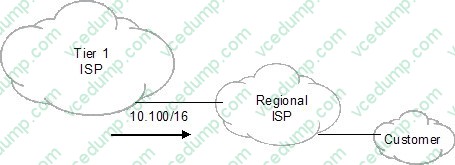
Click the Exhibit button.
You work for the regional Internet service provider shown in the exhibit. You have a partial BGP table and are receiving a 10.100/16 route from your upstream ISP. You have been asked to configure a default route that can be sent to your downstream customer. This route should forward customer traffic toward your upstream Tier 1 ISP as long as the 10.100/16 route is present.
What would accomplish this goal?
A. Create and announce an aggregate default route.
B. Create and announce a static default route with a next-hop of discard.
C. Create and announce a static default route with a next-hop of reject.
D. Create and announce a generated default route. -
Question 235:
By default, which RSVP reservation style is used by the Junos OS?
A. fixed explicit
B. fixed filter
C. shared explicit
D. wildcard filter -
Question 236:
Your customer complains that their Layer 3 VPN is not passing traffic from one site to another. You assigned that customer to VPN-A. Which command on the PE router will confirm the presence of customer routes?
A. show route VPN-A
B. show route VPN-A table bgp.l2vpn.0
C. show route table inet.3 VPN-A
D. show route table VPN-A.inet.0 -
Question 237:
You are asked to configure and apply a new routing policy to influence routing advertisements received from a specific EBGP peer. In this scenario, which statement is true?
A. The new policy should be applied as an export policy for the specific EBGP peer.
B. The new policy should be applied as an import policy for the specific EBGP peer.
C. The new policy should be applied as an export for the EBGP group in which the peer is defined.
D. The new policy should be applied as an import policy for the EBGP group in which the peer is defined. -
Question 238:
Your area boarder router (ABR) receives type 1, 2, and 5 link-state advertisements (LSAs) from a nonbackbone area. What would the ABR do with the information learned from the nonbackbone area?
A. It will generate type 2 and 3 LSAs and flood type 5 LSAs to the backbone area
B. It will generate only type 3 LSAs and flood only type 5 LSAs to the backbone area
C. It will generate type 3 and 4 LSAs, and flood type 5 LSAs to the backbone area
D. It will generate only type 4 LSAs and flood only type 5 LSAs to the backbone area -
Question 239:
Which OSPF state indicates that the router has finished transmitting its database but is still receiving database information?
A. Loading
B. ExStart
C. 2Way
D. Exchange -
Question 240:
What is the role of the route distinguisher (RD) in a Layer 3 VPN?
A. The RD controls the allocation of MPLS labels within a VRF.
B. The RD allows different VRFs to contain the same IP prefixes.
C. The RD is used to create unique routing processes within the global routing instance.
D. The RD is used to control the import and export of routes within a VRF.
Related Exams:
-
JN0-102
Internet Associate, Junos(JNCIA-Junos) -
JN0-104
Junos, Associate (JNCIA-Junos) -
JN0-105
Junos, Associate (JNCIA-Junos) -
JN0-106
Junos - Associate (JNCIA-Junos) Junos OS 21.2 -
JN0-1101
Juniper Networks Certified Design Associate (JNCDA) -
JN0-1103
Design, Associate (JNCIA-Design) -
JN0-130
Juniper networks Certified internet specialist.e(jncis-e) -
JN0-1301
Data Center Design, Specialist (JNCDS-DC) -
JN0-1302
Data Center Design Specialist (JNCDS-DC) -
JN0-1331
Security Design, Specialist (JNCDS-SEC)
Tips on How to Prepare for the Exams
Nowadays, the certification exams become more and more important and required by more and more enterprises when applying for a job. But how to prepare for the exam effectively? How to prepare for the exam in a short time with less efforts? How to get a ideal result and how to find the most reliable resources? Here on Vcedump.com, you will find all the answers. Vcedump.com provide not only Juniper exam questions, answers and explanations but also complete assistance on your exam preparation and certification application. If you are confused on your JN0-361 exam preparations and Juniper certification application, do not hesitate to visit our Vcedump.com to find your solutions here.