CompTIA JK0-022 Online Practice
Questions and Exam Preparation
JK0-022 Exam Details
Exam Code
:JK0-022
Exam Name
:CompTIA Security+ Certification
Certification
:CompTIA Security+
Vendor
:CompTIA
Total Questions
:1149 Q&As
Last Updated
:Feb 05, 2025
CompTIA JK0-022 Online Questions &
Answers
Question 631:
Joe, the system administrator, is performing an overnight system refresh of hundreds of user computers. The refresh has a strict timeframe and must have zero downtime during business hours. Which of the following should Joe take into consideration?
A. A disk-based image of every computer as they are being replaced. B. A plan that skips every other replaced computer to limit the area of affected users. C. An offsite contingency server farm that can act as a warm site should any issues appear. D. A back-out strategy planned out anticipating any unforeseen problems that may arise.
D. A back-out strategy planned out anticipating any unforeseen problems that may arise. A backout is a reversion from a change that had negative consequences. It could be, for example, that everything was working fine until you installed a service pack on a production machine, and then services that were normally available were no longer accessible. The backout, in this instance, would revert the system to the state that it was in before the service pack was applied. Backout plans can include uninstalling service packs, hotfixes, and patches, but they can also include reversing a migration and using previous firmware. A key component to creating such a plan is identifying what events will trigger your implementing the backout. Incorrect Answers: A: A disk image is usually downloaded and installed when a failure occurs. This is not guaranteeing a zero downtime. B: A plan that skips every other replaces computer is not 100% zero down time guaranteed because it will impact on the business hours. C: An offsite contingence server farm will not offer zero downtime. References: Dulaney, Emmett and Chuck Eastton, CompTIA Security+ Study Guide, Sixth Edition, Sybex, Indianapolis, 2014, p 443
Question 632:
DRAG DROP
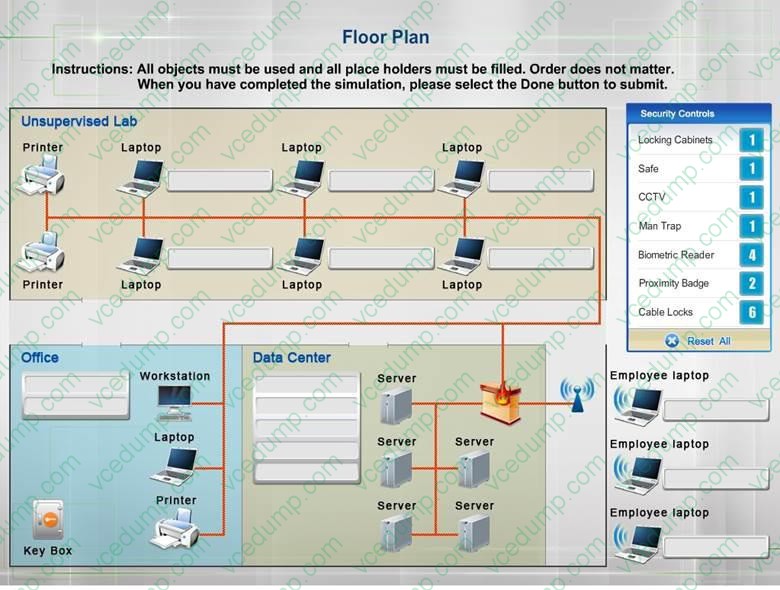
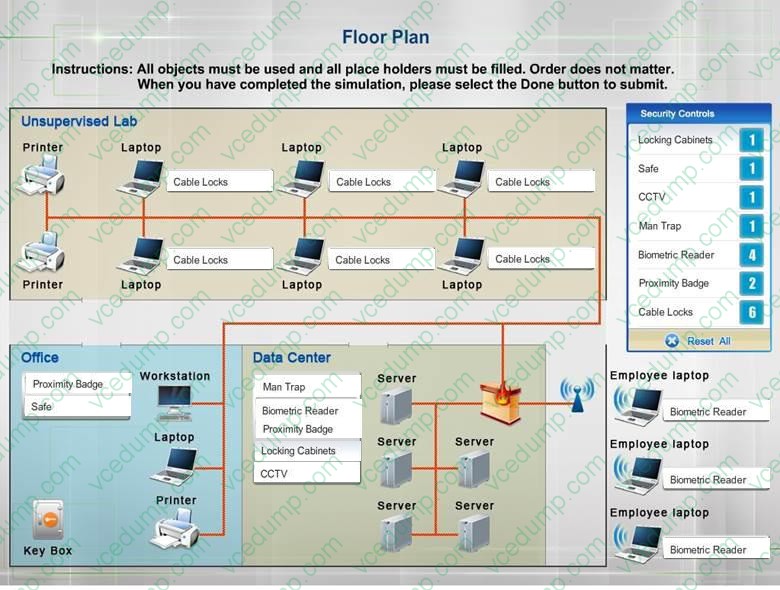
You have been tasked with designing a security plan for your company. Drag and drop the appropriate security controls on the floor plan.
Instructions: All objects must be used and all place holders must be filled. Order does not matter. When you have completed the simulation, please select the Done button to submit.
Select and Place:
Dulaney, Emmett and Chuck Eastton, CompTIA Security+ Study Guide, Sixth Edition, Sybex, Indianapolis, 2014, p 369
Question 633:
Configuring key/value pairs on a RADIUS server is associated with deploying which of the following?
A. WPA2-Enterprise wireless network B. DNS secondary zones C. Digital certificates D. Intrusion detection system
A. WPA2-Enterprise wireless network WPA2-Enterprise is designed for enterprise networks and requires a RADIUS authentication server. Incorrect Answers: B: A secondary zone is merely a copy of a primary zone that is hosted on another server. C: Digital certificates are used for proving the identity of a user or the source of an object. D: An intrusion detection system (IDS) is a device or software application that monitors network or system activities for malicious activities or policy violations and produces reports to a management station. References: http://en.wikipedia.org/wiki/Wi-Fi_Protected_Access https://technet.microsoft.com/en-us/library/cc771898.aspx Stewart, James Michael, CompTIA Security+ Review Guide, Sybex, Indianapolis, 2014, p 61.
Question 634:
Jane, an IT security technician, needs to create a way to secure company mobile devices. Which of the following BEST meets this need?
A. Implement voice encryption, pop-up blockers, and host-based firewalls. B. Implement firewalls, network access control, and strong passwords. C. Implement screen locks, device encryption, and remote wipe capabilities. D. Implement application patch management, antivirus, and locking cabinets.
C. Implement screen locks, device encryption, and remote wipe capabilities. Screen-lock is a security feature that requires the user to enter a password after a short period of inactivity before they can access the system again. This feature ensures that if your device is left unattended or is lost or stolen, it will be difficult for anyone else to access your data or applications. Device encryption encrypts the data on the device. This feature ensures that the data on the device cannot be accessed in a useable form should the device be stolen. Remote wipe is the process of deleting data on a device in the event that the device is stolen. This is performed over remote connections such as the mobile phone service or the internet connection and helps ensure that sensitive data is not accessed by unauthorized people. Incorrect Answers: A: Voice encryption is used to protect audio (voice) transmission. It cannot secure data stored on a mobile device. Pop-up blockers prevent websites from opening new browser windows without the users consent. These are often used for advertisements but can also be used to distribute malicious code. A host-based firewall is installed on a client system and is used to protect the client system from the activities of the user as well as from communication from the network or Internet by filtering the type of network traffic that can sent or received by the systems. B: Firewalls, network access control, and strong passwords would secure the network rather than the mobile device. Firewalls protect systems from network attacks by filtering the type of network traffic that can sent or received by the systems. Strong passwords are likely to mitigate risk of the user account being used to access the network. A strong password would be more difficult to crack. It does not secure the mobile device. D: Patch management is the process of maintaining the latest source code for applications and operating systems by applying the latest vendor updates. This helps protect a systems from newly discovered attacks and vulnerabilities. Antivirus software is used to protect systems against viruses, which are a form of malicious code designed to spread from one system to another, consuming network resources. Locking cabinets would secure mobile device when they have not been issued to users. References: Dulaney, Emmett and Chuck Eastton, CompTIA Security+ Study Guide, Sixth Edition, Sybex, Indianapolis, 2014, pp 161-162, 220, 418-419 Stewart, James Michael, CompTIA Security+ Review Guide, Sybex, Indianapolis, 2014, pp 231- 232, 236, 237, 246
Question 635:
An administrator needs to segment internal traffic between layer 2 devices within the LAN. Which of the following types of network design elements would MOST likely be used?
A. Routing B. DMZ C. VLAN D. NAT
C. VLAN A virtual local area network (VLAN) is a hardware-imposed network segmentation created by switches. VLANs are used for traffic management. Communications between ports within the same VLAN occur without hindrance, but communications between VLANs require a routing function. Incorrect Answers: A: Routing is the process of selecting best paths in a network. C: A demilitarized zone (DMZ) is an area of a network that is designed specifically for public users to access. The DMZ is a buffer network between the public untrusted Internet and the private trusted LAN. Often a DMZ is deployed through the use of a multihomed firewall. D: NAT converts the IP addresses of internal systems found in the header of network packets into public IP addresses. References: Stewart, James Michael, CompTIA Security+ Review Guide, Sybex, Indianapolis, 2014, pp 39, 277. http://en.wikipedia.org/wiki/Routing
Question 636:
A company plans to expand by hiring new engineers who work in highly specialized areas. Each engineer will have very different job requirements and use unique tools and applications in their job. Which of the following is MOST appropriate to use?
A. Role-based privileges B. Credential management C. User assigned privileges D. User access
A. Role-based privileges
Question 637:
The security administrator has been tasked to update all the access points to provide a more secure connection. All access points currently use WPA TKIP for encryption. Which of the following would be configured to provide more secure connections?
A. WEP B. WPA2 CCMP C. Disable SSID broadcast and increase power levels D. MAC filtering
B. WPA2 CCMP CCMP makes use of 128-bit AES encryption with a 48-bit initialization vector. This initialization vector makes cracking a bit more difficult. Incorrect Answers: A: WEP is not a secure encryption protocol. C: This will only cloak the network, and increase the signal strength. D: MAC filtering is vulnerable to spoof attacks. References: Dulaney, Emmett and Chuck Eastton, CompTIA Security+ Study Guide, Sixth Edition, Sybex, Indianapolis, 2014, pp 172, 178.
Question 638:
A recently installed application update caused a vital application to crash during the middle of the workday. The application remained down until a previous version could be reinstalled on the server, and this resulted in a significant loss of data and revenue.
Which of the following could BEST prevent this issue from occurring again?
A. Application configuration baselines B. Application hardening C. Application access controls D. Application patch management
D. Application patch management Patch management is the process of maintaining the latest source code for applications and operating systems by applying the latest vendor updates. This helps protect a systems from newly discovered attacks and vulnerabilities. A part of patch management is testing the effects of vendor updates on a test system first to ensure that the updates do not have detrimental effects on the system, and, should the updates have no detrimental effects on the test systems, backing up the production systems before applying the updates on a production system. Incorrect Answers: A: Application configuration baselining is the process of tuning the settings of an application to ensure it operates at its optimal value while providing security and vulnerability protection. B: Hardening is the process of securing a system by reducing its surface of vulnerability. Reducing the surface of vulnerability typically includes removing or disabling unnecessary functions and features, removing or disabling unnecessary user accounts, disabling unnecessary protocols and ports, and disabling unnecessary services. Hardening also involves tuning and configuring the native security features of the installed software, performing patch management. C: Access control or permissions determines a user's access to an object, such as a file or folder, application, and system. It does not prevent system crashed due to application updates. References: Stewart, James Michael, CompTIA Security+ Review Guide, Sybex, Indianapolis, 2014, pp 231- 232, 235 Dulaney, Emmett and Chuck Eastton, CompTIA Security+ Study Guide, Sixth Edition, Sybex, Indianapolis, 2014, pp 215-217, 219, 220
Question 639:
Which of the following network devices is used to analyze traffic between various network interfaces?
A. Proxies B. Firewalls C. Content inspection D. Sniffers
D. Sniffers A sniffer (packet sniffer) is a tool that intercepts data flowing in a network. If computers are connected to a local area network that is not filtered or switched, the traffic can be broadcast to all computers contained in the same segment. This doesn't generally occur, since computers are generally told to ignore all the comings and goings of traffic from other computers. However, in the case of a sniffer, all traffic is shared when the sniffer software commands the Network Interface Card (NIC) to stop ignoring the traffic. The NIC is put into promiscuous mode, and it reads communications between computers within a particular segment. This allows the sniffer to seize everything that is flowing in the network, which can lead to the unauthorized access of sensitive data. A packet sniffer can take the form of either a hardware or software solution. A sniffer is also known as a packet analyzer. Incorrect Answers: A: Web proxies tend to be used for caching web page content and/or restricting access to websites to aid compliance with company Internet usage policies. They are not used to analyze traffic between various network interfaces. Therefore, this answer is incorrect. B: A firewall is designed to prevent unauthorized access to or from a private network. Firewalls can be implemented in both hardware and software, or a combination of both. Firewalls are frequently used to prevent unauthorized Internet users from accessing private networks connected to the Internet, especially intranets. All data packets entering or leaving the intranet pass through the firewall, which examines each packet and blocks those that do not meet the specified security criteria; typically a combination of port and IP address. A firewall is not used to analyze traffic between various network interfaces. Therefore, this answer is incorrect. C: Content inspection is the process of examining typically web content as it is downloaded to a client computer. The content of a web page is examined but the data packets themselves are not captured and examined as is the case with a packet sniffer. Therefore this answer is incorrect. References: http://www.techopedia.com/definition/4113/sniffer
Question 640:
A security analyst has been notified that trade secrets are being leaked from one of the executives in the corporation. When reviewing this executive's laptop they notice several pictures of the employee's pets are on the hard drive and on a cloud storage network. When the analyst hashes the images on the hard drive against the hashes on the cloud network they do not match.
Which of the following describes how the employee is leaking these secrets?
A. Social engineering B. Steganography C. Hashing D. Digital signatures
B. Steganography Steganography is the process of hiding one message in another. Steganography may also be referred to as electronic watermarking. It is also the process of hiding a message in a medium such as a digital image, audio fi le, or other fi le. In theory, doing this prevents analysts from detecting the real message. You could encode your message in another file or message and use that file to hide your message. Incorrect Answers: A: Social engineering is the process by which intruders gain access to your facilities, your network, and even your employees by exploiting the generally trusting nature of people. A social engineering attack may come from someone posing as a vendor, or it could take the form of an email from a (supposedly) traveling executive who indicates that they have forgotten how to log on to the network or how to get into the building over the weekend. C: Hashing refers to the hash algorithms used in Cryptography. D: Digital Signatures is used to validate the integrity of the message and the sender. References: Dulaney, Emmett and Chuck Eastton, CompTIA Security+ Study Guide, Sixth Edition, Sybex, Indianapolis, 2014, pp 248, 255, 261, 355, 414
Nowadays, the certification exams become more and more important and required by more and more
enterprises when applying for a job. But how to prepare for the exam effectively? How to prepare
for the exam in a short time with less efforts? How to get a ideal result and how to find the
most reliable resources? Here on Vcedump.com, you will find all the answers.
Vcedump.com provide not only CompTIA exam questions,
answers and explanations but also complete assistance on your exam preparation and certification
application. If you are confused on your JK0-022 exam preparations
and CompTIA certification application, do not hesitate to visit our
Vcedump.com to find your solutions here.