CompTIA JK0-022 Online Practice
Questions and Exam Preparation
JK0-022 Exam Details
Exam Code
:JK0-022
Exam Name
:CompTIA Security+ Certification
Certification
:CompTIA Security+
Vendor
:CompTIA
Total Questions
:1149 Q&As
Last Updated
:Feb 05, 2025
CompTIA JK0-022 Online Questions &
Answers
Question 651:
Ann, a technician, is attempting to establish a remote terminal session to an end user's computer using Kerberos authentication, but she cannot connect to the destination machine. Which of the following default ports should Ann ensure is open?
A. 22 B. 139 C. 443 D. 3389
D. 3389 Remote Desktop Protocol (RDP) uses TCP port 3389. Incorrect Answers: A: SSH uses TCP port 22. All protocols encrypted by SSH also use TCP port 22, such as SFTP, SHTTP, SCP, SExec, and slogin. B: NetBIOS Session service uses TCP port 139. C: HTTPS uses TCP port 443 References: Stewart, James Michael, CompTIA Security+ Review Guide, Sybex, Indianapolis, 2014, pp 51, 52.
Question 652:
A security administrator must implement a network authentication solution which will ensure encryption of user credentials when users enter their username and password to authenticate to the network.
Which of the following should the administrator implement?
A. WPA2 over EAP-TTLS B. WPA-PSK C. WPA2 with WPS D. WEP over EAP-PEAP
D. WEP over EAP-PEAP D: Wired Equivalent Privacy (WEP) is designed to provide security equivalent to that of a wired network. WEP has vulnerabilities and isn't considered highly secure. Extensible Authentication Protocol (EAP) provides a framework for authentication that is often used with wireless networks. Among the five EAP types adopted by the WPA/ WPA2 standard are EAP-TLS, EAP- PSK, EAP-MD5, as well as LEAP and PEAP. PEAP is similar in design to EAP-TTLS, requiring only a server-side PKI certificate to create a secure TLS tunnel to protect user authentication, and uses server- side public key certificates to authenticate the server. It then creates an encrypted TLS tunnel between the client and the authentication server. In most configurations, the keys for this encryption are transported using the server's public key. The ensuing exchange of authentication information inside the tunnel to authenticate the client is then encrypted and user credentials are safe from eavesdropping. Incorrect Answers: A: WPA2 is a more recent version of WEP. Although many consider PEAP and EAP-TTLS to be similar options, PEAP is more secure because it establishes an encrypted channel between the server and the client. EAP-Tunneled Transport Layer Security (EAP-TTLS) is an EAP protocol that extends TLS. With EAP TTLS the client can, but does not have to be authenticated via a CA-signed PKI certificate to the server. B: WPA is basically a version of WEP. EAP-PSK, defined in RFC 4764, is an EAP method for mutual authentication and session key derivation using a Pre-Shared Key (PSK). EAP-PSK is documented in an experimental RFC that provides a lightweight and extensible EAP method that does not require any public-key cryptography. The EAP method protocol exchange is done in a minimum of four messages. C: WPA2 is a more recent version of WEP but does not ensure encryption of user credentials when they enter their usernames and passwords to authenticate to the network. References: Dulaney, Emmett and Chuck Eastton, CompTIA Security+ Study Guide, Sixth Edition, Sybex, Indianapolis, 2014, pp 171, 181.
Question 653:
The chief Risk officer is concerned about the new employee BYOD device policy and has requested the security department implement mobile security controls to protect corporate data in the event that a device is lost or stolen. The level of protection must not be compromised even if the communication SIM is removed from the device. Which of the following BEST meets the requirements? (Select TWO)
A. Asset tracking B. Screen-locks C. GEO-Tracking D. Device encryption
A. Asset tracking A: Asset tracking is the process of maintaining oversight over inventory, and ensuring that a device is still in the possession of the assigned authorized user. D: Device encryption encrypts the data on the device. This feature ensures that the data on the device cannot be accessed in a useable form should the device be stolen. Incorrect Answers: B: Screen-lock is a security feature that requires the user to enter a password after a short period of inactivity before they can access the system again. This feature ensures that if your device is left unattended or is lost or stolen, it will be difficult for anyone else to access your data or applications. C: GEO tracking and GPS tracking can be used to identify its location of a stolen device and can allow authorities to recover the device. However, for GPS tracking to work, the device must have an Internet connection or a wireless phone service over which to send its location information. References: Dulaney, Emmett and Chuck Eastton, CompTIA Security+ Study Guide, Sixth Edition, Sybex, Indianapolis, 2014, pp 418-419 Stewart, James Michael, CompTIA Security+ Review Guide, Sybex, Indianapolis, 2014, pp 236, 237, 238
Question 654:
A company is looking to improve their security posture by addressing risks uncovered by a recent penetration test. Which of the following risks is MOST likely to affect the business on a day-to-day basis?
A. Insufficient encryption methods B. Large scale natural disasters C. Corporate espionage D. Lack of antivirus software
D. Lack of antivirus software The most common threat to computers is computer viruses. A computer can become infected with a virus through day-to-day activities such as browsing web sites or emails. As browsing and opening emails are the most common activities performed by all users, computer viruses represent the most likely risk to a business. Incorrect Answers: A: Insufficient encryption methods do not represent the most likely risk to a business. While some weaker encryption methods are still used today, it still takes some determined effort to decrypt the data. This is not something that would happen on a day-to-day basis. Therefore, this answer is incorrect. B: Large scale natural disasters obviously are bad for computer networks. However, they're pretty rare. They certainly don't happen on a day-to-day basis. Computers becoming infected with a virus are much more common. Therefore, this answer is incorrect. C: Corporate espionage is a risk to any business. However, it doesn't happen on a day-to-day basis. Computers becoming infected with a virus are much more common. Therefore, this answer is incorrect.
Question 655:
A quality assurance analyst is reviewing a new software product for security, and has complete access to the code and data structures used by the developers. This is an example of which of the following types of testing?
A. Black box B. Penetration C. Gray box D. White box
D. White box White box testing is the process of testing an application when you have detailed knowledge of the inner workings of the application. White-box testing (also known as clear box testing, glass box testing, transparent box testing, and structural testing) is a method of testing software that tests internal structures or workings of an application, as opposed to its functionality (i.e. black-box testing). In white-box testing an internal perspective of the system, as well as programming skills, are used to design test cases. The tester chooses inputs to exercise paths through the code and determine the appropriate outputs. This is analogous to testing nodes in a circuit, e.g. in-circuit testing (ICT). White-box testing can be applied at the unit, integration and system levels of the software testing process. Although traditional testers tended to think of white-box testing as being done at the unit level, it is used for integration and system testing more frequently today. It can test paths within a unit, paths between units during integration, and between subsystems during a systemlevel test. Incorrect Answers: A: Black-box testing is a method of software testing that examines the functionality of an application without peering into its internal structures or workings. This method of test can be applied to virtually every level of software testing: unit, integration, system and acceptance. It typically comprises most if not all higher level testing, but can also dominate unit testing as well. Specific knowledge of the application's code/internal structure and programming knowledge in general is not required. The tester is aware of what the software is supposed to do but is not aware of how it does it. For instance, the tester is aware that a particular input returns a certain, invariable output but is not aware of how the software produces the output in the first place. In this question, the tester has complete access to the code and data structures providing the tester with detailed knowledge of the inner workings of the application. Therefore, this answer is incorrect. B: Penetration testing (also called pen testing) is the practice of testing a computer system, network or Web application to find vulnerabilities that an attacker could exploit. Pen tests can be automated with software applications or they can be performed manually. Either way, the process includes gathering information about the target before the test (reconnaissance), identifying possible entry points, attempting to break in (either virtually or for real) and reporting back the findings. The main objective of penetration testing is to determine security weaknesses. A pen test can also be used to test an organization's security policy compliance, its employees' security awareness and the organization's ability to identify and respond to security incidents. Penetration tests are used to test the security controls of a system or application. They are not used specifically for general application testing. Therefore, this answer is incorrect. C: Gray box testing, also called gray box analysis, is a strategy for software debugging in which the tester has limited knowledge of the internal details of the program. A gray box is a device, program or system whose workings are partially understood. Gray box testing can be contrasted with black box testing, a scenario in which the tester has no knowledge or access to the internal workings of a program, or white box testing, a scenario in which the internal particulars are fully known. Gray box testing is commonly used in penetration tests. Gray box testing is considered to be non-intrusive and unbiased because it does not require that the tester have access to the source code. With respect to internal processes, gray box testing treats a program as a black box that must be analyzed from the outside. During a gray box test, the person may know how the system components interact but not have detailed knowledge about internal program functions and operation. A clear distinction exists between the developer and the tester, thereby minimizing the risk of personnel conflicts. In this question, the tester has complete access to the code and data structures providing the tester with detailed knowledge of the inner workings of the application. Therefore, this answer is incorrect. References: http://en.wikipedia.org/wiki/White-box_testing http://en.wikipedia.org/wiki/Black-box_testing http://searchsoftwarequality.techtarget.com/definition/penetration-testing http://searchsoftwarequality.techtarget.com/definition/gray-box
Question 656:
The act of magnetically erasing all of the data on a disk is known as:
A. Wiping B. Dissolution C. Scrubbing D. Degaussing
D. Degaussing Degaussing is a form a data wiping that entails the use of magnets to alter the magnetic structure of the storage medium. Incorrect Answers: A: Data wiping is the process of securely removing data remnants from a storage device so that the data cannot be recovered. This is usually done when a device is to be disposed or can be done remotely, when a mobile device is stolen. B, C: Dissolution and scrubbing are not related to erasing data on a disk. References: Stewart, James Michael, CompTIA Security+ Review Guide, Sybex, Indianapolis, 2014, pp 256 http://pcsupport.about.com/od/toolsofthetrade/tp/erase-hard- drive.htm
Question 657:
HOTSPOT
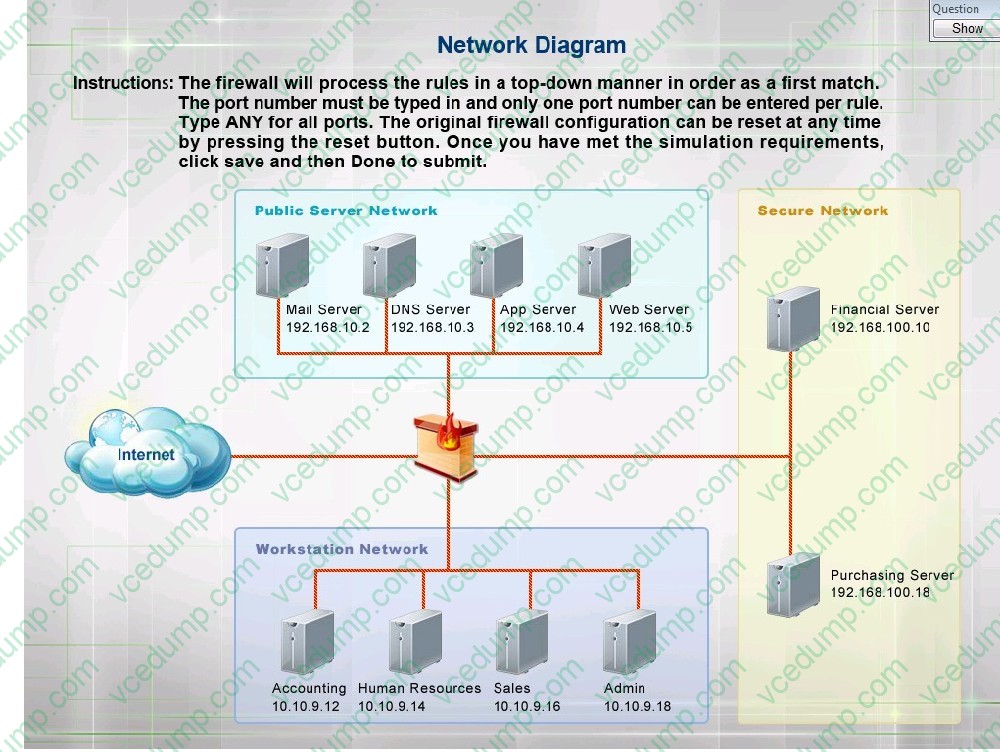
The security administrator has installed a new firewall which implements an implicit DENY policy by default. Click on the firewall and configure it to allow ONLY the following communication.
1.
The Accounting workstation can ONLY access the web server on the public network over the default HTTPS port. The accounting workstation should not access other networks.
2.
The HR workstation should be restricted to communicate with the Financial server ONLY, over the default SCP port
3.
The Admin workstation should ONLY be able to access the servers on the secure network over the default TFTP port.
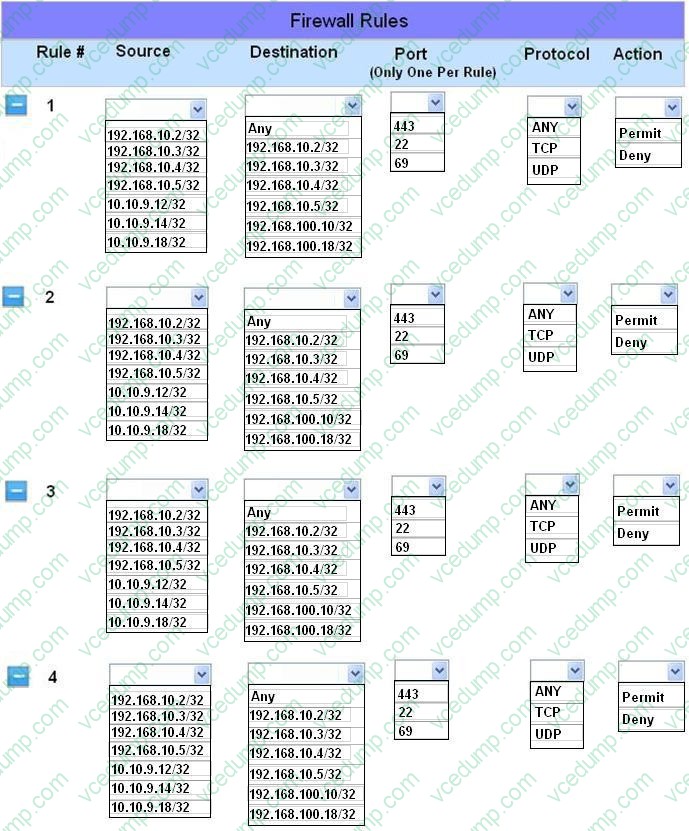
Instructions: The firewall will process the rules in a top-down manner in order as a first match The port number must be typed in and only one port number can be entered per rule Type ANY for all ports. The original firewall configuration can
be reset at any time by pressing the reset button. Once you have met the simulation requirements, click save and then Done to submit.
Hot Area:
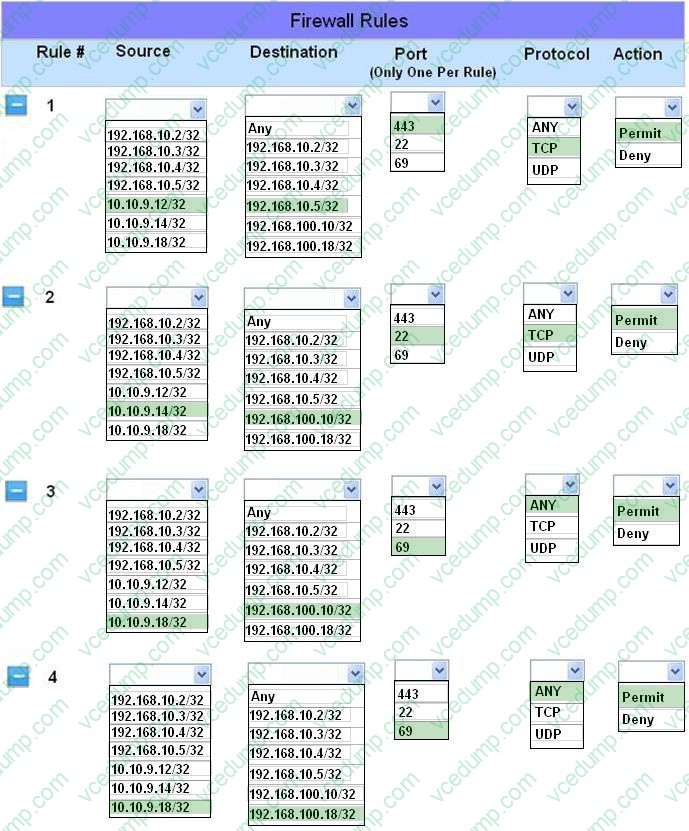
Implicit deny is the default security stance that says if you aren't specifically granted access or privileges for a resource, you're denied access by default. Rule #1 allows the Accounting workstation to ONLY access the web server on the public
network over the default HTTPS port, which is TCP port 443. Rule #2 allows the HR workstation to ONLY communicate with the Financial server over the default SCP port, which is TCP Port 22
Rule #3 and Rule #4 allow the Admin workstation to ONLY access the Financial and Purchasing servers located on the secure network over the default TFTP port, which is Port 69.
Which of the following provides data the best fault tolerance at the LOWEST cost?
A. Load balancing B. Clustering C. Server virtualization D. RAID 6
D. RAID 6 RAID, or redundant array of independent disks (RAID). RAID allows your existing servers to have more than one hard drive so that if the main hard drive fails, the system keeps functioning. RAID can achieve fault tolerance using software which can be done using the existing hardware and software thus representing the lowest cost option. Incorrect Answers: A: Load balancing is a way of providing high availability by splitting the workload across multiple computers. This in itself means more costs if you do not already have the multiple computers. B: Anytime you connect multiple computers to work/act together as a single server, it is known as clustering. Clustered systems utilize parallel processing (improving performance and availability) and add redundancy (but also add costs). C: Virtualization is the foundation for cloud computing. You cannot have cloud computing without virtualization. It makes it possible by abstracting the hardware and making it available to the virtual machines. The abstraction is done through the use of a hypervisor, which can be either Type I (bare metal) or Type II (hosted). It is not a method used for fault tolerance. References: Dulaney, Emmett and Chuck Eastton, CompTIA Security+ Study Guide, Sixth Edition, Sybex, Indianapolis, 2014, pp 234-235
Question 659:
Which of the following results in datacenters with failed humidity controls? (Select TWO).
A. Excessive EMI B. Electrostatic charge C. Improper ventilation D. Condensation E. Irregular temperature
B. Electrostatic charge D. Condensation Humidity control prevents the buildup of static electricity in the environment. If the humidity drops much below 50 percent, electronic components are extremely vulnerable to damage from electrostatic shock. Most environmental systems also regulate humidity; however, a malfunctioning system can cause the humidity to be almost entirely extracted from a room. Make sure that environmental systems are regularly serviced. Electrostatic damage can occur when humidity levels get too low. Condensation is a direct result from failed humidity levels. Incorrect Answers: A: Excessive EMI is resultant of failed EMI shielding. C: Improper ventilation would be the result of failed HVAC system. E: Irregular temperature would be resultant from failed temperature controls which is part of HVAC system. References: Dulaney, Emmett and Chuck Eastton, CompTIA Security+ Study Guide, Sixth Edition, Sybex, Indianapolis, 2014, p 383
Question 660:
Sara, an application developer, implemented error and exception handling alongside input validation. Which of the following does this help prevent?
A. Buffer overflow B. Pop-up blockers C. Cross-site scripting D. Fuzzing
A. Buffer overflow Buffer overflow is an exploit at programming error, bugs and flaws. It occurs when an application is fed more input data than it is programmed to handle. This may cause the application to terminate or to write data beyond the end of the allocated space in memory. The termination of the application may cause the system to send the data with temporary access to privileged levels in the system, while overwriting can cause important data to be lost. Proper error and exception handling and input validation will help prevent Buffer overflow exploits. Incorrect Answers: B: Pop-up blockers prevent websites from opening new browser windows without the users consent. These are often used for advertisements but can also be used to distribute malicious code. This does not entail error and exception handling alongside input validation. C: Cross-site scripting (XSS) is a form of malicious code-injection attack on a web server in which an attacker injects code into the content sent to website visitors. XSS can be mitigated by implementing patch management on the web server, using firewalls, and auditing for suspicious activity. D: Fuzzing is a software testing technique that involves providing invalid, unexpected, or random data to as inputs to a computer program. The program is then monitored for exceptions such as crashes, or failed validation, or memory leaks. References: http://en.wikipedia.org/wiki/Fuzz_testing Dulaney, Emmett and Chuck Eastton, CompTIA Security+ Study Guide, Sixth Edition, Sybex, Indianapolis, 2014, pp 338, 218 Stewart, James Michael, CompTIA Security+ Review Guide, Sybex, Indianapolis, 2014, pp 192, 197, 229, 246
Nowadays, the certification exams become more and more important and required by more and more
enterprises when applying for a job. But how to prepare for the exam effectively? How to prepare
for the exam in a short time with less efforts? How to get a ideal result and how to find the
most reliable resources? Here on Vcedump.com, you will find all the answers.
Vcedump.com provide not only CompTIA exam questions,
answers and explanations but also complete assistance on your exam preparation and certification
application. If you are confused on your JK0-022 exam preparations
and CompTIA certification application, do not hesitate to visit our
Vcedump.com to find your solutions here.