CompTIA JK0-022 Online Practice
Questions and Exam Preparation
JK0-022 Exam Details
Exam Code
:JK0-022
Exam Name
:CompTIA Security+ Certification
Certification
:CompTIA Security+
Vendor
:CompTIA
Total Questions
:1149 Q&As
Last Updated
:Feb 05, 2025
CompTIA JK0-022 Online Questions &
Answers
Question 601:
Ann, the system administrator, is installing an extremely critical system that can support ZERO downtime. Which of the following BEST describes the type of system Ann is installing?
A. High availability B. Clustered C. RAID D. Load balanced
A. High availability
Question 602:
An administrator needs to renew a certificate for a web server. Which of the following should be submitted to a CA?
A. CSR B. Recovery agent C. Private key D. CRL
A. CSR In public key infrastructure (PKI) systems, a certificate signing request (also CSR or certification request) is a message sent from an applicant to a certificate authority in order to apply for a digital identity certificate. When you renew a certificate you send a CSR to the CA to get the certificate resigned. Incorrect Answers: B: You cannot use a Recovery agent to renew a certificate. A recovery agent is an entity that has the ability to recover a key, key components, or plaintext messages as needed. A recovery is not affected when a user is terminated. C: You cannot submit a private key to the CA. A private or secret key is an encryption/decryption key known only to the party or parties that exchange secret messages. D: A CRL cannot be submitted to a CA. A CRL is a database of revoked keys and signatures. References: Dulaney, Emmett and Chuck Eastton, CompTIA Security+ Study Guide, Sixth Edition, Sybex, Indianapolis, 2014, pp 262, 279-280, 285 http://en.wikipedia.org/wiki/Certificate_signing_request
Question 603:
Which of the following is true about input validation in a client-server architecture, when data integrity is critical to the organization?
A. It should be enforced on the client side only. B. It must be protected by SSL encryption. C. It must rely on the user's knowledge of the application. D. It should be performed on the server side.
D. It should be performed on the server side. Client-side validation should only be used to improve user experience, never for security purposes. A client-side input validation check can improve application performance by catching malformed input on the client and, therefore, saving a roundtrip to the server. However, client side validation can be easily bypassed and should never be used for security purposes. Always use server-side validation to protect your application from malicious attacks. Incorrect Answers: A: Client side validation is recommended to improve the user experience. However, it can be easily bypassed and should never be used for security purposes. B: SSL encryption is used for sending data securely between a client and a server. However, it is not used for input validation. C: Input validation must NOT rely on the user's knowledge of the application. If fact, it should assume a lack of knowledge on the user's part. References: http://web.securityinnovation.com/appsec-weekly/blog/bid/67936/Do-Not-Rely-on-Client-Side- Validation
Question 604:
Which of the following will help prevent smurf attacks?
A. Allowing necessary UDP packets in and out of the network B. Disabling directed broadcast on border routers C. Disabling unused services on the gateway firewall D. Flash the BIOS with the latest firmware
B. Disabling directed broadcast on border routers
Question 605:
Which of the following technologies uses multiple devices to share work?
A. Switching B. Load balancing C. RAID D. VPN concentrator
B. Load balancing Load balancing is a way of providing high availability by splitting the workload across multiple computers. Incorrect Answers: A: Switching means making use of a multiport device / not many devices to share work. C: RAID or redundant array of independent disks (RAID). RAID allows your existing servers to have more than one hard drive so that if the main hard drive fails, the system keeps functioning. D: VPN concentrator is a hardware device that is used to create remote access VPNs. References: Dulaney, Emmett and Chuck Eastton, CompTIA Security+ Study Guide, Sixth Edition, Sybex, Indianapolis, 2014, pp 234-235
Question 606:
The security administrator is observing unusual network behavior from a workstation. The workstation is communicating with a known malicious destination over an encrypted tunnel. A full antivirus scan, with an updated antivirus definition file,
does not show any signs of infection.
Which of the following has happened on the workstation?
A. Zero-day attack B. Known malware infection C. Session hijacking D. Cookie stealing
A. Zero-day attack The vulnerability was unknown in that the full antivirus scan did not detect it. This is zero day vulnerability. A zero day vulnerability refers to a hole in software that is unknown to the vendor. This security hole is then exploited by hackers before the vendor becomes aware and hurries to fix it--this exploit is called a zero day attack. Uses of zero day attacks can include infiltrating malware, spyware or allowing unwanted access to user information. The term "zero day" refers to the unknown nature of the hole to those outside of the hackers, specifically, the developers. Once the vulnerability becomes known, a race begins for the developer, who must protect users. Incorrect Answers: B: This is not a known malware infection. The vulnerability was unknown because the full antivirus scan did not detect it. Therefore, this answer is incorrect. C: In computer science, session hijacking, sometimes also known as cookie hijacking is the exploitation of a valid computer session--sometimes also called a session key--to gain unauthorized access to information or services in a computer system. In particular, it is used to refer to the theft of a magic cookie used to authenticate a user to a remote server. It has particular relevance to web developers, as the HTTP cookies used to maintain a session on many web sites can be easily stolen by an attacker using an intermediary computer or with access to the saved cookies on the victim's computer. This is not what is described in this question. Therefore, this answer is incorrect. D: Cookie stealing is another name for session hijacking. In computer science, session hijacking, sometimes also known as cookie hijacking is the exploitation of a valid computer session--sometimes also called a session key--to gain unauthorized access to information or services in a computer system. In particular, it is used to refer to the theft of a magic cookie used to authenticate a user to a remote server. It has particular relevance to web developers, as the HTTP cookies used to maintain a session on many web sites can be easily stolen by an attacker using an intermediary computer or with access to the saved cookies on the victim's computer. This is not what is described in this question. Therefore, this answer is incorrect. References: http://www.pctools.com/security-news/zero-day-vulnerability/ http://en.wikipedia.org/wiki/Session_hijacking
Question 607:
Which of the following protocols provides for mutual authentication of the client and server?
A. Two-factor authentication B. Radius C. Secure LDAP D. Biometrics
C. Secure LDAP C: The LDAP directory service is based on a client-server model. The function of LDAP is to enable access to an existing directory. Because it is a client-server model it makes provision for mutual authentication between the two parties. Incorrect Answers: A: Two-factor authentication refers to an authentication method used to gain access, not a protocol. B: Remote Authentication Dial-In User Service (RADIUS) is a mechanism that allows authentication of remote and other network connections. You should use RADIUS when you want to improve network security by implementing a single service to authenticate users who connect remotely to the network. D: Biometrics is a physical security measure which makes use of some kind of unique biological trait as a means of identification. It is not a protocol. References: Dulaney, Emmett and Chuck Eastton, CompTIA Security+ Study Guide, Sixth Edition, Sybex, Indianapolis, 2014, pp 154, 147, 375. https://msdn.microsoft.com/en-us/library/aa367008%28v=vs.85%29.aspx
Question 608:
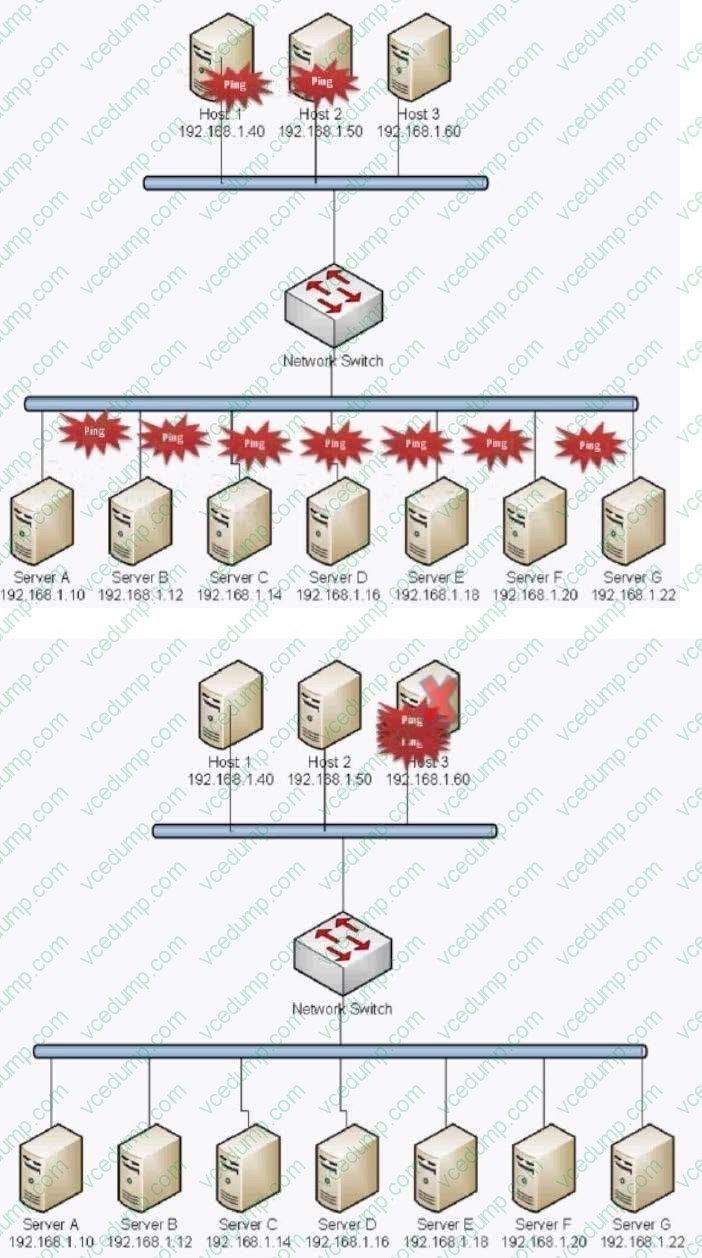
Which of the following BEST describes the type of attack that is occurring?
A. Smurf Attack B. Man in the middle C. Backdoor D. Replay E. Spear Phishing F. Xmas Attack G. Blue Jacking H. Ping of Death
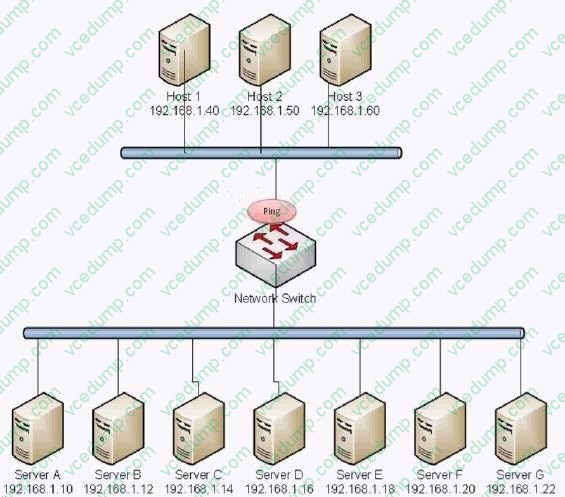
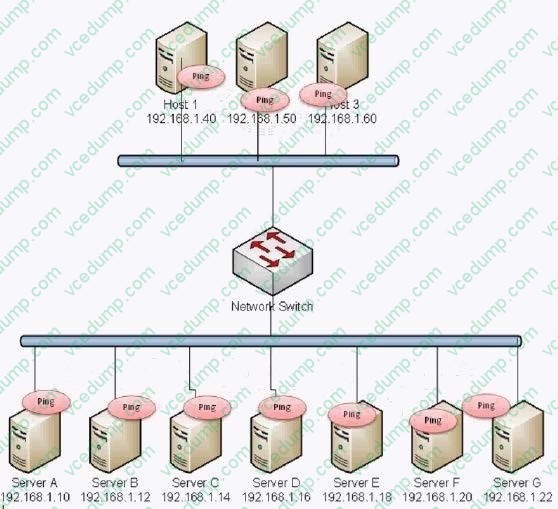
A. Smurf Attack The exhibit shows that all the computers on the network are being `pinged'. This indicates that the ping request was sent to the network broadcast address. We can also see that all the replies were received by one (probably with a spoofed address) host on the network. This is typical of a smurf attack. A smurf attack is a type of network security breach in which a network connected to the Internet is swamped with replies to ICMP echo (PING) requests. A smurf attacker sends PING requests to an Internet broadcast address. These are special addresses that broadcast all received messages to the hosts connected to the subnet. Each broadcast address can support up to 255 hosts, so a single PING request can be multiplied 255 times. The return address of the request itself is spoofed to be the address of the attacker's victim. All the hosts receiving the PING request reply to this victim's address instead of the real sender's address. A single attacker sending hundreds or thousands of these PING messages per second can fill the victim's T-1 (or even T-3) line with ping replies, bring the entire Internet service to its knees. Smurfing falls under the general category of Denial of Service attacks -- security attacks that don't try to steal information, but instead attempt to disable a computer or network. Incorrect Answers: B: In cryptography and computer security, a man-in-the-middle attack (often abbreviated to MITM, MitM, MIM, MiM or MITMA) is an attack where the attacker secretly relays and possibly alters the communication between two parties who believe they are directly communicating with each other. One example is active eavesdropping, in which the attacker makes independent connections with the victims and relays messages between them to make them believe they are talking directly to each other over a private connection, when in fact the entire conversation is controlled by the attacker. The attacker must be able to intercept all relevant messages passing between the two victims and inject new ones. This is straightforward in many circumstances; for example, an attacker within reception range of an unencrypted Wi-Fi wireless access point, can insert himself as a man-in-the-middle. This is not the attack illustrated in this question. Therefore, this answer is incorrect. C: A backdoor in a computer system (or cryptosystem or algorithm) is a method of bypassing normal authentication, securing unauthorized remote access to a computer, obtaining access to plaintext, and so on, while attempting to remain undetected. The backdoor may take the form of an installed program (e.g., Back Orifice) or may subvert the system through a rootkit. This is not the attack illustrated in this question. Therefore, this answer is incorrect. D: A replay attack (also known as playback attack) is a form of network attack in which a valid data transmission is maliciously or fraudulently repeated or delayed. This is carried out either by the originator or by an adversary who intercepts the data and retransmits it, possibly as part of a masquerade attack by IP packet substitution (such as stream cipher attack). For example: Suppose Alice wants to prove her identity to Bob. Bob requests her password as proof of identity, which Alice dutifully provides (possibly after some transformation like a hash function); meanwhile, Eve is eavesdropping on the conversation and keeps the password (or the hash). After the interchange is over, Eve (posing as Alice) connects to Bob; when asked for a proof of identity, Eve sends Alice's password (or hash) read from the last session, which Bob accepts thus granting access to Eve. This is not the attack illustrated in this question. Therefore, this answer is incorrect. E: Spear phishing is an e-mail spoofing fraud attempt that targets a specific organization, seeking unauthorized access to confidential data. As with the e-mail messages used in regular phishing expeditions, spear phishing messages appear to come from a trusted source. Phishing messages usually appear to come from a large and well-known company or Web site with a broad membership base, such as eBay or PayPal. In the case of spear phishing, however, the apparent source of the e-mail is likely to be an individual within the recipient's own company and generally someone in a position of authority. This is not the attack illustrated in this question. Therefore, this answer is incorrect. F: In information technology, a Christmas tree packet is a packet with every single option set for whatever protocol is in use. The term derives from a fanciful image of each little option bit in a header being represented by a different-colored light bulb, all turned on, as in, "the packet was lit up like a Christmas tree." It can also be known as a kamikaze packet, nastygram or a lamp test segment. Christmas tree packets can be used as a method of divining the underlying nature of a TCP/IP stack by sending the packets and awaiting and analyzing the responses. When used as part of scanning a system, the TCP header of a Christmas tree packets has the flags SYN, FIN, URG and PSH set. Many operating systems implement their compliance with the Internet Protocol standard (RFC 791) in varying or incomplete ways. By observing how a host responds to an odd packet, such as a Christmas tree packet, assumptions can be made regarding the host's operating system. Versions of Microsoft Windows, BSD/OS, HP-UX, Cisco IOS, MVS, and IRIX display behaviors that differ from the RFC standard when queried with said packets. A large number of Christmas tree packets can also be used to conduct a DoS attack by exploiting the fact that Christmas tree packets require much more processing by routers and end-hosts than the 'usual' packets do. Christmas tree packets can be easily detected by intrusion-detection systems or more advanced firewalls. From a network security point of view, Christmas tree packets are always suspicious and indicate a high probability of network reconnaissance activities. This is not the attack illustrated in this question. Therefore, this answer is incorrect. G: Bluejacking is the sending of unsolicited messages over Bluetooth to Bluetooth-enabled devices such as mobile phones, PDAs or laptop computers, sending a vCard which typically contains a message in the name field (i.e., for bluedating or bluechat) to another Bluetooth- enabled device via the OBEX protocol. Bluetooth has a very limited range, usually around 10 metres (32.8 ft) on mobile phones, but laptops can reach up to 100 metres (328 ft) with powerful (Class 1) transmitters. Bluejacking is usually harmless, but because bluejacked people generally don't know what has happened, they may think that their phone is malfunctioning. Usually, a bluejacker will only send a text message, but with modern phones it's possible to send images or sounds as well. Bluejacking has been used in guerrilla marketing campaigns to promote advergames. This is not the attack illustrated in this question. Therefore, this answer is incorrect. H: A ping of death is a type of attack on a computer that involves sending a malformed or otherwise malicious ping to a computer. A correctly formed ping message is typically 56 bytes in size, or 84 bytes when the Internet Protocol [IP] header is considered. Historically, many computer systems could not properly handle a ping packet larger than the maximum IPv4 packet size of 65535bytes. Larger packets could crash the target computer. In early implementations of TCP/IP, this bug was easy to exploit. This exploit affected a wide variety of systems, including Unix, Linux, Mac, Windows, printers, and routers. Generally, sending a 65,536-byte ping packet violates the Internet Protocol as documented in RFC 791, but a packet of such a size can be sent if it is fragmented; when the target computer reassembles the packet, a buffer overflow can occur, which often causes a system crash. Later a different kind of ping attack became widespread--ping flooding simply floods the victim with so much ping traffic that normal traffic fails to reach the system, a basic denial-of-service attack. The exhibit shows that all the computers on the network are being `pinged'. This indicates that the ping request was sent to the network broadcast address. This is more typical of a smurf attack than a ping of death attack. Therefore, this answer is incorrect. References: http://www.webopedia.com/TERM/S/smurf.html http://en.wikipedia.org/wiki/Man-in-the-middle_attack http://en.wikipedia.org/wiki/Backdoor_%28computing%29 http://en.wikipedia.org/wiki/Replay_attack http://searchsecurity.techtarget.com/definition/spear-phishing http://en.wikipedia.org/wiki/Christmas_tree_packet http://en.wikipedia.org/wiki/Bluejacking http://en.wikipedia.org/wiki/Ping_of_death
Question 609:
A technician wants to implement a dual factor authentication system that will enable the organization to authorize access to sensitive systems on a need-to-know basis. Which of the following should be implemented during the authorization stage?
A. Biometrics B. Mandatory access control C. Single sign-on D. Role-based access control
A. Biometrics This question is asking about "authorization", not authentication. Mandatory access control (MAC) is a form of access control commonly employed by government and military environments. MAC specifies that access is granted based on a set of rules rather than at the discretion of a user. The rules that govern MAC are hierarchical in nature and are often called sensitivity labels, security domains, or classifications. MAC can also be deployed in private sector or corporate business environments. Such cases typically involve the following four security domain levels (in order from least sensitive to most sensitive): Public Sensitive Private Confidential A MAC environment works by assigning subjects a clearance level and assigning objects a sensitivity label--in other words, everything is assigned a classification marker. Subjects or users are assigned clearance levels. The name of the clearance level is the same as the name of the sensitivity label assigned to objects or resources. A person (or other subject, such as a program or a computer system) must have the same or greater assigned clearance level as the resources they wish to access. In this manner, access is granted or restricted based on the rules of classification (that is, sensitivity labels and clearance levels). MAC is named as it is because the access control it imposes on an environment is mandatory. Its assigned classifications and the resulting granting and restriction of access can't be altered by users. Instead, the rules that define the environment and judge the assignment of sensitivity labels and clearance levels control authorization. MAC isn't a very granularly controlled security environment. An improvement to MAC includes the use of need to know: a security restriction where some objects (resources or data) are restricted unless the subject has a need to know them. The objects that require a specific need to know are assigned a sensitivity label, but they're compartmentalized from the rest of the objects with the same sensitivity label (in the same security domain). The need to know is a rule in and of itself, which states that access is granted only to users who have been assigned work tasks that require access to the cordoned-off object. Even if users have the proper level of clearance, without need to know, they're denied access. Need to know is the MAC equivalent of the principle of least privilege from DAC Incorrect Answers: A: Biometrics is used in authentication. Biometrics includes fingerprints and retina scans. This question is asking about "authorization", which generally comes after authentication. C: Single sign-on is used to access multiple systems with a single login. Single sign-on is used for authentication, not authorization. D: Role-based access control (RBAC) defines access to resources based on job role. We need to authorize access to sensitive systems on a need-to-know basis. Therefore, the default access should be "no access" unless the person can prove a `need to know'. RBAC would give everyone performing a role access to the sensitive system. References: Stewart, James Michael, CompTIA Security+ Review Guide, Sybex, Indianapolis, 2014, pp 278- 284.
Question 610:
A security administrator notices large amounts of traffic within the network heading out to an external website. The website seems to be a fake bank site with a phone number that when called, asks for sensitive information. After further investigation, the security administrator notices that a fake link was sent to several users. This is an example of which of the following attacks?
A. Vishing B. Phishing C. Whaling D. SPAM E. SPIM
B. Phishing Phishing is the act of sending an email to a user falsely claiming to be an established legitimate enterprise in an attempt to scam the user into surrendering private information that will be used for identity theft. Phishing email will direct the user to visit a website where they are asked to update personal information, such as a password, credit card, social security, or bank account numbers, that the legitimate organization already has. The website, however, is bogus and set up only to steal the information the user enters on the page. Phishing emails are blindly sent to thousands, if not millions of recipients. By spamming large groups of people, the "phisher" counts on the email being read by a percentage of people who actually have an account with the legitimate company being spoofed in the email and corresponding webpage. Phishing, also referred to as brand spoofing or carding, is a variation on "fishing," the idea being that bait is thrown out with the hopes that while most will ignore the bait, some will be tempted into biting. Incorrect Answers: A: Vishing is the telephone equivalent of phishing. Vishing is the act of using the telephone in an attempt to scam the user into surrendering private information that will be used for identity theft. The scammer calls the victim, usually pretending to be a legitimate business and fools the victim into thinking he or she will profit. The question states that a fake link was sent to several users (probably by email). Therefore, this is not the correct answer. C: Whaling is a specific kind of malicious hacking within the more general category of phishing, which involves hunting for data that can be used by the hacker. In general, phishing efforts are focused on collecting personal data about users. In whaling, the targets are high-ranking bankers, executives or others in powerful positions or job titles. Hackers who engage in whaling often describe these efforts as "reeling in a big fish," applying a familiar metaphor to the process of scouring technologies for loopholes and opportunities for data theft. Those who are engaged in whaling may, for example, hack into specific networks where these powerful individuals work or store sensitive data. They may also set up keylogging or other malware on a work station associated with one of these executives. There are many ways that hackers can pursue whaling, leading C-level or top-level executives in business and government to stay vigilant about the possibility of cyber threats. The question states that a fake link was sent to several users (probably by email). As the email was sent to general users rather than upper management, this is not the correct answer. D: Spam is most often considered to be electronic junk mail or junk newsgroup postings. Some people define spam even more generally as any unsolicited email. However, if a long-lost brother finds your email address and sends you a message, this could hardly be called spam, even though it is unsolicited. Real spam is generally email advertising for some product sent to a mailing list or newsgroup. In addition to wasting people's time with unwanted e-mail, spam also eats up a lot of network bandwidth. Consequently, there are many organizations, as well as individuals, who have taken it upon themselves to fight spam with a variety of techniques. But because the Internet is public, there is really little that can be done to prevent spam, just as it is impossible to prevent junk mail. However, some online services have instituted policies to prevent spammers from spamming their subscribers. Spam is usually marketing for legitimate businesses, not fake imitation web sites. Therefore, this is not the correct answer. E: SPIM is a term sometimes used to refer to spam over IM (Instant Messaging). It's also called just spam, instant spam, or IM marketing. No matter what the name, it consists of unwanted messages transmitted through some form of instant messaging service, which can include Short Message Service (SMS). The question states that a fake link was sent to several users (probably by email). Therefore, this is not the correct answer. References: http://www.webopedia.com/TERM/P/phishing.html http://www.webopedia.com/TERM/V/vishing.html http://www.techopedia.com/definition/28643/whaling http://www.webopedia.com/TERM/S/spam.html
Nowadays, the certification exams become more and more important and required by more and more
enterprises when applying for a job. But how to prepare for the exam effectively? How to prepare
for the exam in a short time with less efforts? How to get a ideal result and how to find the
most reliable resources? Here on Vcedump.com, you will find all the answers.
Vcedump.com provide not only CompTIA exam questions,
answers and explanations but also complete assistance on your exam preparation and certification
application. If you are confused on your JK0-022 exam preparations
and CompTIA certification application, do not hesitate to visit our
Vcedump.com to find your solutions here.