CompTIA JK0-022 Online Practice
Questions and Exam Preparation
JK0-022 Exam Details
Exam Code
:JK0-022
Exam Name
:CompTIA Security+ Certification
Certification
:CompTIA Security+
Vendor
:CompTIA
Total Questions
:1149 Q&As
Last Updated
:Feb 05, 2025
CompTIA JK0-022 Online Questions &
Answers
Question 1041:
A system administrator wants to enable WPA2 CCMP. Which of the following is the only encryption used?
A. RC4 B. DES C. 3DES D. AES
D. AES Cipher Block Chaining Message Authentication Code Protocol (CCMP) makes use of 128-bit AES encryption with a 48-bit initialization vector. Incorrect Answers: A, B, C: These are not used by CCMP References: Dulaney, Emmett and Chuck Eastton, CompTIA Security+ Study Guide, Sixth Edition, Sybex, Indianapolis, 2014, pp 172, 250.
Question 1042:
What is the term for the process of luring someone in (usually done by an enforcement officer or a government agent)?
A. Enticement B. Entrapment C. Deceit D. Sting
A. Enticement Enticement is the process of luring someone into your plan or trap. Incorrect Answers: B: Entrapment is the process in which a law enforcement officer or a government agent encourages or induces a person to commit a crime when the potential criminal expresses a desire not to go ahead. Entrapment is a valid legal defense in a criminal prosecution. C: Deceit is an act to propagate beliefs of things that are not true. D: According to Wikipedia a sting is a deceptive operation designed to catch a person committing a crime. Almost akin to setting a honey trap. References: Dulaney, Emmett and Chuck Eastton, CompTIA Security+ Study Guide, Sixth Edition, Sybex, Indianapolis, 2014, p 65 http://en.wikipedia.org/wiki/Sting_operation
Question 1043:
A technician wants to verify the authenticity of the system files of a potentially compromised system. Which of the following can the technician use to verify if a system file was compromised? (Select TWO).
A. AES B. PGP C. SHA D. MD5 E. ECDHE
C. SHA D. MD5
Question 1044:
Joe, a network security engineer, has visibility to network traffic through network monitoring tools.
However, he's concerned that a disgruntled employee may be targeting a server containing the company's financial records. Which of the following security mechanism would be MOST appropriate to confirm Joe's suspicion?
A. HIDS B. HIPS C. NIPS D. NIDS
A. HIDS A host-based IDS (HIDS) is an intrusion detection system that runs as a service on a host computer system. It is used to monitor the machine logs, system events, and application activity for signs of intrusion. It is useful for detecting attacks that originate outside the organization as well as attacks by internal users logged on to the system. Incorrect Answers: B: A host-based IPS (HIPS) is an intrusion detection and prevention system that runs as a service on a host computer system. It is used to monitor the machine logs, system events, and application activity for signs of intrusion. C: A network-based IPS (NIPS) is an intrusion detection and prevention system that scans network traffic in real time against a database of attack signatures. It is useful for detecting and responding to network-based attacks originating from outside the organization. D: A network-based IDS (NIDS) is an intrusion detection system that scans network traffic in real time and is useful for detecting network-based attacks originating from outside the organization. References: Dulaney, Emmett and Chuck Eastton, CompTIA Security+ Study Guide, Sixth Edition, Sybex, Indianapolis, 2014, pp 111-112, 116-117 Stewart, James Michael, CompTIA Security+ Review Guide, Sybex, Indianapolis, 2014, pp 13-16
Question 1045:
Which of the following would Matt, a security administrator, use to encrypt transmissions from an internal database to an internal server, keeping in mind that the encryption process must add as little latency to the process as possible?
A. ECC B. RSA C. SHA D. 3DES
D. 3DES 3DES would be less secure compared to ECC, but 3DES would require less computational power. Triple-DES (3DES) is a technological upgrade of DES. 3DES is still used, even though AES is the preferred choice for government applications. 3DES is considerably harder to break than many other systems, and it's more secure than DES. It increases the key length to 168 bits (using three 56-bit DES keys). Incorrect Answers: A: Elliptic Curve Cryptography (ECC) provides similar functionality to RSA but uses smaller key sizes to obtain the same level of security. ECC encryption systems are based on the idea of using points on a curve combined with a point at infinity and the difficulty of solving discrete logarithm problems. B: The RSA algorithm is an early public-key encryption system that uses large integers as the basis for the process. RSA encryption and decryption would require more computation compared to 3DES. C: SHA is not an encryption algorithm. The Secure Hash Algorithm (SHA) was designed to ensure the integrity of a message. References: Dulaney, Emmett and Chuck Eastton, CompTIA Security+ Study Guide, Sixth Edition, Sybex, Indianapolis, 2014, pp 250, 251, 253, 255, 255-256
Question 1046:
Which of the following is true about asymmetric encryption?
A. A message encrypted with the private key can be decrypted by the same key B. A message encrypted with the public key can be decrypted with a shared key. C. A message encrypted with a shared key, can be decrypted by the same key. D. A message encrypted with the public key can be decrypted with the private key.
D. A message encrypted with the public key can be decrypted with the private key. Asymmetric algorithms use two keys to encrypt and decrypt data. These asymmetric keys are referred to as the public key and the private key. The sender uses the public key to encrypt a message, and the receiver uses the private key to decrypt the message; what one key does, the other one undoes. Incorrect Answers: A: The message is encrypted with a public key, not with a private key. B: The message is decrypted with a private key, not with a shared key. C: The message is encrypted with a public key, not with a shared key. References: Dulaney, Emmett and Chuck Eastton, CompTIA Security+ Study Guide, Sixth Edition, Sybex, Indianapolis, 2014, pp 251-254
Question 1047:
Which of the following can be used on a smartphone to BEST protect against sensitive data loss if the device is stolen? (Select TWO).
A. Tethering B. Screen lock PIN C. Remote wipe D. Email password E. GPS tracking F. Device encryption
C. Remote wipe F. Device encryption C: Remote wipe is the process of deleting data on a device in the event that the device is stolen. This is performed over remote connections such as the mobile phone service or the internet connection and helps ensure that sensitive data is not accessed by unauthorized people. F: Device encryption encrypts the data on the device. This feature ensures that the data on the device cannot be accessed in a useable form should the device be stolen. Incorrect Answers: A: Device tethering is the process of connecting one device to another over a wireless LAN (Wi- Fi) or Bluetooth connection or by using a cable. This allows the tethered devices to share an Internet connection. It does not protect the device against data loss in the event of the device being stolen. B: Screen locks are a security feature that requires the user to enter a PIN or a password after a short period of inactivity before they can access the system again. This feature ensures that if your device is left unattended or is lost or stolen, it will be a bit difficult for anyone else to access your data or applications. However, screen locks may have workarounds, such as accessing the phone application through the emergency calling feature. D: Some email applications allow users to set a password on an email that could be shared with the recipient. This does not protect against sensitive data loss if the device is stolen. E: Global Positioning System (GPS) tracking can be used to identify its location of a stolen device and can allow authorities to locate the device. However, for GPS tracking to work, the device must have an Internet connection or a wireless phone service over which to send its location information. References: Dulaney, Emmett and Chuck Eastton, CompTIA Security+ Study Guide, Sixth Edition, Sybex, Indianapolis, 2014, pp 418-419 Stewart, James Michael, CompTIA Security+ Review Guide, Sybex, Indianapolis, 2014, pp 236,
Question 1048:
Which of the following, if properly implemented, would prevent users from accessing files that are unrelated to their job duties? (Select TWO).
A. Separation of duties B. Job rotation C. Mandatory vacation D. Time of day restrictions E. Least privilege
A. Separation of duties E. Least privilege
Question 1049:
Which of the following is used to certify intermediate authorities in a large PKI deployment?
A. Root CA B. Recovery agent C. Root user D. Key escrow
A. Root CA The root CA certifies other certification authorities to publish and manage certificates within the organization. In a hierarchical trust model, also known as a tree, a root CA at the top provides all of the information. The intermediate CAs are next in the hierarchy, and they trust only information provided by the root CA. The root CA also trusts intermediate CAs that are in their level in the hierarchy and none that aren't. This arrangement allows a high level of control at all levels of the hierarchical tree. . Incorrect Answers: B: A recovery agent is an entity that has the ability to recover a key, key components, or plaintext messages as needed. A recovery agent does not certify entities. C: The root is the user name or account that by default has access to all commands and files on a Linux or other Unix-like operating system. The root user does not certify entities. D: Key escrow is not related to certifying authorities. Key escrow addresses the possibility that a third party may need to access keys. Under the conditions of key escrow, the keys needed to encrypt/decrypt data are held in an escrow account (think of the term as it relates to home mortgages) and made available if that third party requests them. The third party in question is generally the government, but it could also be an employer if an employee's private messages have been called into question. References: Dulaney, Emmett and Chuck Eastton, CompTIA Security+ Study Guide, Sixth Edition, Sybex, Indianapolis, 2014, pp 262, 278-290
Question 1050:
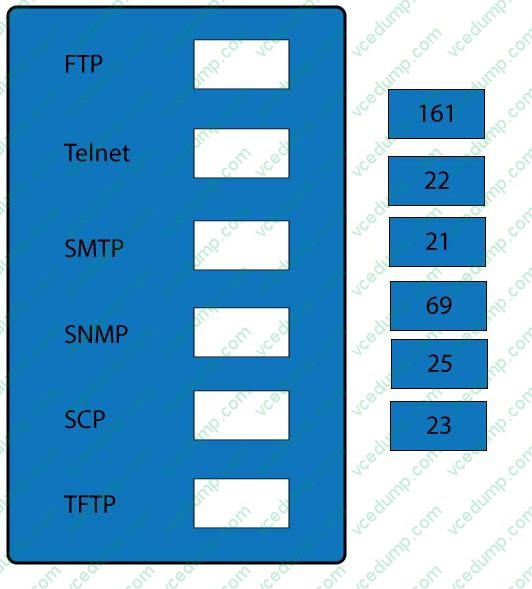
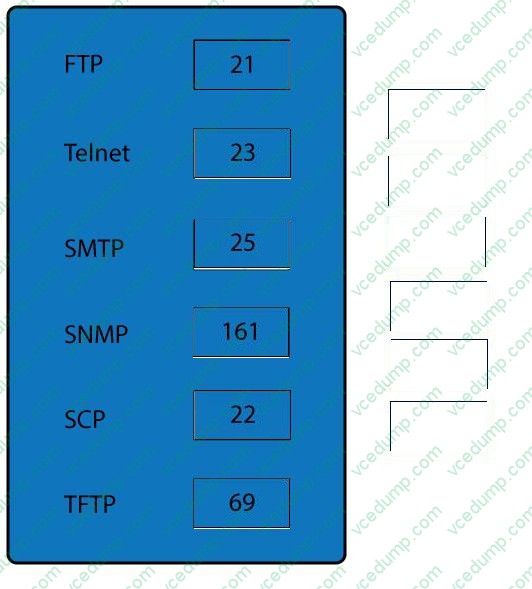
Drag and drop the correct protocol to its default port.
Select and Place:
FTP uses TCP port 21.
Telnet uses port 23.
SSH uses TCP port 22. All protocols encrypted by SSH, including SFTP, SHTTP, SCP, SExec, and slogin, also use TCP port 22. Secure Copy Protocol (SCP) is a
secure file-transfer facility based on SSH and Remote Copy Protocol (RCP). Secure FTP (SFTP) is a secured alternative to standard File Transfer Protocol (FTP).
Nowadays, the certification exams become more and more important and required by more and more
enterprises when applying for a job. But how to prepare for the exam effectively? How to prepare
for the exam in a short time with less efforts? How to get a ideal result and how to find the
most reliable resources? Here on Vcedump.com, you will find all the answers.
Vcedump.com provide not only CompTIA exam questions,
answers and explanations but also complete assistance on your exam preparation and certification
application. If you are confused on your JK0-022 exam preparations
and CompTIA certification application, do not hesitate to visit our
Vcedump.com to find your solutions here.