IMANET-CMA Exam Details
-
Exam Code
:IMANET-CMA -
Exam Name
:Certified Management Accountant (CMA) -
Certification
:IMANET Certifications -
Vendor
:IMANET -
Total Questions
:1336 Q&As -
Last Updated
:Jun 01, 2026
IMANET IMANET-CMA Online Questions & Answers
-
Question 651:
A proposed transfer price may be based upon the outlay cost. Outlay cost plus opportunity cost is the
A. Retail price
B. Price representing the cash outflows of the supplying division plus the contribution to the supplying division from an outside sale
C. Price usually set by an absorption-costing calculation
D. Price set by charging for variable costs plus a lump sum or an additional markup, but less than full markup -
Question 652:
Which of the five promotional tools of the marketing communications mix involves lobbying, sponsorship, community outreach, and gifts to charity?
A. Direct marketing.
B. Personal selling.
C. Sales promotions.
D. Public relations. -
Question 653:
The Sommers Company manufactures a vanity of industrial valves. Current', the company is operating at about 70% capacity and is earning a satisfactory return on investment. Management has been approached by Glascow Industries Ltd. of Scotland with an offer to buy 120.000 units of a pressure valve. Glascow manufactures a valve that is almost identical to Sommers' pressure valve; however, a fire in Glascow Industries' valve plant has shut down its manufacturing operations. Glascow needs the 120,000 valves over the next 4 months to meet commitments to its regular customers; the company is prepared to pay $19 each for the valves, FOB shipping point. Sommers' product cost, based on current attainable standards, foi the pressure valve is
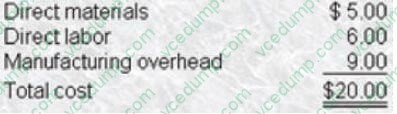
Manufacturing overhead is applied to production at the rate of $18 per standard direct labor hour. This overhead rate is made up of the following components

What is the minimum unit price that Sommers could accept without reducing net income?
A. $14
B. $14. 40
C. $20
D. $20.40 -
Question 654:
The Moore Corporation is considering the acquisition of a new machine. The machine can be purchased for $90,000; twill cost $6,000 to transport to Moore's plant and $9,000 to install. It is estimated that the machine will last 10 years, and it is expected to have an estimated salvage value of $5,000. Over its 10-year life, the machine is expected to produce 2,000 units per year with a selling price of $500 and combined material and labor costs of $450 per unit. Federal tax regulations permit machines of this type to be depreciated using the straight-line method over 5 years with no estimated salvage value. Moore ha a marginal tax rate of 40%. What is the net cash flow for the tenth year of the project that Moore Corporation should use in a capital budgeting analysis?
A. $100,000
B. $81,000
C. $68,400
D. $63,000 -
Question 655:
Which factor most likely encourages entry into an existing market?
A. Governmental subsidies for new investors.
B. High product differentiation, principally produced by trademarks.
C. Knowledge of the industry, wit high investments in development.
D. Low fixed exit costs. -
Question 656:
When calculating a firm's cost of capital, all of the following are true except that
A. The cost of capital of a firm is the weighted average cost of its various financing components.
B. The calculation of the cost of capital should focus on the historical costs of alternative forms of financing rather than market or current costs.
C. All costs should be expressed as after-tax costs.
D. The time value of money should be incorporated into the calculations. -
Question 657:
Several surveys point out that most managers use full product costs, including unit fixed costs and unit variable costs, in developing cost-based pricing. Which one of the following is least associated with cost-based pricing?
A. Price stability
B. Price justification.
C. Target pricing.
D. Fixed-cost recovery. -
Question 658:
Which of the following is not a typical benefit of an outsourcing arrangement?
A. Reduced costs.
B. Access to technology
C. Avoidance of risk of obsolescence
D. Increased control over a necessary function. -
Question 659:
A company obtained a short-term bank loan of $500,000 at an annual interest rate of 8%. As a condition of the loan, the company is required to maintain a compensating balance of $100,000 in its checking account. The checking account earns interest at an annual rate of 3%. Ordinarily, the company maintains a balance of $50,000 in its account for transaction purposes. What is the effective interest rate of the loan?
A. 7. 77%
B. 8.22%
C. 9.25%
D. 8.56% -
Question 660:
Poster Inc. is considering implementing a Lock box collection system at a cost of $80,000 per year. Annual sales are $90 million, and the lockbox system will reduce collection time by 3 days. If Poster can invest funds at 8%, should it use the lockbox system? Assume a 360-day year.
A. Yes, producing savings of $140,000 per year.
B. Yes, producing savings of $60,000 per year.
C. No, producing a loss of $20,000 per year.
D. No, producing a loss of $60,000 per year.
Related Exams:
Tips on How to Prepare for the Exams
Nowadays, the certification exams become more and more important and required by more and more enterprises when applying for a job. But how to prepare for the exam effectively? How to prepare for the exam in a short time with less efforts? How to get a ideal result and how to find the most reliable resources? Here on Vcedump.com, you will find all the answers. Vcedump.com provide not only IMANET exam questions, answers and explanations but also complete assistance on your exam preparation and certification application. If you are confused on your IMANET-CMA exam preparations and IMANET certification application, do not hesitate to visit our Vcedump.com to find your solutions here.