HPE6-A41 Exam Details
-
Exam Code
:HPE6-A41 -
Exam Name
:Applying Aruba Switching Fundamentals for Mobility -
Certification
:HP Certifications -
Vendor
:HP -
Total Questions
:125 Q&As -
Last Updated
:Jul 11, 2026
HP HPE6-A41 Online Questions & Answers
-
Question 11:
Refer to the exhibit.
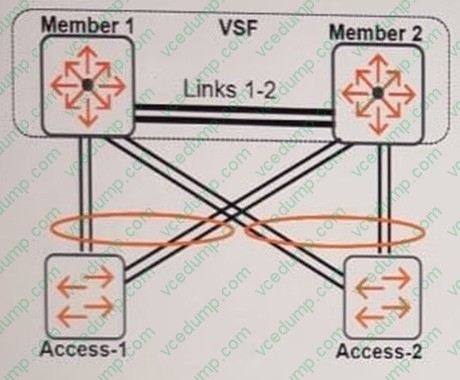
Which feature should the network administrator configure on the Virtual Switching Framework (VSF) fabric to prevent issues if Links 1 and 2 fail?
A. Graceful OSPF (non-stop forwarding)
B. Multi-Active Detection (MAD)
C. Distributed trunking
D. Virtual Router Redundancy Protocol (VRRP) -
Question 12:
A network administrator needs to configure a static route. What should the administrator use as the next hop address?
A. the lowest IP address on the neighboring router in the path towards its destination
B. the IP address on the local interface that is used to egress traffic towards its destination
C. the IP address of the default gateway in the destination subnet
D. the IP address on the connected interface of a neighboring router in the path towards its destination -
Question 13:
Refer to the exhibit.
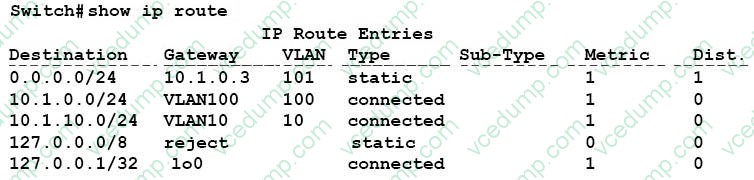
Prior to implementing OSPF on the network, an ArubaOS switch had the IP routing table shown in the exhibit. The network administrator then sets up OSPF in the network. The switch calculates these OSPF routes to 10.1.20.0/24:
Through 10.1.0.1 with cost 3 and administrative distance 110 Through 10.1.0.2 with cost 3 and administrative distance 110
How does the way the switch handles traffic destined to 10.1.20.0/24 change with the introduction of OSPF?
A. The switch stops sending the traffic to 10.1.0.3 and instead load balances it to 10.1.0.1 and 10.1.0.2.
B. The switch no longer drops this traffic and instead load balances it to 10.1.0.1 and 10.1.0.2.
C. The switch continues to send the traffic to 10.1.0.3, but it now has backup routes for the traffic in case the connection to 10.1.0.3 fails.
D. The switch no longer drops this traffic and instead sends it to 10.1.0.1. -
Question 14:
Refer to the exhibit.
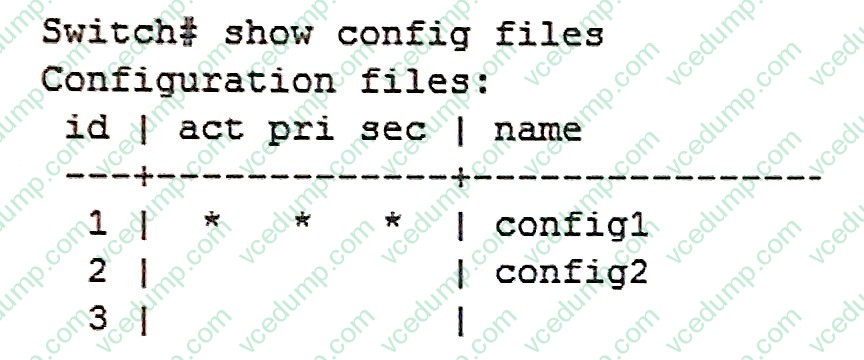
A network administrator views the configuration files on an ArubaOS switch and sees the output in the exhibit. The administrator enters this command:
Switch# boot system flash primary config config2 After the switch boots, the administrator makes some configuration changes and saves the configuration with the write memory command. The administrator then enters this command: Switch# boot
After the switch boots, the configuration changes just made are not present. How can the administrator restore the configuration with the changes?
A. Use the boot set-default command to configure the switch to use the secondary software. Then reboot the switch.
B. Reboot the switch and interrupt the boot process. Find the temporary file with the configuration changes and apply that file to the startup-config.
C. Rename the config2 file to config1. Then reboot the switch.
D. Use the startup-default command to configure the switch to use the config2 file with the primary software. Then reboot the switch. -
Question 15:
A network administrator implements a wireless network that uses three wireless APs. The administrator wants to ensure that users can roam seamlessly from one AP to another. Which type of wireless network should the administrator implement?
A. an ad hoc network that does not use channel bonding
B. an infrastructure network with a different Service Set Identifier (SSID) on each AP
C. an ad hoc network that uses channel bonding
D. an infrastructure network with the same Service Set Identifier (SSID) on each AP -
Question 16:
A network administrator wants to be able to access an Aruba Instant cluster at the same IP address even if the current master fails. How can the administrator achieve this goal?
A. Configure a VC IP address that is a reserved IP address in the AP's subnet.
B. Configure the AirWave IP address in the instant cluster System > Admin settings.
C. Assign static IP addresses, rather than DHCP ones, to all APs in the instant cluster.
D. Assign a static IP addresses, rather than a DHCP one, to the AP that is elected master. -
Question 17:
Which technology can provide automated network optimization for unified communication applications such as Skype for Business?
A. Software-defined Networking (SDN)
B. Zero Touch Provisioning (ZTP)
C. Simple Network Management Protocol (SNMP)
D. Virtual Switching Framework (VSF) -
Question 18:
Refer to the exhibit.
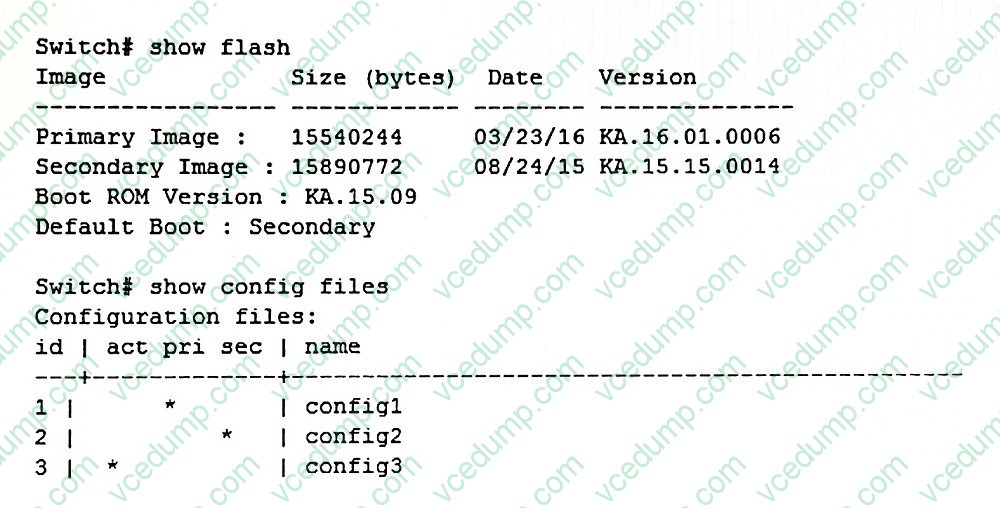
The network administrator enters this command: Switch# reload
Which software and configuration file will load?
A. software version KA.16.01 and config3
B. software version KA.15.15 and config2
C. software version KA.15.15 and config3
D. software version KA.16.01 and config1 -
Question 19:
Refer to the exhibit. Exhibit 1.
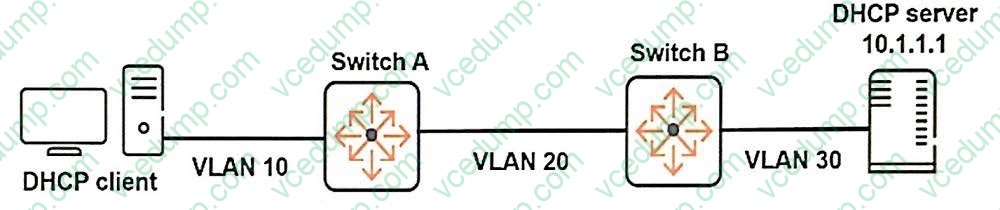
Exhibit 2.
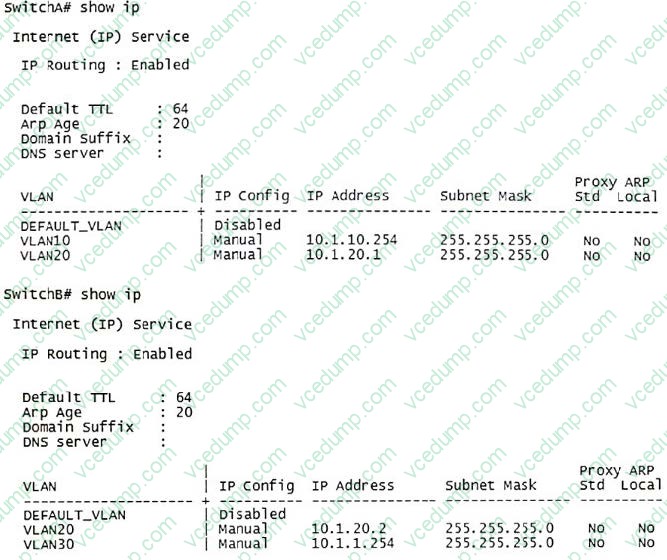
A network administrator needs to set up DHCP relay in a switched network comprised of ArubaOS switches. Switch A and Switch B have the IP settings in Exhibit 2, and no static or dynamic routes. Switch B is the DCHP server's default gateway. The administrator correctly configures the IP helper address on Switch A. However, when the DHCP client attempts to acquire an IP address in VLAN 10, the process fails.
What does the administrator need to do to solve this problem?
A. Configure a static route on Switch A, and enable IP Helper on Switch B.
B. Configure a static route on Switch A.
C. Configure a static route on Switch A and Switch B, and enable IP Helper on Switch B.
D. Configure a static route on Switch A and Switch B. -
Question 20:
Refer to the exhibit.

This switch currently assigns all VLANs to MSTP instance 0 or the Internal Spanning Tree (IST). Which statement correctly describes interface 21?
A. The interface is down at Layer 2; it is not available for sending or receiving any traffic.
B. The interface does not forward or accept data traffic, but it is ready to start forwarding if interface 19 fails.
C. The interface is an edge port but has received Bridge Protocol Data Units (BPDUs), so it is disabled.
D. The interface does not support spanning tree; it is possible that it will introduce a loop in the network.
Related Exams:
-
HP0-003
HP OpenView Service Desk 5.x -
HP0-045
Supporting the ESL E-Series Lobraries -
HP0-052
Planning and Design of HP 9000/HP Integrity Server Solutions -
HP0-053
Enterprise Integration and Management of HP ProLiant Servers -
HP0-054
Compaq/Oracle 8i I and P with Windows NT -
HP0-055
Implementing HP ProLiant Servers -
HP0-058
Configuration and Management of HP Integrity Mid-Range Servers -
HP0-063
LF PROFESSIONAL COLOR WORKFLOW MANAGEMENT -
HP0-064
HP BladeSystems C-Class Solutions 1 -
HP0-065
Planning and Designing ProLiant Solutions for the Enterprise
Tips on How to Prepare for the Exams
Nowadays, the certification exams become more and more important and required by more and more enterprises when applying for a job. But how to prepare for the exam effectively? How to prepare for the exam in a short time with less efforts? How to get a ideal result and how to find the most reliable resources? Here on Vcedump.com, you will find all the answers. Vcedump.com provide not only HP exam questions, answers and explanations but also complete assistance on your exam preparation and certification application. If you are confused on your HPE6-A41 exam preparations and HP certification application, do not hesitate to visit our Vcedump.com to find your solutions here.