FCP_FGT_AD-7.6 Exam Details
-
Exam Code
:FCP_FGT_AD-7.6 -
Exam Name
:FortiGate 7.6 Administrator FCP_FGT_AD-7.6 -
Certification
:Fortinet Certifications -
Vendor
:Fortinet -
Total Questions
:138 Q&As -
Last Updated
:Jul 11, 2026
Fortinet FCP_FGT_AD-7.6 Online Questions & Answers
-
Question 61:
Refer to the exhibit.
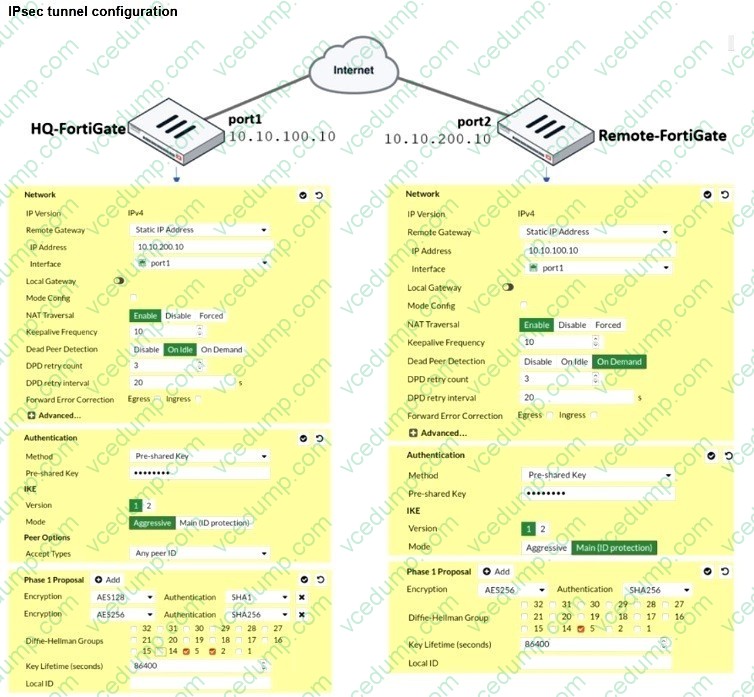
A network administrator is troubleshooting an IPsec tunnel between two FortiGate devices. The administrator has determined that phase 1 failed to come up. The administrator has also re-entered the pre-shared key on both FortiGate devices to make sure they match.
Based on the phase 1 configuration and the diagram shown in the exhibit, which two configuration changes can the administrator make to bring phase 1 up? (Choose two.)
A. On HQ-FortiGate, set IKE mode to Main (ID protection).
B. On Remote-FortiGate, set port2 as Interface.
C. On HQ-FortiGate, disable Diffie-Helman group 2.
D. On both FortiGate devices, set Dead Peer Detection to On Demand. -
Question 62:
Refer to the exhibit.
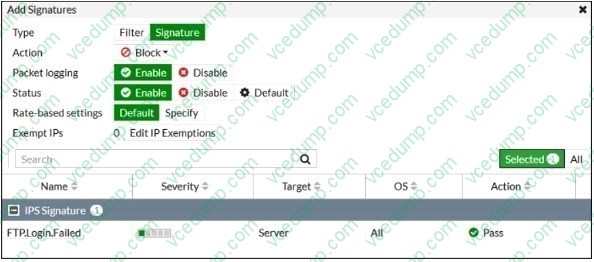
Review the intrusion prevention system (IPS) profile signature settings shown in the exhibit.
What do you conclude when adding the FTP.Login.Failed signature to the IPS sensor profile?
A. Traffic matching the signature will be allowed and logged.
B. The signature setting uses a custom rating threshold.
C. The signature setting includes a group of other signatures.
D. Traffic matching the signature will be silently dropped and logged. -
Question 63:
Refer to the exhibit, which shows a partial configuration from the remote authentication server.

Why does the FortiGate administrator need this configuration?
A. To set up a RADIUS server Secret.
B. To authenticate Any FortiGate user groups.
C. To authenticate and match the Training OU on the RADIUS server.
D. To authenticate only the Training user group. -
Question 64:
Refer to the exhibits, which show the system performance output and the default configuration of high memory usage thresholds in a FortiGate.
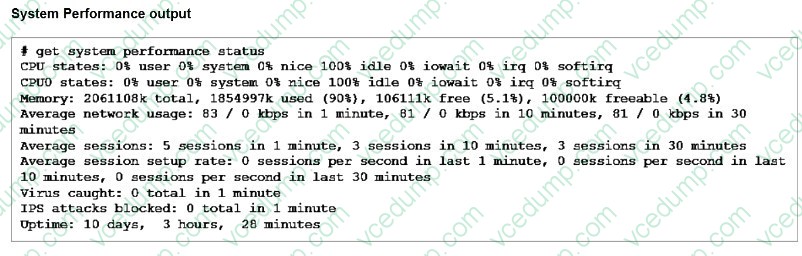
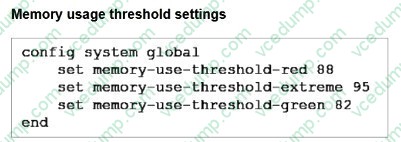
Based on the system performance output, what can be the two possible outcomes? (Choose two.)
A. FortiGate will start sending all files to FortiSandbox for inspection.
B. Administrators can access FortiGate only through the console port.
C. FortiGate has entered conserve mode.
D. Administrators cannot change the configuration. -
Question 65:
Refer to the exhibit.
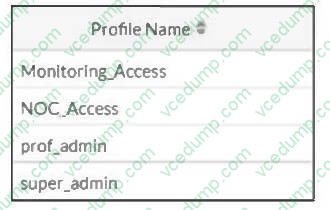
The NOC team connects to the FortiGate GUI with the NOC_Access admin profile. They request that their GUI sessions do not disconnect too early during inactivity.
What must the administrator configure to answer this specific request from the NOC team?
A. Move NOC_Access to the top of the list to ensure all profile settings take effect.
B. Increase the offline value of the Override Idle Timeout parameter in the NOC_Access admin profile.
C. Ensure that all NOC_Access users are assigned the super_admin role to guarantee access
D. Increase the admintimeout value under config system accprofile NOC_Access. -
Question 66:
What is the primary FortiGate election process when the HA override setting is enabled?
A. Connected monitored ports > Priority > HA uptime > FortiGate serial number
B. Connected monitored ports > Priority > System uptime > FortiGate serial number
C. Connected monitored ports > HA uptime > Priority > FortiGate serial number
D. Connected monitored ports > System uptime > Priority > FortiGate serial number -
Question 67:
An administrator wants to analyze and manage digital certificates to prevent browser warnings when users connect to the SSL VPN portal.
Which two statements describe how to correctly do this? (Choose two.)
A. The administrator can rely on the default FortiGate self-signed certificate to prevent all security warnings in the browser.
B. The administrator must disable HTTPS administrative access entirely to avoid certificate warnings.
C. The administrator can use a publicly trusted certificate from a known certificate authority (CA) to stop browser warnings.
D. The administrator can import the FortiGate self-signed certificate into each user's browser as a trusted certificate. -
Question 68:
An administrator needs to ensure that a specific SSL VPN user group is allowed to log in only from countries defined in a geographic object.
Which configuration on FortiGate meets this requirement?
A. Configure a firewall policy with geo-based source address under the SSL root interface
B. Enable source-address-filter in the SSL VPN portal and assign the geographic object
C. Add the geographic object under SSL VPN settings Authentication/Portal Mapping
D. Configure a local-in policy to restrict SSL VPN access based on the geographic object -
Question 69:
Refer to the exhibit.
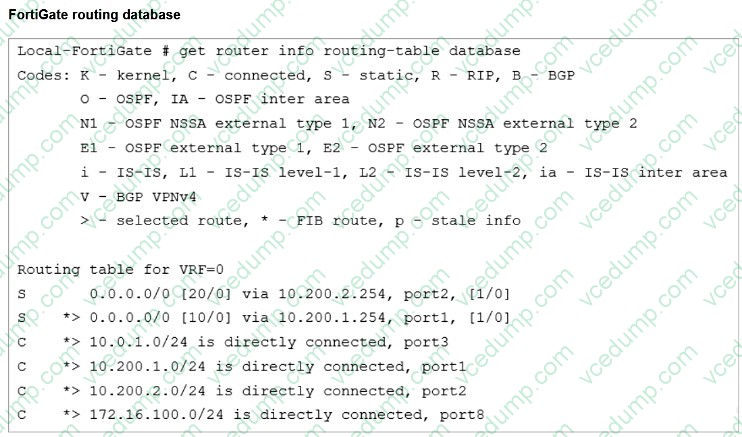
Which two statements are true about the routing entries in this database table? (Choose two.)
A. The default route on port2 is marked as the standby route.
B. Both default routes have different administrative distances.
C. The port2 interface is marked as inactive.
D. All of the entries in the routing database table are installed in the FortiGate routing table -
Question 70:
A network administrator wants to ensure that a specific address object created on the root FortiGate is synchronized to downstream devices in the Security Fabric.
Which configuration is required?
A. Enable object-sync in the downstream FortiGate device
B. Set fabric-object-unification to default on the root FortiGate
C. Enable auto-authorization on all downstream devices
D. Configure the address object as type "Fabric Connector"
Related Exams:
-
EMEA-ADVANCED-SUPPORT
Fortinet EMEA Advanced Support -
FCP_FAC_AD-6.5
FCP - FortiAuthenticator 6.5 Administrator -
FCP_FAZ_AD-7.4
FCP - FortiAnalyzer 7.4 Administrator -
FCP_FAZ_AN-7.4
FCP - FortiAnalyzer 7.4 Analyst -
FCP_FAZ_AN-7.6
Fortinet NSE 5 - FortiAnalyzer 7.6 Analyst -
FCP_FCT_AD-7.2
FCP - Forti Client EMS 7.2 Administrator -
FCP_FCT_AD-7.4
Fortinet NSE 6 - FortiClient EMS 7.4 Administrator -
FCP_FGT_AD-7.4
FCP - FortiGate 7.4 Administrator -
FCP_FGT_AD-7.6
FortiGate 7.6 Administrator FCP_FGT_AD-7.6 -
FCP_FMG_AD-7.4
FCP - FortiManager 7.4 Administrator
Tips on How to Prepare for the Exams
Nowadays, the certification exams become more and more important and required by more and more enterprises when applying for a job. But how to prepare for the exam effectively? How to prepare for the exam in a short time with less efforts? How to get a ideal result and how to find the most reliable resources? Here on Vcedump.com, you will find all the answers. Vcedump.com provide not only Fortinet exam questions, answers and explanations but also complete assistance on your exam preparation and certification application. If you are confused on your FCP_FGT_AD-7.6 exam preparations and Fortinet certification application, do not hesitate to visit our Vcedump.com to find your solutions here.