FCP_FGT_AD-7.6 Exam Details
-
Exam Code
:FCP_FGT_AD-7.6 -
Exam Name
:FortiGate 7.6 Administrator FCP_FGT_AD-7.6 -
Certification
:Fortinet Certifications -
Vendor
:Fortinet -
Total Questions
:138 Q&As -
Last Updated
:Jul 11, 2026
Fortinet FCP_FGT_AD-7.6 Online Questions & Answers
-
Question 111:
Refer to the exhibit.

What can you conclude from the log shown in the exhibit?
A. The IPS scan is paused by the IPS diagnostic command with bypass mode option 5.
B. The IPS socket buffer is full and IPS engine needs more memory to create new sessions.
C. The IPS session scan is paused and reevaluating the packet because of a dirty flag.
D. The IPS socket buffer is full and IPS engine cannot decode a packet. -
Question 112:
An administrator must enable a DHCP server on one of the directly connected networks on FortiGate.
However, the administrator is unable to complete the process on the GUI to enable the service on the interface.
In this scenario, what prevents the administrator from enabling DHCP service?
A. The DHCP server setting is available only on the CLI.
B. Another interface is configured as the only DHCP server on FortiGate.
C. The FortiGate model does not support the DHCP server.
D. The role of the interface prevents setting a DHCP server. -
Question 113:
Refer to the exhibit to view the firewall policy.
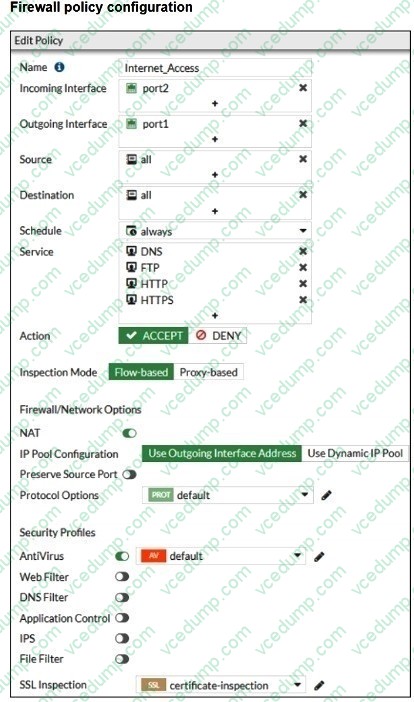
Why would the firewall policy not block a well-known virus, for example eicar?
A. The firewall policy does not apply deep content inspection.
B. Web filter is not enabled on the firewall policy to complement the antivirus profile.
C. The firewall policy is not configured in proxy-based inspection mode.
D. The action on the firewall policy is not set to deny. -
Question 114:
Refer to the exhibits.
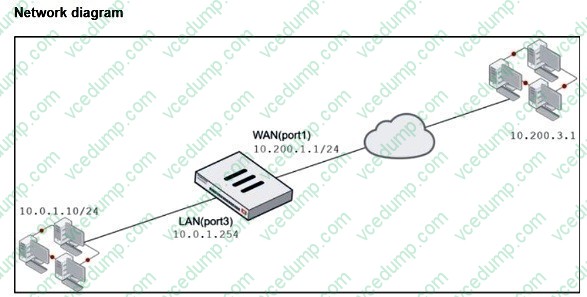
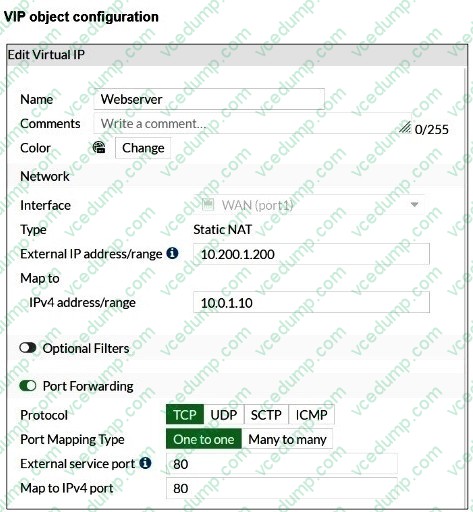
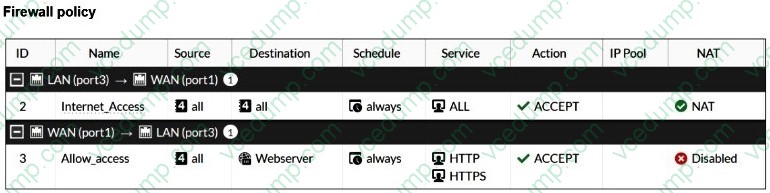
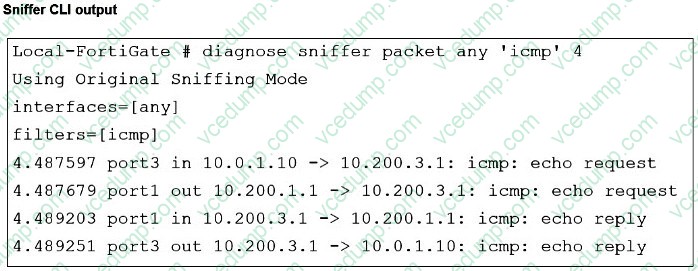
The exhibits show a diagram of a FortiGate device connected to the network, VIP configuration, firewall policy, and the sniffer CLI output on the FortiGate device.
The WAN (port1) interface has the IP address 10.200.1.1/24.
The LAN (port3) interface has the IP address 10.0.1.254/24.
The webserver host (10.0.1.10) must use its VIP external IP address as the source NAT (SNAT) when it pings remote server (10.200.3.1).
Which two statements are valid to achieve this goal? (Choose two.)
A. Enable NAT on the Allow_access firewall policy.
B. Disable NAT on the Internet_Access firewall policy.
C. Disable port forwarding on the VIP object.
D. Create a new firewall policy before Internet_Access for the webserver and apply the IP pool. -
Question 115:
Refer to the exhibit.

Why did FortiGate drop the packet?
A. It matched the default implicit firewall policy.
B. It failed the RPF check.
C. The next-hop IP address is unreachable.
D. It matched an explicitly configured firewall policy with the action DENY. -
Question 116:
An administrator needs to analyze and resolve port conflicts between SSL VPN and HTTPS administrative access on the same interface.
In which two ways can this be done? (Choose two.)
A. Disable SSL VPN if HTTPS administrative access is using port 443 on any interface.
B. Keep port 443 for both SSL VPN and HTTPS administrative access on the same interface without any problems.
C. Run SSL VPN on one interface using port 443 and enable HTTPS administrative access on a different interface, also using port 443.
D. Change the port number for either the SSL VPN service or the HTTPS administrative service if both are on the same interface. -
Question 117:
A FortiGate firewall policy is configured with active authentication, however, the user cannot authenticate when accessing a website.
Which protocol must FortiGate allow even though the user cannot authenticate?
A. LDAP
B. TACASC+
C. Kerberos
D. DNS -
Question 118:
Refer to the exhibits.
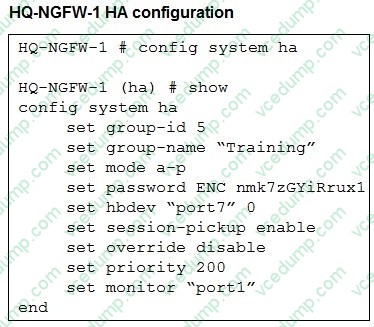
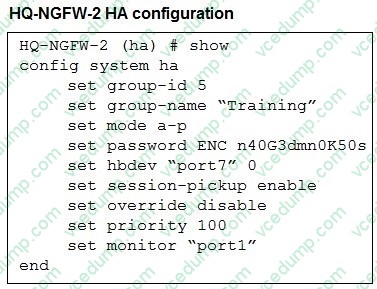
An administrator configured both members of an HA cluster at the same time. After one week of monitoring, the administrator wants to verify the HA failover performance.
How can the administrator force a failover?
A. The administrator must reset the HA uptime on HQ-NGFW-1.
B. The administrator must set the parameter override to enable on HQ-NGFW-2.
C. The administrator must increase the HA priority on HQ-NGFW-2.
D. The administrator must set the monitored port to down on HQ-NGFW-1. -
Question 119:
An administrator notices that SSL VPN users can connect, but no traffic is passing through the tunnel.
Which configuration issue is the most likely cause?
A. Split tunneling is disabled
B. The SSL VPN portal does not define bookmark URLs
C. The SSL VPN user group is not added to a firewall policy
D. The SSL VPN interface has no IP assigned -
Question 120:
You have configured the below commands on a FortiGate.
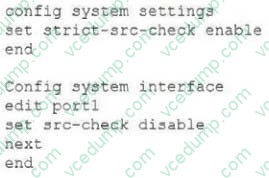
What would be the impact of this configuration on FortiGate?
A. FortiGate will enable strict RPF on ail its interfaces and port1 will be enable for asymmetric routing.
B. FortiGate will enable strict RPF on all its interfaces and port1 will be exempted from RPF checks.
C. Port1 will be enabled with flexible RPF, and all other interfaces will be enabled for strict RPF
D. The global configuration will take precedence and FortiGate will enable strict RPF on all interfaces.
Related Exams:
-
EMEA-ADVANCED-SUPPORT
Fortinet EMEA Advanced Support -
FCP_FAC_AD-6.5
FCP - FortiAuthenticator 6.5 Administrator -
FCP_FAZ_AD-7.4
FCP - FortiAnalyzer 7.4 Administrator -
FCP_FAZ_AN-7.4
FCP - FortiAnalyzer 7.4 Analyst -
FCP_FAZ_AN-7.6
Fortinet NSE 5 - FortiAnalyzer 7.6 Analyst -
FCP_FCT_AD-7.2
FCP - Forti Client EMS 7.2 Administrator -
FCP_FCT_AD-7.4
Fortinet NSE 6 - FortiClient EMS 7.4 Administrator -
FCP_FGT_AD-7.4
FCP - FortiGate 7.4 Administrator -
FCP_FGT_AD-7.6
FortiGate 7.6 Administrator FCP_FGT_AD-7.6 -
FCP_FMG_AD-7.4
FCP - FortiManager 7.4 Administrator
Tips on How to Prepare for the Exams
Nowadays, the certification exams become more and more important and required by more and more enterprises when applying for a job. But how to prepare for the exam effectively? How to prepare for the exam in a short time with less efforts? How to get a ideal result and how to find the most reliable resources? Here on Vcedump.com, you will find all the answers. Vcedump.com provide not only Fortinet exam questions, answers and explanations but also complete assistance on your exam preparation and certification application. If you are confused on your FCP_FGT_AD-7.6 exam preparations and Fortinet certification application, do not hesitate to visit our Vcedump.com to find your solutions here.