DATABRICKS-CERTIFIED-PROFESSIONAL-DATA-ENGINEER Exam Details
-
Exam Code
:DATABRICKS-CERTIFIED-PROFESSIONAL-DATA-ENGINEER -
Exam Name
:Databricks Certified Data Engineer Professional -
Certification
:Databricks Certifications -
Vendor
:Databricks -
Total Questions
:127 Q&As -
Last Updated
:Jul 15, 2026
Databricks DATABRICKS-CERTIFIED-PROFESSIONAL-DATA-ENGINEER Online Questions & Answers
-
Question 51:
The business reporting tem requires that data for their dashboards be updated every hour. The total processing time for the pipeline that extracts transforms and load the data for their pipeline runs in 10 minutes. Assuming normal operating conditions, which configuration will meet their service-level agreement requirements with the lowest cost?
A. Schedule a jo to execute the pipeline once and hour on a dedicated interactive cluster.
B. Schedule a Structured Streaming job with a trigger interval of 60 minutes.
C. Schedule a job to execute the pipeline once hour on a new job cluster.
D. Configure a job that executes every time new data lands in a given directory. -
Question 52:
A Delta table of weather records is partitioned by date and has the below schema:
date DATE, device_id INT, temp FLOAT, latitude FLOAT, longitude FLOAT
To find all the records from within the Arctic Circle, you execute a query with the below filter:
latitude > 66.3
Which statement describes how the Delta engine identifies which files to load?
A. All records are cached to an operational database and then the filter is applied
B. The Parquet file footers are scanned for min and max statistics for the latitude column
C. All records are cached to attached storage and then the filter is applied
D. The Delta log is scanned for min and max statistics for the latitude column
E. The Hive metastore is scanned for min and max statistics for the latitude column -
Question 53:
A data engineer wants to create a cluster using the Databricks CLI for a big ETL pipeline. The cluster should havefive workers,one driverof type i3.xlarge, and should use the '14.3.x-scala2.12' runtime. Which command should the data engineer use?
A. databricks clusters create 14.3.x-scala2.12 --num-workers 5 --node-type-id i3.xlarge -- cluster-name DataEngineer_cluster
B. databricks clusters add 14.3.x-scala2.12 --num-workers 5 --node-type-id i3.xlarge -- cluster-name Data Engineer_cluster
C. databricks compute add 14.3.x-scala2.12 --num-workers 5 --node-type-id i3.xlarge -- cluster-name Data Engineer_cluster
D. databricks compute create 14.3.x-scala2.12 --num-workers 5 --node-type-id i3.xlarge -- cluster-name Data Engineer_cluster -
Question 54:
The DevOps team has configured a production workload as a collection of notebooks scheduled to run daily using the Jobs UI. A new data engineering hire is onboarding to the team and has requested access to one of these notebooks to review the production logic.
What are the maximum notebook permissions that can be granted to the user without allowing accidental changes to production code or data?
A. Can Manage
B. Can Edit
C. No permissions
D. Can Read
E. Can Run -
Question 55:
A user new to Databricks is trying to troubleshoot long execution times for some pipeline logic they are working on. Presently, the user is executing code cell-by-cell, usingdisplay() calls to confirm code is producing the logically correct results as new transformations are added to an operation. To get a measure of average time to execute, the user is running each cell multiple times interactively.
Which of the following adjustments will get a more accurate measure of how code is likely to perform in production?
A. Scala is the only language that can be accurately tested using interactive notebooks; because the best performance is achieved by using Scala code compiled to JARs. all PySpark and Spark SQL logic should be refactored.
B. The only way to meaningfully troubleshoot code execution times in development notebooks Is to use production-sized data and production-sized clusters with Run All execution.
C. Production code development should only be done using an IDE; executing code against a local build of open source Spark and Delta Lake will provide the most accurate benchmarks for how code will perform in production.
D. Calling display () forces a job to trigger, while many transformations will only add to the logical query plan; because of caching, repeated execution of the same logic does not provide meaningful results.
E. The Jobs Ul should be leveraged to occasionally run the notebook as a job and track execution time during incremental code development because Photon can only be enabled on clusters launched for scheduled jobs. -
Question 56:
A data engineer is testing a collection of mathematical functions, one of which calculates the area under a curve as described by another function.
Which kind of the test does the above line exemplify?
A. Integration
B. Unit
C. Manual
D. functional -
Question 57:
The data governance team is reviewing user for deleting records for compliance with GDPR. The following logic has been implemented to propagate deleted requests from the user_lookup table to the user aggregate table.
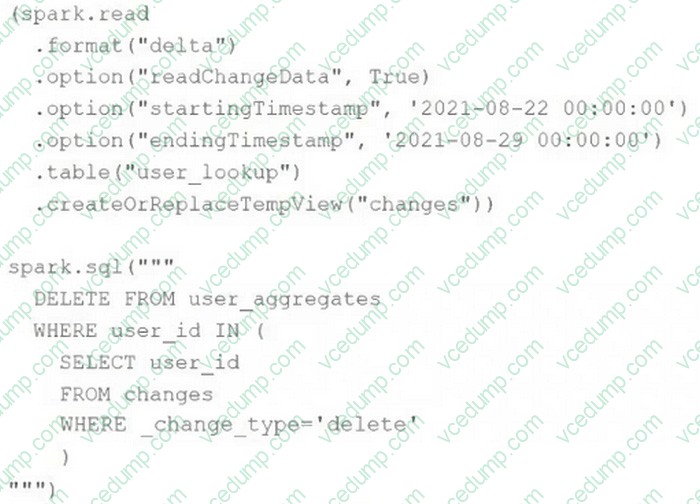
Assuming that user_id is a unique identifying key and that all users have requested deletion have been removed from the user_lookup table, which statement describes whether successfully executing the above logic guarantees that the records to be deleted from the user_aggregates table are no longer accessible and why?
A. No: files containing deleted records may still be accessible with time travel until a VACUUM command is used to remove invalidated data files.
B. Yes: Delta Lake ACID guarantees provide assurance that the DELETE command successed fully and permanently purged these records.
C. No: the change data feed only tracks inserts and updates not deleted records.
D. No: the Delta Lake DELETE command only provides ACID guarantees when combined with the MERGE INTO command -
Question 58:
A data ingestion task requires a one-TB JSON dataset to be written out to Parquet with a target part-file size of 512 MB. Because Parquet is being used instead of Delta Lake, built- in file-sizing features such as Auto-Optimize and Auto-Compaction cannot be used.
Which strategy will yield the best performance without shuffling data?
A. Set spark.sql.files.maxPartitionBytes to 512 MB, ingest the data, execute the narrow transformations, and then write to parquet.
B. Set spark.sql.shuffle.partitions to 2,048 partitions (1TB*1024*1024/512), ingest the data, execute the narrow transformations, optimize the data by sorting it (which automatically repartitions the data), and then write to parquet.
C. Set spark.sql.adaptive.advisoryPartitionSizeInBytes to 512 MB bytes, ingest the data, execute the narrow transformations, coalesce to 2,048 partitions (1TB*1024*1024/512), and then write to parquet.
D. Ingest the data, execute the narrow transformations, repartition to 2,048 partitions (1TB* 1024*1024/512), and then write to parquet.
E. Set spark.sql.shuffle.partitions to 512, ingest the data, execute the narrow transformations, and then write to parquet. -
Question 59:
The marketing team is looking to share data in an aggregate table with the sales organization, but the field names used by the teams do not match, and a number of marketing specific fields have not been approval for the sales org. Which of the following solutions addresses the situation while emphasizing simplicity?
A. Create a view on the marketing table selecting only these fields approved for the sales team alias the names of any fields that should be standardized to the sales naming conventions.
B. Use a CTAS statement to create a derivative table from the marketing table configure a production jon to propagation changes.
C. Add a parallel table write to the current production pipeline, updating a new sales table that varies as required from marketing table.
D. Create a new table with the required schema and use Delta Lake's DEEP CLONE functionality to sync up changes committed to one table to the corresponding table. -
Question 60:
Although the Databricks Utilities Secrets module provides tools to store sensitive credentials and avoid accidentally displaying them in plain text users should still be careful with which credentials are stored here and which users have access to using these secrets.
Which statement describes a limitation of Databricks Secrets?
A. Because the SHA256 hash is used to obfuscate stored secrets, reversing this hash will display the value in plain text.
B. Account administrators can see all secrets in plain text by logging on to the Databricks Accounts console.
C. Secrets are stored in an administrators-only table within the Hive Metastore; database administrators have permission to query this table by default.
D. Iterating through a stored secret and printing each character will display secret contents in plain text.
E. The Databricks REST API can be used to list secrets in plain text if the personal access token has proper credentials.
Related Exams:
-
DATABRICKS-CERTIFIED-ASSOCIATE-DEVELOPER-FOR-APACHE-SPARK
Databricks Certified Associate Developer for Apache Spark 3.0 -
DATABRICKS-CERTIFIED-ASSOCIATE-DEVELOPER-FOR-APACHE-SPARK-35
Databricks Certified Associate Developer for Apache Spark 3.5 - Python -
DATABRICKS-CERTIFIED-DATA-ANALYST-ASSOCIATE
Databricks Certified Data Analyst Associate -
DATABRICKS-CERTIFIED-DATA-ENGINEER-ASSOCIATE
Databricks Certified Data Engineer Associate -
DATABRICKS-CERTIFIED-GENERATIVE-AI-ENGINEER-ASSOCIATE
Databricks Certified Generative AI Engineer Associate -
DATABRICKS-CERTIFIED-PROFESSIONAL-DATA-ENGINEER
Databricks Certified Data Engineer Professional -
DATABRICKS-CERTIFIED-PROFESSIONAL-DATA-SCIENTIST
Databricks Certified Professional Data Scientist -
DATABRICKS-MACHINE-LEARNING-ASSOCIATE
Databricks Certified Machine Learning Associate -
DATABRICKS-MACHINE-LEARNING-PROFESSIONAL
Databricks Certified Machine Learning Professional
Tips on How to Prepare for the Exams
Nowadays, the certification exams become more and more important and required by more and more enterprises when applying for a job. But how to prepare for the exam effectively? How to prepare for the exam in a short time with less efforts? How to get a ideal result and how to find the most reliable resources? Here on Vcedump.com, you will find all the answers. Vcedump.com provide not only Databricks exam questions, answers and explanations but also complete assistance on your exam preparation and certification application. If you are confused on your DATABRICKS-CERTIFIED-PROFESSIONAL-DATA-ENGINEER exam preparations and Databricks certification application, do not hesitate to visit our Vcedump.com to find your solutions here.