DATA-ARCHITECTURE-AND-MANAGEMENT-DESIGNER Exam Details
-
Exam Code
:DATA-ARCHITECTURE-AND-MANAGEMENT-DESIGNER -
Exam Name
:Salesforce Certified Data Architecture and Management Designer -
Certification
:Salesforce Certifications -
Vendor
:Salesforce -
Total Questions
:246 Q&As -
Last Updated
:Feb 28, 2026
Salesforce DATA-ARCHITECTURE-AND-MANAGEMENT-DESIGNER Online Questions & Answers
-
Question 221:
A business that works directly with individual consumers (B2C) currently has a home-grown CRM system, but they are moving to Salesforce. The business has 1.2 million consumer records and wants assistance with achieving optimal use of Salesforce functionality while also avoiding data loading issues.
What should an Architect recommend?
A. Create a Custom Object Individual Consumer c to load all individual consumers.
B. Load all individual consumers as Account records and avoid using the Contact object.
C. Load one Account record and one Contact record for each individual consumer.
D. Create one Account and load individual consumers as Contacts linked to that one Account. -
Question 222:
DreamHouse Realty uses Custom Metadata Types instead of Custom setting. What is an advantage of this decision?
A. Custom metadata records are editable in Apex.
B. Report definitions can include references to Custom Metadata Types.
C. Custom metadata records are NOT copied from production to sandbox.
D. Packages can be used to deploy Custom metadata records. -
Question 223:
Get Cloudy Consulting is migrating their legacy system's users and data to Salesforce. They will be creating 15,000 users, 1.5 million Account records, and 15 million Invoice records. The visibility of these records is controlled by a 50 owner
and criteria-based sharing rules.
Get Cloudy Consulting needs to minimize data loading time during this migration to a new organization.
Which two approaches will accomplish this goal? (Choose two.)
A. Create the users, upload all data, and then deploy the sharing rules.
B. Contact Salesforce to activate indexing before uploading the data.
C. First, load all account records, and then load all user records.
D. Defer sharing calculations until the data has finished uploading. -
Question 224:
Universal Containers has large amount of orders coming in from its online portal. Historically all orders are assigned to a generic user.
Which two measures should a data architect recommend to avoid any performance issues while working with large number of order records? (Choose two.)
A. Clear the role field in the generic user record.
B. Salesforce handles the assignment of orders automatically and there is no performance impact.
C. Create a role at top of role hierarchy and assign the role to the generic user.
D. Create a pool of generic users and distribute the assignment of memory to the pool of users. -
Question 225:
Universal Containers (UC) has built a B2C ecommerce site on Heroku that shares customer and order data with a Heroku Postgres database. UC is currently utilizing Postgres as the Single Source of Truth for both customers and orders. UC has asked a data architect to replicate this data into Salesforce so that Salesforce can now act as the System of Record.
What are the three considerations that a data architect should weigh before implementing this requirement? (Choose three.)
A. Consider whether the data is required for sales reports, dashboards and KPI's.
B. Determine if the data is driver of key process implemented within salesforce.
C. Ensure there is a tight relationship between order data and an enterprise resource plaining (ERP) application.
D. Ensure the data is CRM center and able to populate standard of custom objects.
E. A selection of the tool required to replicate the data.
F. -Heroku Connect is required but this is confusing -
Question 226:
Universal Containers has a custom object with millions of rows of data. When executing SOQL queries, which three options prevent a query from being selective? (Choose three.)
A. Using leading % wildcards.
B. Using trailing % wildcards.
C. Performing large loads and deletions.
D. Using NOT and != operators.
E. Using a custom index on a deterministic formula field. -
Question 227:
Northern trail Outfitters (NTO) uses Sales Cloud and service Cloud to manage sales and support processes. Some of NTOs team are complaining they see new fields on their page unsure of which values need be input. NTO is concerned about lack of governance in making changes to Salesforce. Which governance measure should a data architect recommend to solve this issue?
A. Add description fields to explain why the field is used, and mark the field as required.
B. Create and manage a data dictionary and ups a governance process for changes made to common objects.
C. Create reports to identify which users are leaving blank, and use external data sources o agreement the missing data.
D. Create validation rules with error messages to explain why the fields is used -
Question 228:
DreamHouse Realty has a data model as shown in the image. The Project object has a private sharing model, and it has Roll-Up summary fields to calculate the number of resources assigned to the project, total hours for the project, and the number of work items associated to the project. There will be a large amount of time entry records to be loaded regularly from an external system into Salesforce.
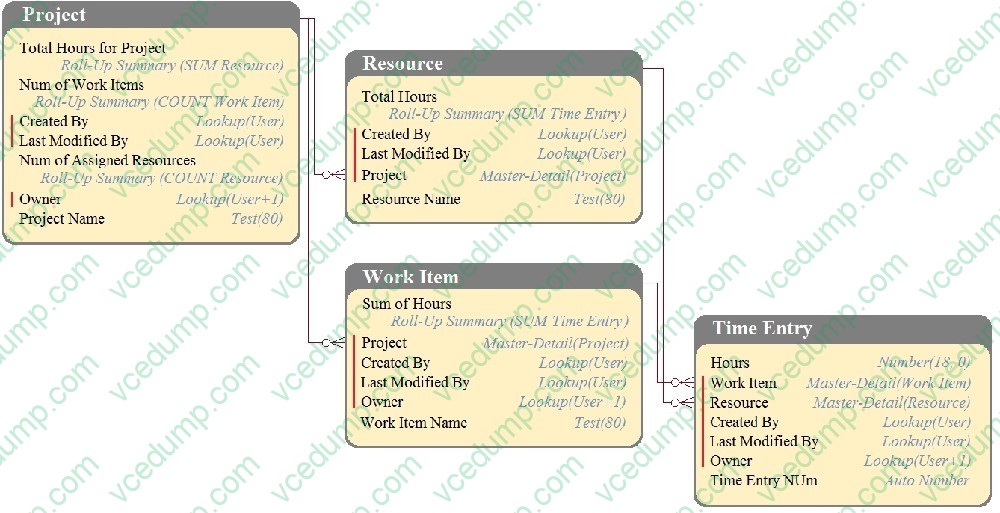
What should the Architect consider in this situation?
A. Load all data after deferring sharing calculations.
B. Calculate summary values instead of Roll-Up by using workflow.
C. Calculate summary values instead of Roll-Up by using triggers.
D. Load all data using external IDs to link to parent records. -
Question 229:
Universal Containers (UC) has 1,000 accounts and 50,000 opportunities. UC has an enterprise security requirement to export all sales data outside of Salesforce on a weekly basis. The security requirement also calls for exporting key operational data that includes events such as file downloads, logins, logouts, etc. Which two recommended approaches would address the above requirement?
A. Use Field Audit History to capture operational data and extract it to on-premise systems.
B. Use Weekly Export to extract transactional data to on-premise systems.
C. Use a custom built extract job to extract operational data to on-premise systems.
D. Use Event Monitoring to extract event data to on-premise systems. -
Question 230:
Two million Opportunities need to be loaded in different batches into Salesforce using the Bulk API in parallel mode. What should an Architect consider when loading the Opportunity records?
A. Use the Name field values to sort batches.
B. Order batches by Auto-number field.
C. Create indexes on Opportunity object text fields.
D. Group batches by the AccountId field.
Related Exams:
-
201-COMMERCIAL-BANKING-FUNCTIONAL
Salesforce enCino 201 Commercial Banking Functional -
ADM-201
Salesforce Certified Platform Administrator (Plat-Admn-201) -
ADM-211
Administration Essentials for Experienced Admin (ADM-211) -
ADM-261
Service Cloud Administration (SU24) -
ADVANCED-ADMINISTRATOR
Salesforce Certified Advanced Administrator -
ADVANCED-CROSS-CHANNEL
Marketing Cloud Advanced Cross Channel Accredited Professional -
ADX-201
Administrative Essentials for New Admins in Lightning Experience -
ADX-271
Salesforce Certified Community Cloud Consultant (ADX-271) -
AGENTFORCE-SPECIALIST
Salesforce Certified Agentforce Specialist (AI-201) -
ALS-CON-201
Salesforce Certified Agentforce Life Sciences Consultant
Tips on How to Prepare for the Exams
Nowadays, the certification exams become more and more important and required by more and more enterprises when applying for a job. But how to prepare for the exam effectively? How to prepare for the exam in a short time with less efforts? How to get a ideal result and how to find the most reliable resources? Here on Vcedump.com, you will find all the answers. Vcedump.com provide not only Salesforce exam questions, answers and explanations but also complete assistance on your exam preparation and certification application. If you are confused on your DATA-ARCHITECTURE-AND-MANAGEMENT-DESIGNER exam preparations and Salesforce certification application, do not hesitate to visit our Vcedump.com to find your solutions here.