CompTIA CV0-003 Online Practice
Questions and Exam Preparation
CV0-003 Exam Details
Exam Code
:CV0-003
Exam Name
:CompTIA Cloud+
Certification
:CompTIA Certifications
Vendor
:CompTIA
Total Questions
:502 Q&As
Last Updated
:May 27, 2026
CompTIA CV0-003 Online Questions &
Answers
Question 161:
A systems administrator is working within a private cloud environment. Over time. random 4K read/write speeds on all VMS in the environment slow down until the VMS are completely unusable, with disk speeds of less than 1MBps. The
administrator has gathered the information below:
There is no correlation between the slowdown and VM/hypervisor resource utilization.
The network is rated to 40Gbps and utilization is between 1--5%.
The hypervisors use hundreds of NFSv3 mounts to the same storage appliance, one per VM.
The VMS on each hypervisor become unresponsive after two weeks of uptime.
The unresponsiveness is resolved by moving slow VMS onto a rebooted hypervisor.
Which of the following solutions will MOST likely resolve this issue?
A. Increase caching on the storage appliance. B. Configure jumbo frames on the hypervisors and storage. C. Increase CPU/RAM resources on affected VMS. D. Reduce the number of NFSv3 mounts to one.
D. Reduce the number of NFSv3 mounts to one.
Explanation
The correct answer is
D. Reduce the number of NFSv3 mounts to one. NFSv3 is a network file system protocol that allows clients to access files stored on a remote server. NFSv3 uses TCP or UDP as the transport layer protocol, and typically runs on port 20491. One of the known issues with NFSv3 mounts is that they can cause performance degradation and unresponsiveness on the client side if there are too many mounts or if there are network connectivity problems. This is because NFSv3 does not handle connection failures or timeouts gracefully, and may keep retrying to access the server indefinitely, blocking other processes or threads. This can result in slow disk speeds, high CPU usage, and system hangs23. Therefore, one of the possible solutions to this issue is to reduce the number of NFSv3 mounts to one per hypervisor, instead of one per VM. This way, the hypervisor can manage the access to the shared storage appliance more efficiently, and avoid creating too many TCP connections or UDP packets that may overload the network or the server. Reducing the number of NFSv3 mounts can also simplify the configuration and troubleshooting of the network file system. Increasing caching on the storage appliance may improve the read performance of the NFSv3 mounts, but it will not solve the underlying issue of connection failures or timeouts. Caching may also introduce data inconsistency or corruption issues if the cache is not synchronized with the server. Configuring jumbo frames on the hypervisors and storage may improve the network throughput and efficiency of the NFSv3 mounts, but it will not solve the underlying issue of connection failures or timeouts. Jumbo frames are larger than standard Ethernet frames, and require that all devices on the network path support them. Jumbo frames may also introduce fragmentation or compatibility issues if they are not configured properly. Increasing CPU/RAM resources on affected VMs may improve their performance in general, but it will not solve the underlying issue of connection failures or timeouts. Increasing CPU/RAM resources may also be costly and wasteful if they are not needed for other purposes.
Question 162:
Some VMs that are hosted on a dedicated host server have each been allocated with 32GB of memory. Some of VMs are not utilizing more than 30% of the allocation. Which of the following should be enabled to optimize the memory utilization?
A. Auto-scaling of compute B. Oversubscription C. Dynamic memory allocations on guests D. Affinity rules in the hypervisor
C. Dynamic memory allocations on guests
Explanation
Enabling dynamic memory allocations on guests is the best option to optimize memory utilization for VMs that have been allocated with 32GB of memory but are not utilizing more than 30% of it. Dynamic memory allocation is a feature that allows a VM to adjust its memory usage according to its workload and demand, without requiring a reboot or manual intervention. Dynamic memory allocation can help to improve memory utilization and efficiency by allocating more memory to VMs that need it and releasing memory from VMs that do not need it.
Question 163:
A cloud administrator is having difficulty correlating logs for multiple servers. Upon inspection, the administrator finds that the time-zone settings are mismatched throughout the deployment. Which of the following solutions can help maintain time synchronization between all the resources?
A. DNS B. IPAM C. NTP D. SNMP
C. NTP
Explanation
The correct answer is
C. NTP.
NTP stands for Network Time Protocol, which is a standard protocol for synchronizing the clocks of computers over a network. NTP uses a hierarchical, client-server architecture, where a client requests the current time from a server, and the server responds with a timestamp. The client then adjusts its own clock to match the server's time, taking into account the network delay and clock drift. NTP can achieve sub-millisecond accuracy over local area networks and a few milliseconds over the internet12. NTP can help maintain time synchronization between all the resources in a distributed cloud environment, as it allows each resource to get the accurate time from a reliable source. This can help with correlating logs, auditing, security, and other time-sensitive operations. NTP can also handle different time zones, as it uses Coordinated Universal Time (UTC) as the reference time, and each resource can convert UTC to its local time zone12. DNS stands for Domain Name System, which is a protocol for resolving domain names into IP addresses. DNS does not provide any functionality for time synchronization3. IPAM stands for IP Address Management, which is a method for planning, tracking, and managing the IP address space used in a network. IPAM does not provide any functionality for time synchronization. SNMP stands for Simple Network Management Protocol, which is a protocol for collecting and organizing information about managed devices on a network. SNMP can be used to monitor the performance, availability, configuration, and security of network devices, but it does not provide any functionality for time synchronization.
Question 164:
A systems administrator is planning the storage requirements for a two-disk mirror of a server OS disk partition. Which of the following is the amount of disk space available in the mirrored volume?
A. 30% B. 50% C. 75% D. 100%
B. 50%
Explanation
B. 50%: In a two-disk mirror (RAID 1), one disk is used for redundancy. Therefore, only 50% of the total disk capacity is available for storage.
References:
CompTIA Cloud+ CV0-003 Study Guide Chapter 12: Storage in Cloud Environments.
Question 165:
A VDI administrator has received reports from the drafting department that rendering is slower than normal. Which of the following should the administrator check FIRST to optimize the performance of the VDI infrastructure?
A. GPU B. CPU C. Storage D. Memory
A. GPU
Explanation
Checking the GPU (Graphics Processing Unit) is the first thing that the VDI administrator should do to optimize the performance of the VDI infrastructure for rendering tasks. GPU is a specialized hardware device that accelerates graphics processing and rendering. GPU can improve the user experience and performance of VDI applications that require intensive graphics processing, such as drafting, gaming, video editing, etc.
Question 166:
A systems administrator is trying to establish an RDP session from a desktop to a server in the cloud. However, the connection appears to be refused even through the VM is responding to ICMP echo requests. Which of the following should the administrator check FIRST?
A. The firewall B. The subnet C. The gateway D. The services
A. The firewall
Explanation
The firewall is the first thing that the administrator should check if an RDP (Remote Desktop Protocol) session from a desktop to a server in the cloud is refused even though the VM is responding to ICMP echo requests. A firewall is a device or software that controls the incoming and outgoing network traffic based on predefined rules or policies. A firewall may block RDP connections by default or require specific ports or rules to be opened or configured.
Question 167:
A systems administrator needs to connect the companys network to a public cloud services provider. Which of the following will BEST ensure encryption in transit for data transfers?
A. Identity federation B. A VPN tunnel C. A proxy solution D. A web application firewall
B. A VPN tunnel
Explanation
SAML (Security Assertion Markup Language) is a standard for exchanging authentication and authorization data between different parties, such as a user and a service provider. In a federated cluster, SAML can be used to enable single sign-on (SSO) for users across multiple clusters or cloud providers. SAML relies on the exchange of XML-based assertions that contain information about the user's identity, attributes, and entitlements. If the users' API access tokens have become invalid, it could be because the SAML assertions have expired, been revoked, or corrupted. The administrator should check the SAML configuration and logs to determine the cause of this issue. Some possible sources of information about SAML and federated clusters are: Authenticating | Kubernetes: This page provides an overview of authenticating users in Kubernetes, including using SAML for federated identity. Authenticating to the Kubernetes API server - Google Cloud: This page explains how to authenticate to the Kubernetes API server on Google Cloud, including using SAML for federated identity with Google Cloud Identity Platform. Error 403 User not authorized when trying to access Azure Databricks API through Active Directory
- Stack Overflow: This page discusses a similar issue of users getting an error when trying to access Azure Databricks API using SAML and Active Directory.
Question 168:
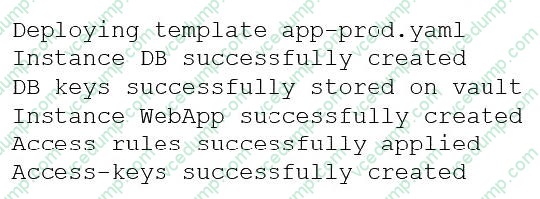
A security analyst is investigating a recurring alert. The alert is reporting an insecure firewall configuration state after every cloud application deployment. The process of identifying the issue, requesting a fix, and waiting for the developers to manually patch the environment is being repeated multiple times. In an effort to identify the root issue, the following logs were collected:
Which of the following options will provide a permanent fix for the issue?
A. Validate the IaC code used during the deployment. B. Avoid the use of a vault to store database passwords. C. Rotate the access keys that were created during deployment. D. Recommend that the developers do not create multiple resources at once.
A. Validate the IaC code used during the deployment.
Explanation
The logs indicate the deployment process, and the issue appears to be related to the deployment process or configuration. By validating the Infrastructure as Code (IaC) code used during the deployment, the security analyst can identify and rectify any insecure firewall configuration settings or other issues in the deployment process. This will help ensure that the deployments are carried out securely and avoid recurring insecure configuration alerts.
Question 169:
Given the metric below:
Using iSCSI storage reports across three datacenters, which of the following recorded metrics indicates an anomaly in the performance?
A. Disk latency B. CPU utilization C. WAN latency D. RAM utilization
D. RAM utilization
Explanation
Question 170:
A systems administrator is performing upgrades to all the hypervisors in the environment. Which of the following components of the hypervisors should be upgraded? (Choose two.)
A. The fabric interconnects B. The virtual appliances C. The firmware D. The virtual machines E. The baselines F. The operating system
C. The firmware F. The operating system
Explanation
These are the components of the hypervisors that should be upgraded by the administrator who is performing upgrades to all the hypervisors in the environment. A hypervisor is a software or hardware that allows multiple VMs (Virtual Machines) to run on a single physical host or server. A hypervisor consists of various components, such as: The firmware: This is the software that controls the basic functions and operations of the hardware or device. The firmware can affect the performance, compatibility, and security of the hypervisor and the VMs. The firmware should be upgraded to ensure that it supports the latest features and functions of the hardware or device, as well as fix any bugs or vulnerabilities. The operating system: This is the software that manages the resources and activities of the hypervisor and the VMs. The operating system can affect the functionality, reliability, and efficiency of the hypervisor and the VMs. The operating system should be upgraded to ensure that it supports the latest applications and services of the hypervisor and the VMs, as well as improve stability and performance.
Nowadays, the certification exams become more and more important and required by more and more
enterprises when applying for a job. But how to prepare for the exam effectively? How to prepare
for the exam in a short time with less efforts? How to get a ideal result and how to find the
most reliable resources? Here on Vcedump.com, you will find all the answers.
Vcedump.com provide not only CompTIA exam questions,
answers and explanations but also complete assistance on your exam preparation and certification
application. If you are confused on your CV0-003 exam preparations
and CompTIA certification application, do not hesitate to visit our
Vcedump.com to find your solutions here.