CV0-003 Exam Details
-
Exam Code
:CV0-003 -
Exam Name
:CompTIA Cloud+ -
Certification
:CompTIA Certifications -
Vendor
:CompTIA -
Total Questions
:502 Q&As -
Last Updated
:May 27, 2026
CompTIA CV0-003 Online Questions & Answers
-
Question 151:
A web consultancy group currently works in an isolated development environment. The group uses this environment for the creation of the final solution, but also for showcasing it to customers, before commissioning the sites in production. Recently, customers of newly commissioned sites have reported they are not receiving the final product shown by the group, and the website is performing in unexpected ways. Which of the following additional environments should the group adopt and include in its process?
A. Provide each web consultant a local environment on their device.
B. Require each customer to have a blue-green environment.
C. Leverage a staging environment that is tightly controlled for showcasing
D. Initiate a disaster recovery environment to fail to in the event of reported issues. -
Question 152:
A new private cloud platform is being deployed by an engineer. SLA requirements state that any clusters should have a baseline redundancy sufficient to handle the failure of at least two hosts. The engineer records the following metrics after the deployment:
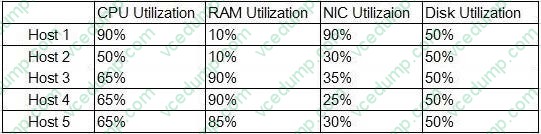
Which of the following metrics is MOST likely to represent a violation of SLA?
A. RAM utilization
B. NIC utilization
C. CPU utilization
D. Disk utilization -
Question 153:
A systems administrator is configuring a storage array.
Which of the following should the administrator configure to set up mirroring on this array?
A. RAID 0
B. RAID 1
C. RAID 5
D. RAID 6 -
Question 154:
A startup online gaming company is designing the optimal graphical user experience for multiplayer scenarios. However, online players have reported latency issues. Which of the following should the company configure as a remediation?
A. Additional GPU memory
B. Faster clock speed
C. Additional CPU cores
D. Dynamic allocations -
Question 155:
A cloud administrator needs to reduce storage costs. Which of the following would best help the administrator reach that goal?
A. Enabling compression
B. Implementing deduplication
C. Using containers
D. Rightsizing the VMs -
Question 156:
A systems administrator is troubleshooting performance issues with a Windows VDI environment. Users have reported that VDI performance is very slow at the start of the work day, but the performance is fine during the rest of the day.
Which of the following is the MOST likely cause of the issue?
A. Disk I/O limits
B. Affinity rule
C. CPU oversubscription
D. RAM usage -
Question 157:
A company still has several dedicated servers and wants to migrate them to its private cloud. Which of the following migration methods would be BEST to accomplish this goal?
A. Virtual-to-virtual
B. Storage
C. Cloud-to-cloud
D. Physical-to-virtual -
Question 158:
A company has an internal SLA for CPU and RAM oversubscription that should stay below 120%. Storage utilization should stay below 90% with oversubscription below 160%. Given the following:
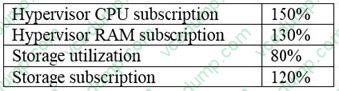
Which of the following should be done to meet the SLA?
A. Install a different hypervisor
B. Add RAM to the hypervisors and new shelves to the storage array
C. Add RAM to the hypervisors and increase the CPU clock
D. Add CPU and RAM to the cluster -
Question 159:
A systems administrator receives an alert that VDI performance on the cluster is poor. Opening any application takes one to two minutes. The administrator investigates and finds the following conditions:
1.Cluster memory utilization: 65%
2.Cluster SSD utilization: 70%
3.Average VM CPU wait time: 14%
4.Cluster CPU utilization: 75%
Which of the following actions should the administrator take to improve VDI performance?
A. Add CPU resources to the cluster.
B. Increase the number of vCPUs per VM.
C. Add memory to the nodes in the cluster.
D. Increase the amount of SSD storage in the cluster. -
Question 160:
A database analyst reports it takes two hours to perform a scheduled job after onboarding 10,000 new users to the system. The analyst made no changes to the scheduled job before or after onboarding the users. The database is hosted in an IaaS instance on a cloud provider.
Which of the following should the cloud administrator evaluate to troubleshoot the performance of the job?
A. The laaS compute configurations, the capacity trend analysis reports, and the storage IOPS
B. The hypervisor logs, the memory utilization of the hypervisor host, and the network throughput of the hypervisor
C. The scheduled job logs for successes and failures, the time taken to execute the job, and the job schedule
D. Migrating from laaS to on premises, the network traffic between on-premises users and the laaS instance, and the CPU utilization of the hypervisor host
Related Exams:
-
220-1001
CompTIA A+ Certification: Core 1 -
220-1002
CompTIA A+ Certification: Core 2 -
220-1101
CompTIA A+ Certification: Core 1 -
220-1102
CompTIA A+ Certification: Core 2 -
220-1201
CompTIA A+ Certification: Core 1 -
220-1202
CompTIA A+ Core 2 (2026) -
220-902
CompTIA A+ Certification -
CAS-004
CompTIA Advanced Security Practitioner (CASP+) -
CAS-005
CompTIA SecurityX -
CLO-001
CompTIA Cloud Essentials+
Tips on How to Prepare for the Exams
Nowadays, the certification exams become more and more important and required by more and more enterprises when applying for a job. But how to prepare for the exam effectively? How to prepare for the exam in a short time with less efforts? How to get a ideal result and how to find the most reliable resources? Here on Vcedump.com, you will find all the answers. Vcedump.com provide not only CompTIA exam questions, answers and explanations but also complete assistance on your exam preparation and certification application. If you are confused on your CV0-003 exam preparations and CompTIA certification application, do not hesitate to visit our Vcedump.com to find your solutions here.