CS0-003 Exam Details
-
Exam Code
:CS0-003 -
Exam Name
:CompTIA Cybersecurity Analyst (CySA+) -
Certification
:CompTIA Certifications -
Vendor
:CompTIA -
Total Questions
:680 Q&As -
Last Updated
:Jul 12, 2026
CompTIA CS0-003 Online Questions & Answers
-
Question 481:
After conducting a cybersecurity risk assessment for a new software request, a Chief Information Security Officer (CISO) decided the risk score would be too high. The CISO refused the software request.
Which of the following risk management principles did the CISO select?
A. Avoid
B. Transfer
C. Accept
D. Mitigate -
Question 482:
Which of the following is the best technical method to protect sensitive data at an organizational level?
A. Deny all traffic on port 8080 with sensitive information on the VLAN.
B. Develop a Python script to review email traffic for PII.
C. Employ a restrictive policy for the use and distribution of sensitive information.
D. Implement a DLP for all egress and ingress of sensitive information on the network. -
Question 483:
A company that has a geographically diverse workforce and dynamic IPs wants to implement a vulnerability scanning method with reduced network traffic.
Which of the following would best meet this requirement?
A. External
B. Agent-based
C. Non-credentialed
D. Credentialed -
Question 484:
In the last hour, a high volume of failed RDP authentication attempts has been logged on a critical server. All of the authentication attempts originated from the same remote IP address and made use of a single valid domain user account.
Which of the following mitigating controls would be most effective to reduce the rate of success of this brute-force attack? (Select two).
A. Increase the granularity of log-on event auditing on all devices.
B. Enable host firewall rules to block all outbound traffic to TCP port 3389.
C. Configure user account lockout after a limited number of failed attempts.
D. Implement a firewall block for the IP address of the remote system.
E. Install a third-party remote access tool and disable RDP on all devices.
F. Block inbound to TCP port 3389 from untrusted remote IP addresses at the perimeter firewall. -
Question 485:
An organization is preparing for a disaster recovery exercise.
Which of the following actions should be implemented first?
A. Gather all internal stakeholders and review the actions according to the defined incident playbook.
B. Coordinate the supporting staff for the recovery process to ensure availability at the recovery site.
C. Ensure that the vendor for the disaster recovery site is scheduled to support the recovery.
D. Identify a business-critical system and test by failing over to the disaster recovery location. -
Question 486:
A security analyst observed the following activity from a privileged account:
1. Accessing emails and sensitive information
2. Audit logs being modified
3. Abnormal log-in times
Which of the following best describes the observed activity?
A. Irregular peer-to-peer communication
B. Unauthorized privileges
C. Rogue devices on the network
D. Insider attack -
Question 487:
An after-action review of a ransomware attack on a company identified deficiencies in responsiveness and consistency.
Which of the following choices would best facilitate improvement of these deficiencies?
A. Leverage a SIEM.
B. Utilize threat intelligence sharing.
C. Source multiple threat feeds.
D. Implement SOAR. -
Question 488:
A company has decided to expose several systems to the internet, The systems are currently available internally only. A security analyst is using a subset of CVSS3.1 exploitability metrics to prioritize the vulnerabilities that would be the most exploitable when the systems are exposed to the internet. The systems and the vulnerabilities are shown below:
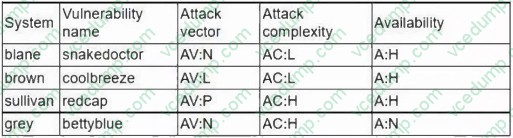
Which of the following systems should be prioritized for patching?
A. brown
B. grey
C. blane
D. sullivan -
Question 489:
An employee downloads a freeware program to change the desktop to the classic look of legacy Windows. Shortly after the employee installs the program, a high volume of random DNS queries begin to originate from the system. An investigation on the system reveals the following:
Add-MpPreference -ExclusionPath '%Program Filest\ksysconfig'
Which of the following is possibly occurring?
A. Persistence
B. Privilege escalation
C. Credential harvesting
D. Defense evasion -
Question 490:
An analyst received an alert regarding an application spawning a suspicious command shell process. Upon further investigation, the analyst observes the following registry change occurring immediately after the suspicious event:
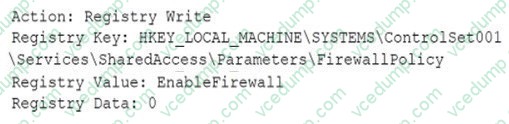
Which of the following was the suspicious event able to accomplish?
A. Impair defenses.
B. Establish persistence.
C. Bypass file access controls.
D. Implement beaconing.
Related Exams:
-
220-1001
CompTIA A+ Certification: Core 1 -
220-1002
CompTIA A+ Certification: Core 2 -
220-1101
CompTIA A+ Certification: Core 1 -
220-1102
CompTIA A+ Certification: Core 2 -
220-1201
CompTIA A+ Certification: Core 1 -
220-1202
CompTIA A+ Core 2 (2026) -
220-902
CompTIA A+ Certification -
CAS-004
CompTIA Advanced Security Practitioner (CASP+) -
CAS-005
CompTIA SecurityX -
CLO-001
CompTIA Cloud Essentials+
Tips on How to Prepare for the Exams
Nowadays, the certification exams become more and more important and required by more and more enterprises when applying for a job. But how to prepare for the exam effectively? How to prepare for the exam in a short time with less efforts? How to get a ideal result and how to find the most reliable resources? Here on Vcedump.com, you will find all the answers. Vcedump.com provide not only CompTIA exam questions, answers and explanations but also complete assistance on your exam preparation and certification application. If you are confused on your CS0-003 exam preparations and CompTIA certification application, do not hesitate to visit our Vcedump.com to find your solutions here.