CS0-003 Exam Details
-
Exam Code
:CS0-003 -
Exam Name
:CompTIA Cybersecurity Analyst (CySA+) -
Certification
:CompTIA Certifications -
Vendor
:CompTIA -
Total Questions
:680 Q&As -
Last Updated
:Jul 20, 2026
CompTIA CS0-003 Online Questions & Answers
-
Question 211:
A cybersecurity analyst is working with a SIEM tool and reviewing the following table:
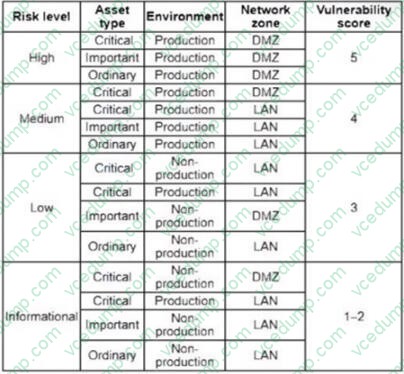
When creating a rule in the company's SIEM, which of the following would be the BEST approach for the analyst to use to assess the risk level of each vulnerability that is discovered by the vulnerability assessment tool?
A. Create a trend with the table and join the trend with the desired rule to be able to extract the risk level of each vulnerability
B. Use Boolean filters in the SIEM rule to take advantage of real-time processing and RAM to store the table dynamically, generate the results faster, and be able to display the table in a dashboard or export it as a report
C. Use a static table stored on the disk of the SIEM system to correlate its data with the data ingested by the vulnerability scanner data collector
D. Use the table as a new index or database for the SIEM to be able to use multisearch and then summarize the results as output -
Question 212:
An analyst is investigating a phishing incident and has retrieved the following as part of the investigation:
cmd.exe /c c:\Windows\System32\WindowsPowerShell\v1.0\powershell.exe -WindowStyle Hidden -ExecutionPolicy Bypass -NoLogo -NoProfile -EncodedCommand <VERY LONG STRING>
Which of the following should the analyst use to gather more information about the purpose of this command?
A. Echo the command payload content into 'base64 -d'.
B. Execute the command from a Windows VM.
C. Use a command console with administrator privileges to execute the code.
D. Run the command as an unprivileged user from the analyst workstation. -
Question 213:
A group of hacktivists has breached and exfiltrated data from several of a bank's competitors. Given the following network log output:
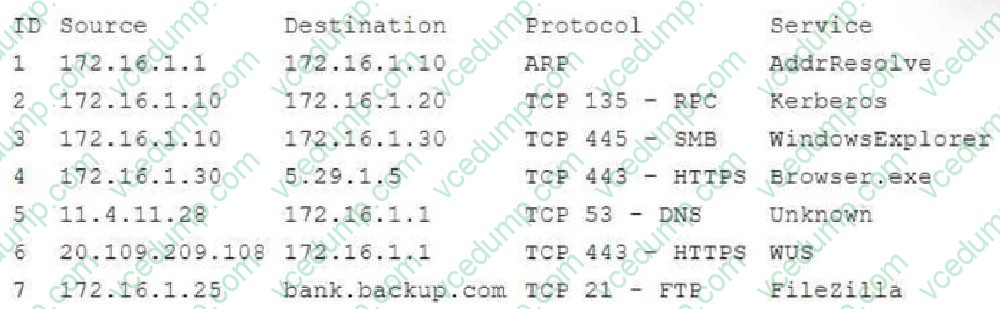
Which of the following represents the greatest concerns with regard to potential data exfiltration? (Choose two.)
A. 1
B. 2
C. 3
D. 4
E. 5
F. 6
G. 7 -
Question 214:
A cybersecurity analyst is recommending a solution to ensure emails that contain links or attachments are tested before they reach a mail server.
Which of the following will the analyst most likely recommend?
A. Sandboxing
B. MFA
C. DKIM
D. Vulnerability scan -
Question 215:
An organization wants to consolidate a number of security technologies throughout the organization and standardize a workflow for identifying security issues prioritizing the severity and automating a response.
Which of the following would best meet the organization's needs'?
A. MaaS
B. SIEM
C. SOAR
D. CI/CD -
Question 216:
An auditor is reviewing an evidence log associated with a cybercrime. The auditor notices that a gap exists between individuals who were responsible for holding onto and transferring the evidence between individuals responsible for the investigation.
Which of the following best describes the evidence handling process that was not properly followed?
A. Validating data integrity
B. Preservation
C. Legal hold
D. Chain of custody -
Question 217:
A virtual web server in a server pool was infected with malware after an analyst used the internet to research a system issue. After the server was rebuilt and added back into the server pool, users reported issues with the website, indicating the site could not be trusted.
Which of the following is the most likely cause of the server issue?
A. The server was configured to use SSL to securely transmit data.
B. The server was supporting weak TLS protocols for client connections.
C. The malware infected all the web servers in the pool.
D. The digital certificate on the web server was self-signed. -
Question 218:
Which of the following best describes the document that defines the expectation to network customers that patching will only occur between 2:00 a.m. and 4:00 a.m.
?
A. SLA
B. LOI
C. MOU
D. KPI -
Question 219:
Which of the following best describes the goal of a disaster recovery exercise as preparation for possible incidents?
A. To provide metrics and test continuity controls
B. To verify the roles of the incident response team
C. To provide recommendations for handling vulnerabilities
D. To perform tests against implemented security controls -
Question 220:
A security analyst s monitoring a company's network traffic and finds ping requests going to accounting and human resources servers from a SQL server. Upon investigation, the analyst discovers a technician responded to potential network connectivity issues.
Which of the following is the best way for the security analyst to respond?
A. Report this activity as a false positive, as the activity is legitimate.
B. Isolate the system and begin a forensic investigation to determine what was compromised.
C. Recommend network segmentation to the management team as a way to secure the various environments.
D. Implement host-bases firewalls on all systems to prevent ping sweeps in the future.
Related Exams:
-
220-1001
CompTIA A+ Certification: Core 1 -
220-1002
CompTIA A+ Certification: Core 2 -
220-1101
CompTIA A+ Certification: Core 1 -
220-1102
CompTIA A+ Certification: Core 2 -
220-1201
CompTIA A+ Certification: Core 1 -
220-1202
CompTIA A+ Core 2 (2026) -
220-902
CompTIA A+ Certification -
CAS-004
CompTIA Advanced Security Practitioner (CASP+) -
CAS-005
CompTIA SecurityX -
CLO-001
CompTIA Cloud Essentials+
Tips on How to Prepare for the Exams
Nowadays, the certification exams become more and more important and required by more and more enterprises when applying for a job. But how to prepare for the exam effectively? How to prepare for the exam in a short time with less efforts? How to get a ideal result and how to find the most reliable resources? Here on Vcedump.com, you will find all the answers. Vcedump.com provide not only CompTIA exam questions, answers and explanations but also complete assistance on your exam preparation and certification application. If you are confused on your CS0-003 exam preparations and CompTIA certification application, do not hesitate to visit our Vcedump.com to find your solutions here.