AICPA CPA-TEST Online Practice
Questions and Exam Preparation
CPA-TEST Exam Details
Exam Code
:CPA-TEST
Exam Name
:Certified Public Accountant Test: Auditing and Attestation, Business Environment and Concepts, Financial Accounting and Reporting, Regulation
Certification
:AICPA Certifications
Vendor
:AICPA
Total Questions
:1241 Q&As
Last Updated
:Jun 03, 2026
AICPA CPA-TEST Online Questions &
Answers
Question 611:
Which of the following statements is correct concerning liability when a partner in a general partnership commits a tort while engaged in partnership business?
A. The partner committing the tort is the only party liable. B. The partnership is the only party liable. C. Each partner is jointly and severally liable. D. Each partner is liable to pay an equal share of any judgment.
C. Each partner is jointly and severally liable. Choice "c" is correct. Each partner is jointly and severally liable for torts committed by any partner while in the course of partnership business. Choice "a" is incorrect. All partners may be held liable for a tort committed by a partner in the course of partnership business. Choice "b" is incorrect. Each partner is liable for torts committed by any partner while in the course of partnership business. Choice "d" is incorrect. Each partner is liable for the full amount of damages incurred as a result of a partner's tort; the partners are not liable only for their pro rata share.
Question 612:
Cobb, Inc., a partner in TLC Partnership, assigns its partnership interest to Bean, who is not made a partner. After the assignment, Bean asserts the rights to:
A. Participate in the management of TLC. II. Cobb's share of TLC's partnership profits. Bean is correct as to which of these rights? B. I only. C. II only. D. I and II. E. Neither I nor II.
B. I only. Choice "b" is correct. Rule: The assignee of a partner's interest in the partnership does not thereby become a partner absent the unanimous consent of the other partners. Thus, the assignee has no right to participate in the management of the partnership and has only a right to receive the assignor's share of the partnership profits. Choices "a", "c", and "d" are incorrect, per the above rules.
Question 613:
The kinked demand curve is associated with:
A. The analysis of agricultural markets. B. The analysis of monopolistic competition. C. The analysis of pure competition. D. The analysis of oligopoly.
D. The analysis of oligopoly. Choice "d" is correct. The demand curve for any individual oligopolist is kinked sharply downward. This occurs because, in oligopoly market conditions, the other firms in the market will match any price reduction so they do not lose market share but will not match any price increase of an individual firm. Therefore, for the individual firm attempting to raise its prices beyond equilibrium, consumers will quickly buy from other firms in the market and demand will drop off sharply creating a kinked demand curve. Choices "a", "b", and "c" are incorrect, per the explanation above.
Question 614:
When disclaiming an opinion due to a client-imposed scope limitation, an auditor should indicate in a separate paragraph why the audit did not comply with generally accepted auditing standards. The auditor should also omit the:
A. Option A B. Option B C. Option C D. Option D
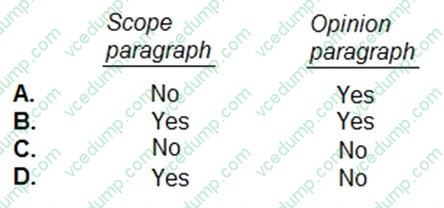
D. Option D Choice "d" is correct. When disclaiming an opinion because of scope limitations, the auditor should indicate in a separate paragraph(s) the reasons that the audit did not comply with GAAS. The auditor should also omit the scope paragraph. The opinion paragraph is not omitted; however, it indicates that no opinion is expressed. Choices "a", "b", and "c" are incorrect, as per the above explanation.
Question 615:
ABC Corp.'s trial balance of Income Statement Accounts for the year ended December 31, 1988 as follows:
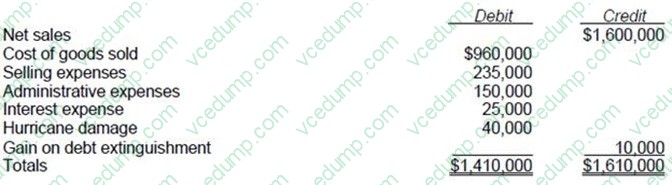
ABC's income tax rate is 30%. The gain on debt extinguishment is considered a usual and recurring part of ABC's operations. The hurricane is considered an unusual and infrequent event. ABC prepares a multiple- step income statement for
1988.
Net income is:
A. $140,000 B. $161,000 C. $168,000 D. $200,000
A. $140,000 Choice "a" is correct. $140,000. Net income is the "bottom line" amount after all has been considered on the income statement. Without showing all the line items as required for the income statement, the "bottom line" amount of $140,000 is derived as follows:
Question 616:
During 1994, ABC Corp. experienced the following power outages:
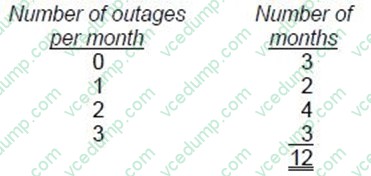
Each power outage results in out-of-pocket costs of $400. For $500 per month, ABC can lease an auxiliary generator to provide power during outages. If ABC leases an auxiliary generator in 1995, the estimated savings (or additional
expenditures) for 1995 would be:
A. ($3,600) B. ($1,200) C. $1,600 D. $1,900
C. $1,600 Explanation Explanation/Reference:Choice "c" is correct. Choice "a" is incorrect. The estimated savings is dependent on the number of outages and on the number of months, since there are two costs involved. Choice "b" is incorrect. The estimated savings is not the difference between the out-of-pocket costs and cost of generator, times 12 months. Choice "d" is incorrect. The cost of the generator is a monthly cost, not dependent on the number of power outages.
Question 617:
Which of the following is a true statement regarding documentation requirements for analytical procedures?
A. When an analytical procedure is used as the principal substantive test of a significant financial statement assertion, the auditor is required to document the reasons analytical procedures were performed instead of tests of details. B. When an analytical procedure is used as the principal substantive test of a significant financial statement assertion, the auditor is required to document his or her expectation and management's concurrence with that expectation. C. When an analytical procedure is used during the overall review stage of the audit, the auditor is required to document the auditor's expectation and any additional procedures performed to investigate significant unexplained differences. D. When an analytical procedure is used as the principal substantive test of a significant financial statement assertion, the auditor is required to document both the auditor's expectation and the factors considered in developing that expectation.
D. When an analytical procedure is used as the principal substantive test of a significant financial statement assertion, the auditor is required to document both the auditor's expectation and the factors considered in developing that expectation. Choice "d" is correct. When an analytical procedure is used as the principal substantive test of a significant financial statement assertion, the auditor is required to document both the auditor's expectation and the factors considered in developing that expectation. Choice "a" is incorrect. There is no requirement that the auditor document the reasons analytical procedures were performed instead of tests of details. Choice "b" is incorrect. There is no requirement that the auditor document management's concurrence with the expectation. Choice "c" is incorrect. When an analytical procedure is performed during the overall review stage, there are no specific documentation requirements. The requirement that the auditor document the expectation and any additional procedures performed to investigate significant unexplained differences relates to analytical procedures performed as principal substantive tests.
Question 618:
Which of the following factors most likely would lead a CPA to conclude that a potential audit engagement should be rejected?
A. The details of most recorded transactions are not available after a specified period of time. B. Internal control activities requiring the segregation of duties are subject to management override. C. It is unlikely that sufficient appropriate evidence is available to support an opinion on the financial statements. D. Management has a reputation for consulting with several accounting firms about significant accounting issues.
C. It is unlikely that sufficient appropriate evidence is available to support an opinion on the financial statements. Choice "c" is correct. A CPA cannot render an opinion on financial statements unless he or she has obtained sufficient appropriate audit evidence supporting that opinion. If such evidence were unlikely to be available, the CPA would most likely reject the potential audit engagement. Choice "a" is incorrect. The auditor takes the availability of information into account when planning the audit, and would need to perform testing throughout the period, but this would not be cause for rejecting a potential audit engagement. Choice "b" is incorrect. The risk of management override is considered during planning and would not be cause for rejecting a potential audit engagement. Choice "d" is incorrect. Management may consult with several accounting firms, and this would not be cause for rejecting a potential audit engagement.
Question 619:
In an audit of contingent liabilities, which of the following procedures would be least effective?
A. Reviewing a bank confirmation letter. B. Examining customer confirmation replies. C. Examining invoices for professional services. D. Reading the minutes of the board of directors.
B. Examining customer confirmation replies. Choice "b" is correct. Customer confirmations relate to receivables, and would not be likely to disclose a contingent liability. Choice "a" is incorrect. A standard bank confirmation will most likely identify contingent liabilities because it contains confirmation of discounted drafts and/or guarantees of notes and/or other open letters of credit. Choice "c" is incorrect. Examining professional invoices may disclose a contingent liability. For example, invoices from attorneys may provide information regarding litigation, claims, and assessments. Choice "d" is incorrect. Reviewing the board minutes may identify a contingent liability. For example, the board may discuss contingencies during one of its meetings. Other procedures that may be effective in an audit of contingent liabilities include: Discussing long-term purchase commitments with the purchasing agent. Reviewing long-term leases. Obtaining a client representation letter.
Question 620:
An auditor was engaged to conduct a performance audit of a governmental entity in accordance with Government Auditing Standards. These standards do not require, as part of this auditor's report:
A. A statement of the audit objectives and a description of the audit scope. B. Indications or instances of illegal acts that could result in criminal prosecution discovered during the audit. C. The pertinent views of the entity's responsible officials concerning the auditor's findings. D. A concurrent opinion on the financial statements taken as a whole.
D. A concurrent opinion on the financial statements taken as a whole. Choice "d" is correct. A concurrent opinion on the financial statements taken as a whole is not a required part of the auditor's report. Choice "a" is incorrect. A statement of the audit objectives and a description of the audit scope are required parts of the auditor's report. Choice "b" is incorrect. The auditor would provide indications of illegal acts discovered during the audit. Choice "c" is incorrect. The pertinent views of the entity's responsible officials concerning the auditor's findings are generally part of the auditor's report.
Nowadays, the certification exams become more and more important and required by more and more
enterprises when applying for a job. But how to prepare for the exam effectively? How to prepare
for the exam in a short time with less efforts? How to get a ideal result and how to find the
most reliable resources? Here on Vcedump.com, you will find all the answers.
Vcedump.com provide not only AICPA exam questions,
answers and explanations but also complete assistance on your exam preparation and certification
application. If you are confused on your CPA-TEST exam preparations
and AICPA certification application, do not hesitate to visit our
Vcedump.com to find your solutions here.