CCBA Exam Details
-
Exam Code
:CCBA -
Exam Name
:Certification of Competency in Business Analysis (CCBA) -
Certification
:IIBA Certifications -
Vendor
:IIBA -
Total Questions
:522 Q&As -
Last Updated
:Jul 14, 2026
IIBA CCBA Online Questions & Answers
-
Question 71:
You are the business analyst for your organization and you're creating the requirements package. In this documentation, to what level should you document the requirements for your stakeholders?
A. All requirements should be clearly defined with technical, business, functional, and non- functional attributes.
B. All requirements should be defined only to the extent needed to assure understanding by the team.
C. All requirements should be defined to the extent the organizational process assets demand.
D. All requirements should be defined in detail to the work package level of WBS. -
Question 72:
A business analyst needs to prepare the requirements package for her endeavor in a predefined template for her company. What term can be assigned to this standardized template for packaging the requirements?
A. Organizational process assets
B. Derivative adaption
C. Essential
D. Enterprise environmental factors -
Question 73:
A business. analyst (BA) is working on a project to implement a commercial off-the-shelf application for tracking customers. In an observation session with a Domain subject matter expert (SMF). the BA notes that the SME keeps separate records for the customers who are also vendors. The BA knows that the new software has a module for vendor management that would integrate the vendor and customer records. Which type of opportunity has the BA identified?
A. Reduction of duplicate tasks performed by staff
B. Potential to provide future value supported by the system
C. Ability to provide greater amount of information to staff
D. Automation to increase consistency of behavior -
Question 74:
As a business analyst in your organization, you must understand the difference between operative rules and structural rules. What is the difference between structural rules and operative rules?
A. Structural rules are rules that the organization chooses to enforce as a matter of policy. Operative rules are intended to help determine when something is or is not true, or when things fall into a specific category.
B. Operative rules are rules that the organization chooses to enforce as a matter of policy. Structural rules are intended to help determine when something is or is not true, or when things fall into a specific category.
C. Operative rules are rules that describe the organizational process assets of the organization. Structural rules are policies that restrict the authority of each line of business.
D. Operative rules are rules that define how an organization operates. Structural rules define the boundaries of the structure, business units, and departments within the organization. -
Question 75:
Verification of requirements on the projects have highlighted an issue regarding misunderstanding of design models among key stakeholders. A major reason cited for the misunderstanding was the technical jargon and models used in the documentation. What must the business analyst (BA) do to improve the understanding?
A. Ensure completeness within the models used
B. Verify that elements within the models are used consistently
C. Represent design models using common terminology
D. Check for compliance with organization standards -
Question 76:
The following chart represents attendance of subject matter experts (SME) and the solution owner for a requirements review and approval meeting held weekly by a business analyst (BA).
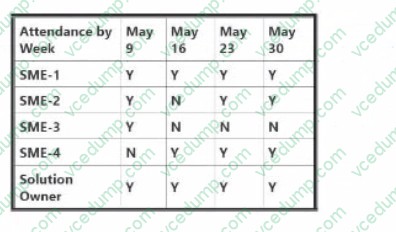
The requirements package was approved by the solution owner during the May 30 meeting. After implementation of the solution, the BA learns that the users in SME-3 s area are not using the system. Which business analysis activity should the BA have monitored more closely to mitigate this situation?
A. Business processes
B. Requirements scope
C. Solution performance
D. Stakeholder engagement -
Question 77:
Which of the following is an output of the Identify Stakeholders process?
A. Scope baseline
B. Project charter
C. Stakeholder register
D. Project scope statement -
Question 78:
A business analyst (BA) is working on a project that has a number of stakeholder conflicts and issues. The BA is finding it difficult to resolve the conflicts and issues effectively. What should the BA do to prevent a similar situation in the future?
A. Plan business analysis governance
B. Verify requirements
C. Perform stakeholder analysis
D. Validate requirements -
Question 79:
A business analyst (BA) is designing solutions for a set of requirements and finds that there is an opportunity to improve the operations of the business. Which of the following is an opportunity for improvement the BA could recommend?
A. Create a solution by constructing a number of solution components to meet the requirements
B. Enable the solutions that will satisfy the highest priority requirements and stakeholder needs
C. Provide information to staff so they can answer customer inquiries directly themselves
D. Purchase software that contains features that are not currently required but are included for free -
Question 80:
You are the business analyst for your organization and you're creating a data flow diagram to show how information is input, processed, stored, and output from a system. Which element of a data flow diagram represents a process that transforms data by combining it with other data?
A. Data flow
B. External entities
C. Data process D. Concatenation
Related Exams:
-
CBAP
Cetified business analysis professional (CBAP) -
CBDA
Certification in Business Data Analytics (CBDA) -
CCBA
Certification of Competency in Business Analysis (CCBA) -
ECBA
Entry Certificate in Business Analysis (ECBA) -
IIBA-AAC
IIBA Agile Analysis Certification (AAC) -
IIBA-CCA
Certificate in Cybersecurity Analysis (CCA) -
IIBA-CPOA
Certificate in Product Ownership Analysis (IIBA-CPOA)
Tips on How to Prepare for the Exams
Nowadays, the certification exams become more and more important and required by more and more enterprises when applying for a job. But how to prepare for the exam effectively? How to prepare for the exam in a short time with less efforts? How to get a ideal result and how to find the most reliable resources? Here on Vcedump.com, you will find all the answers. Vcedump.com provide not only IIBA exam questions, answers and explanations but also complete assistance on your exam preparation and certification application. If you are confused on your CCBA exam preparations and IIBA certification application, do not hesitate to visit our Vcedump.com to find your solutions here.