AZ-700 Exam Details
-
Exam Code
:AZ-700 -
Exam Name
:Designing and Implementing Microsoft Azure Networking Solutions -
Certification
:Microsoft Certifications -
Vendor
:Microsoft -
Total Questions
:452 Q&As -
Last Updated
:Jul 16, 2026
Microsoft AZ-700 Online Questions & Answers
-
Question 241:
HOTSPOT
You have the Azure environment shown in the exhibit.
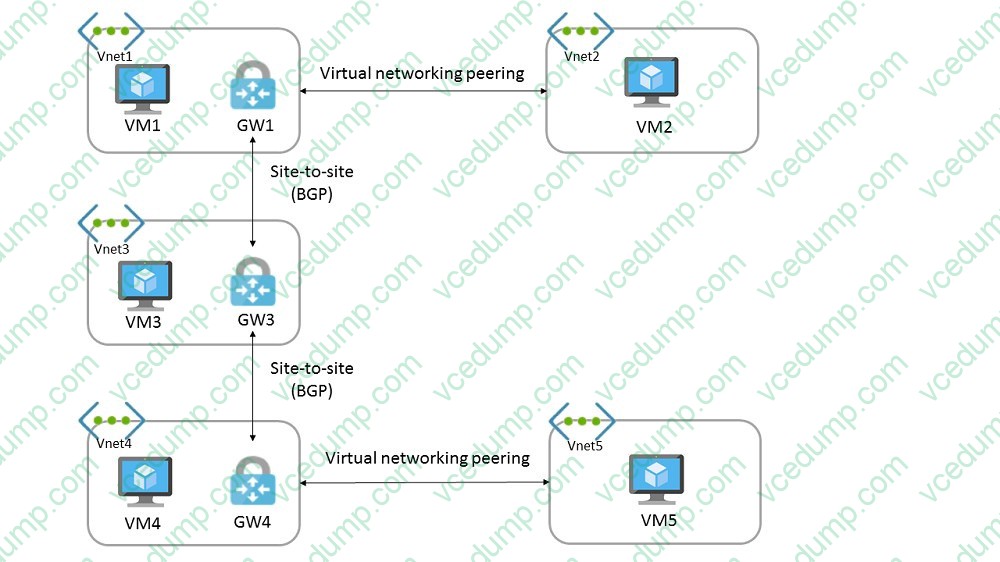
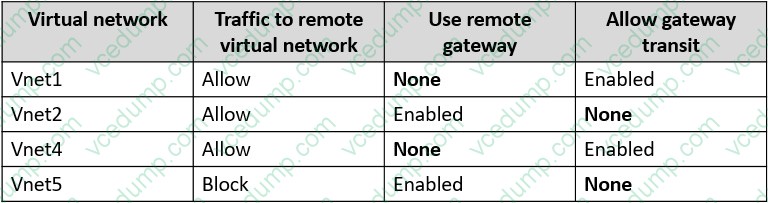
You have virtual network peering between Vnet1 and Vnet2. You have virtual network peering between Vnet4 and Vnet5. The virtual network peering is configured as shown in the following table.
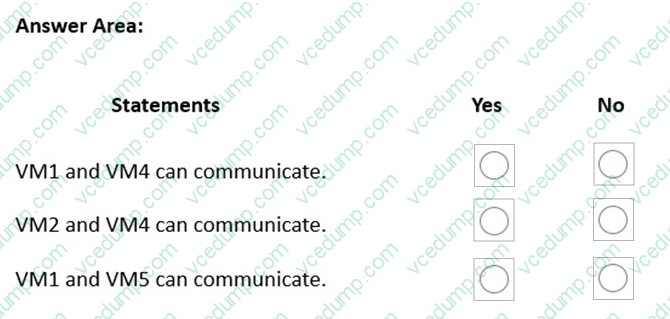
For each of the following statements, select Yes if the statement is true. Otherwise, select No.
-
Question 242:
You have the Azure subscriptions shown in the following table.
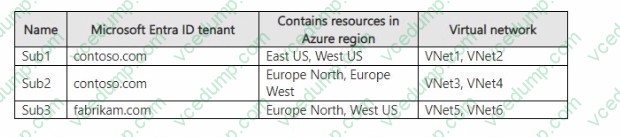
Each virtual network contains 20 internet-accessible resources that are assigned public IP addresses.
You need to implement Azure DDoS Network Protection to protect the resources. The solution must minimize costs.
What is the minimum number of DDoS Network Protection plans you should deploy?
A. 1
B. 2
C. 3
D. 6 -
Question 243:
HOTSPOT
You have an Azure subscription.
You plan 10 implement an Azure application gateway named AGW1.
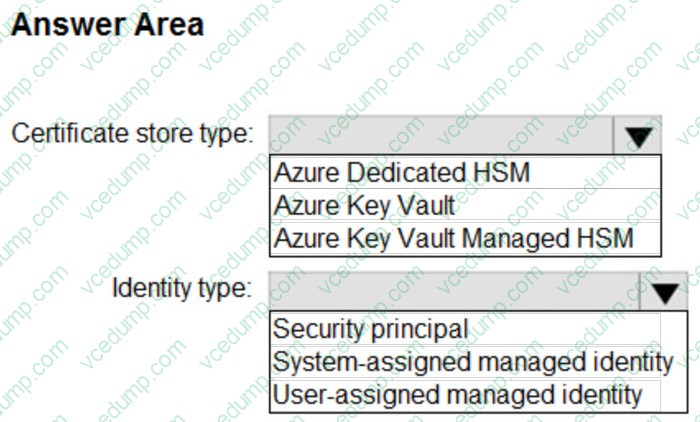
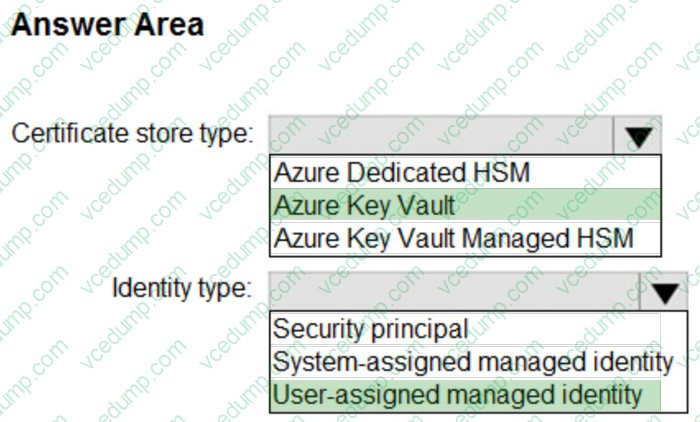
You need to implement an external TLS certificate store for AGW1. The solution must meet the following requirements:
1. Keys must be stored by using the highest possible security.
2. Administrative effort must be minimized.
Which type of certificate store should you use, and which type of identity should you use to access the store? To answer, select the appropriate options in the answer area.
NOTE: Each correct answer is worth one point.
-
Question 244:
You have an Azure subscription that contains the following resources:
1. A virtual network named Vnet1
2. Two subnets named subnet1 and AzureFirewallSubnet
3. A public Azure Firewall named FW1
4. A route table named RT1 that is associated to Subnet1
5. A rule routing of 0.0.0.0/0 to FW1 in RT1
After deploying 10 servers that run Windows Server to Subnet1, you discover that none of the virtual machines were activated.
You need to ensure that the virtual machines can be activated.
What should you do?
A. On FW1, create an outbound service tag rule for AzureCloud.
B. On FW1, create an outbound network rule that allows traffic to the Azure Key Management Service (KMS).
C. On FW1, configure a DNAT rule for port 1688.
D. To Subnet1, associate a network security group (NSG) that allows outbound access to port 1688. -
Question 245:
HOTSPOT
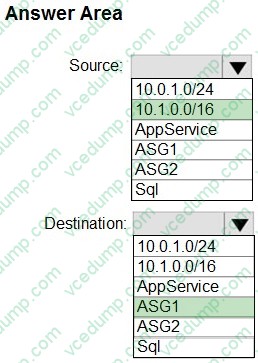
You have an Azure subscription that contains the resources shown in the following table:
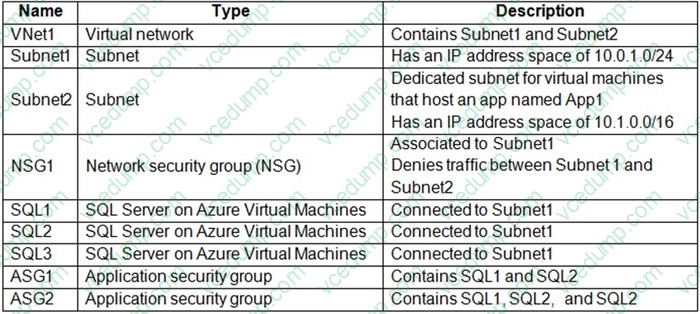
Each quarter, you deploy five new virtual machines to host App1.
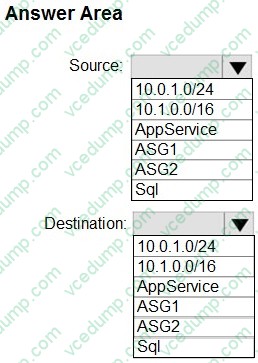
You need to add a rule to NSG1 to ensure that the virtual machines that host App1 can connect to SQL1 and SQL2. The solution must follow the principle of least privilege and minimize administrative effort.
How should you configure the source property and the destination property for the rule? To answer, select the appropriate options in the answer area.
NOTE: Each correct selection is worth one point.
-
Question 246:
You have an on-premises network named Site1.
You have an Azure subscription that contains a storage account named storage1 and a virtual network named VNet1.
VNet1 contains a subnet named Subnet1. A private endpoint for storage1 is connected to Subnet1 Site1 is connected to VNet1 by using a Site-to-Site (S2S) VPN.
You need to control access to storage1 from Site1 by using network security groups (NSGs).
What should you do first?
A. Associate a route table with Subnet1.
B. Associate a NAT gateway with Subnet1.
C. Configure a network policy for private endpoints on Subnet1.
D. Create a subnet delegation on Subnet1. -
Question 247:
HOTSPOT
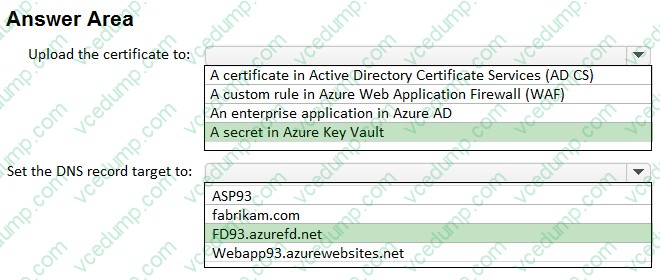
You are planning an Azure Front Door deployment that will contain the resources shown in the following table.

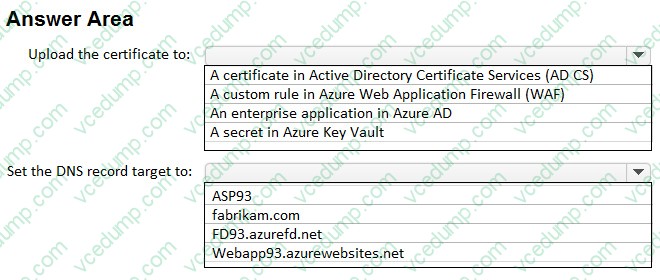
Users will connect to the App Service through Front Door by using a URL of https://www.fabrikarn.com.Youobtainacertificateforthehostnameofwww.fabfikam.com.YouneedtoconfigureaDNSrecordforwww.fabrikam.comanduploadthecertificatetoAzure.Whatshouldyoudo?Toanswer,selecttheappropriateoptionsintheanswerarea.NOTE:Eachcorrectselectionisworthonepoint.
-
Question 248:
Which virtual machines can VM4 ping successfully?
A. VM3 only
B. VM1 and VM3 only
C. VM1, VM2 and VM3 only
D. VM1, VM2, VM3 and VM5 -
Question 249:
You have an Azure subscription that contains a virtual network named VNet1 and the resources shown in the following table.
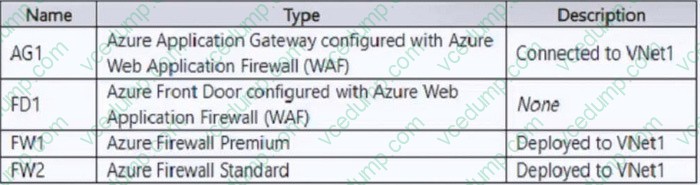
You need to implement a solution for the traffic originating from VNet1. The solution must meet the following requirements:
1. Perform transparent proxying to external web servers.
2. Inspect all outbound TLS traffic.
3. Minimize costs.
Which resource should you include in the solution?
A. FW2
B. AG1
C. FD1
D. FW1 -
Question 250:
DRAG DROP
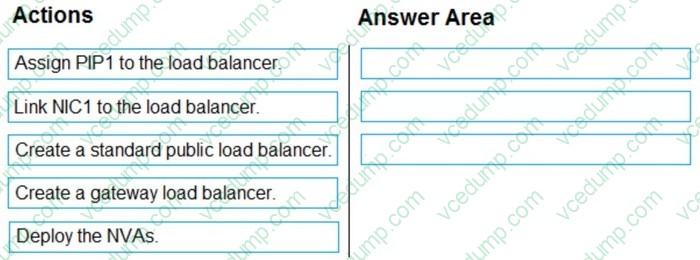
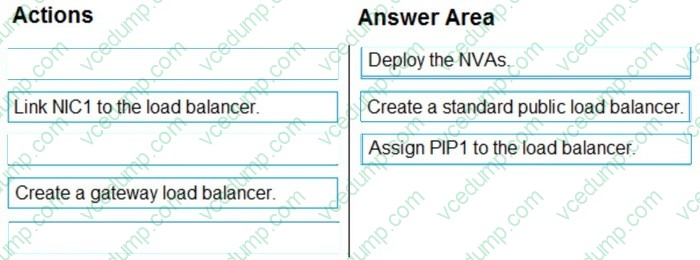
You have an Azure subscription that contains a virtual machine named VM1. VM1 contains a NIC named NIC1 and a public IP address named PIP1. PIP1 is assigned to NIC1.
You plan to deploy four Network Virtual Appliances (NVAs).
You need to ensure that all the inbound traffic from the internet to PIP1 is inspected by the NVAs. The solution must ensure that the NVA deployment is highly available.
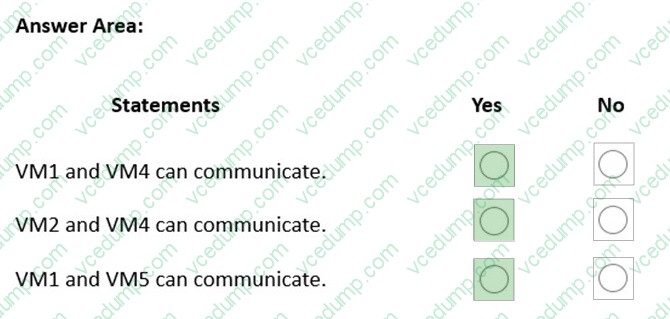
Which three actions should you perform in sequence? To answer, move the appropriate actions from the list of actions to the answer area and arrange them in the correct order.
Select and Place:
Related Exams:
-
62-193
Technology Literacy for Educators -
70-243
Administering and Deploying System Center 2012 Configuration Manager -
70-355
Universal Windows Platform – App Data, Services, and Coding Patterns -
77-420
Excel 2013 -
77-427
Excel 2013 Expert Part One -
77-725
Word 2016 Core Document Creation, Collaboration and Communication -
77-726
Word 2016 Expert Creating Documents for Effective Communication -
77-727
Excel 2016 Core Data Analysis, Manipulation, and Presentation -
77-728
Excel 2016 Expert: Interpreting Data for Insights -
77-731
Outlook 2016 Core Communication, Collaboration and Email Skills
Tips on How to Prepare for the Exams
Nowadays, the certification exams become more and more important and required by more and more enterprises when applying for a job. But how to prepare for the exam effectively? How to prepare for the exam in a short time with less efforts? How to get a ideal result and how to find the most reliable resources? Here on Vcedump.com, you will find all the answers. Vcedump.com provide not only Microsoft exam questions, answers and explanations but also complete assistance on your exam preparation and certification application. If you are confused on your AZ-700 exam preparations and Microsoft certification application, do not hesitate to visit our Vcedump.com to find your solutions here.