AZ-305 Exam Details
-
Exam Code
:AZ-305 -
Exam Name
:Designing Microsoft Azure Infrastructure Solutions -
Certification
:Microsoft Certifications -
Vendor
:Microsoft -
Total Questions
:395 Q&As -
Last Updated
:Jul 13, 2026
Microsoft AZ-305 Online Questions & Answers
-
Question 371:
You have an Azure subscription that contains 100 virtual machines in the North Europe Azure region.
You replicate the virtual machines to the West Europe region by using Azure Site Recovery.
You plan to perform disaster recovery testing once a month. The testing will be performed during an eight-hour period, during which the virtual machines will be accessed, and their functionality validated. The virtual machines will be shut down when testing is not being performed.
You need to estimate the costs of the Site Recovery solution per month.
Which costs should the estimate include?
A. the virtual machine compute costs for only eight hours, the virtual machine storage costs for the entire month, and the Site Recovery license costs per protected virtual machine for the entire month
B. the virtual machine compute costs for the entire month, the virtual machine storage costs for all the hours each month, and the Site Recovery license costs per protected virtual machine for the entire month
C. the virtual machine compute costs for only eight hours, the virtual machine storage costs for only eight hours, and the Site Recovery license costs per protected virtual machine for only eight hours
D. the virtual machine compute costs for only eight hours, the virtual machine storage costs for only eight hours, and the Site Recovery license costs per protected virtual machine for the entire month -
Question 372:
Your company develops Azure applications.
You need to recommend a solution for deploying infrastructure across multiple Azure subscriptions.
The solution must meet the following requirements: Ensure consistent virtual machine and virtual network configurations across all subscriptions Support repeatable and automated deployments Minimize administrative effort for environment setup What should you include in the recommendation?
A. Provision resource groups.
B. Support deployments across all Azure regions.
C. Create custom role-based access control (RBAC) roles.
D. Use infrastructure-as-code (IaC) templates to standardize deployments. -
Question 373:
HOTSPOT
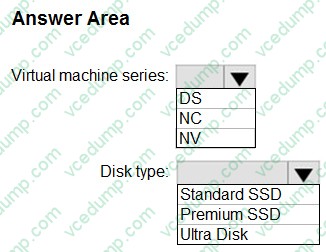
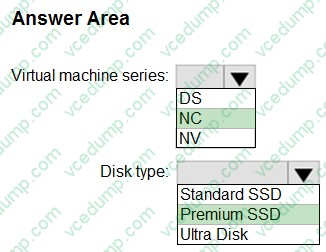
You need to deploy an instance of SQL Server on Azure Virtual Machines. The solution must meet the following requirements:
1. Support 15.000 disk IOPS.
2. Support SR-IOV.
3. Minimize costs.
What should you include in the solution?
To answer, select the appropriate options in the answer area. NOTE: Each correct selection is worth one point
-
Question 374:
You are designing an app that will include two components. The components will communicate by sending messages via a queue.
You need to recommend a solution to process the messages by using a First in. First out (FIFO) pattern.
What should you include in the recommendation?
A. storage queues with a custom metadata setting
B. Azure Service Bus queues with sessions enabled
C. Azure Service Bus queues with partitioning enabled
D. storage queues with a stored access policy -
Question 375:
HOTSPOT
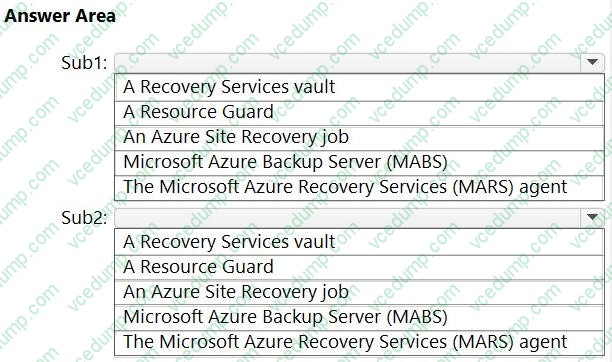
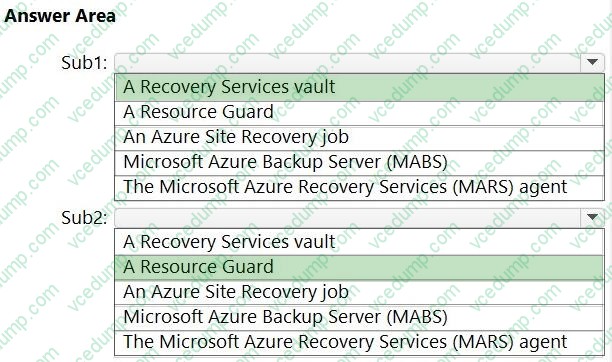
You have the Azure subscriptions shown in the following table.

Contoso.onmicrosft.com contains a user named User1.
You need to deploy a solution to protect against ransomware attacks. The solution must meet the following requirements:
1. Ensure that all the resources in Sub1 are backed up by using Azure Backup.
2. Require that User1 first be assigned a role for Sub2 before the user can make major changes to the backup configuration.
What should you create in each subscription? To answer, select the appropriate options in the answer area.
NOTE: Each correct selection is worth one point.
-
Question 376:
You have an Azure Functions microservice app named App1 that is hosted in the Consumption plan. App1 uses an Azure Queue Storage trigger.
You plan to migrate App1 to an Azure Kubernetes Service (AKS) cluster.
You need to prepare the AKS cluster to support App1. The solution must meet the following requirements:
1. Use the same scaling mechanism as the current deployment.
2. Support kubenet and Azure Container Networking Interface (CNI) networking.
Which two actions should you perform? Each correct answer presents part of the solution.
NOTE: Each correct answer is worth one point.
A. Configure the horizontal pod autoscaler.
B. Install Virtual Kubelet.
C. Configure the AKS cluster autoscaler.
D. Configure the virtual node add-on.
E. Install Kubemetes-based Event Driven Autoscaling (KEDA). -
Question 377:
DRAG DROP
You have an on-premises named App 1.
Customers App1 to manage digital images.
You plan to migrate App1 to Azure.
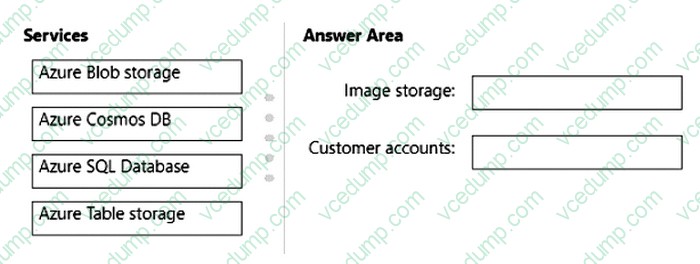
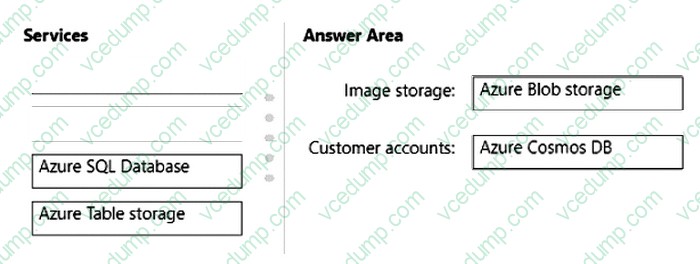
You need to recommend a data storage solution for App1. The solution must meet the following image storage requirements:
1. Encrypt images at rest.
2. Allow files up to 50 MB.
3. Manage access to the images by using Azure Web Application Firewall (WAF) on Azure Front Door.
The solution must meet the following customer account requirements:
1. Support automatic scale out of the storage.
2. Maintain the availability of App1 if a datacenter fails.
3. Support reading and writing data from multiple Azure regions.
Which service should you include in the recommendation for each type of data? To answer, drag the appropriate services to the correct type of data. Each service may be used once, more than once, or not at all. You may need to drag the split bar between panes or scroll to view content.
NOTE: Each correct answer is worth one point.
Select and Place:
-
Question 378:
What should you recommend to meet the monitoring requirements for App2?
A. VM insights
B. Azure Application Insights
C. Microsoft Sentinel
D. Container insights -
Question 379:
HOTSPOT
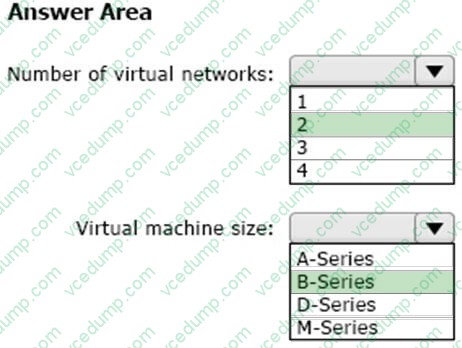
You are developing a multi-tier app named App1 that will be hosted on Azure virtual machines. The peak utilization periods for App1 will be from 8 AM to 9 AM and 4 PM to 5 PM on weekdays.
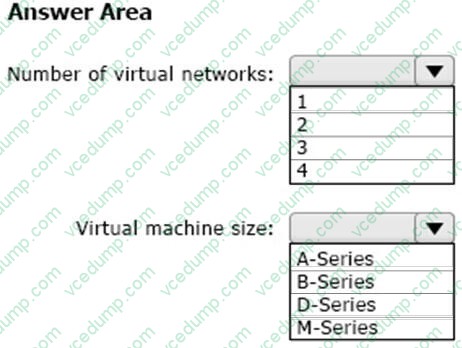
You need to deploy the infrastructure for App1. The solution must meet the following requirements:
1. Support virtual machines deployed to four availability zones across two Azure regions.
2. Minimize costs by accumulating CPU credits during periods of low utilization.
What is the minimum number of virtual networks you should deploy, and which virtual machine size should you use? To answer, select the appropriate options in the answer area.
-
Question 380:
You have 12 on-premises data sources that contain customer information and consist of Microsoft SQL Server, MySQL, and Oracle databases.
You have an Azure subscription.
You plan to create an Azure Data Lake Storage account that will consolidate the customer information for analysis and reporting.
You need to recommend a solution to automatically copy new information from the data sources to the Data Lake Storage account by using extract, transform and load (ETL). The solution must minimize administrative effort.
What should you include in the recommendation?
A. Azure Data Factory
B. Azure Data Explorer
C. Azure Data Share
D. Azure Data Studio
Related Exams:
-
62-193
Technology Literacy for Educators -
70-243
Administering and Deploying System Center 2012 Configuration Manager -
70-355
Universal Windows Platform – App Data, Services, and Coding Patterns -
77-420
Excel 2013 -
77-427
Excel 2013 Expert Part One -
77-725
Word 2016 Core Document Creation, Collaboration and Communication -
77-726
Word 2016 Expert Creating Documents for Effective Communication -
77-727
Excel 2016 Core Data Analysis, Manipulation, and Presentation -
77-728
Excel 2016 Expert: Interpreting Data for Insights -
77-731
Outlook 2016 Core Communication, Collaboration and Email Skills
Tips on How to Prepare for the Exams
Nowadays, the certification exams become more and more important and required by more and more enterprises when applying for a job. But how to prepare for the exam effectively? How to prepare for the exam in a short time with less efforts? How to get a ideal result and how to find the most reliable resources? Here on Vcedump.com, you will find all the answers. Vcedump.com provide not only Microsoft exam questions, answers and explanations but also complete assistance on your exam preparation and certification application. If you are confused on your AZ-305 exam preparations and Microsoft certification application, do not hesitate to visit our Vcedump.com to find your solutions here.