AZ-305 Exam Details
-
Exam Code
:AZ-305 -
Exam Name
:Designing Microsoft Azure Infrastructure Solutions -
Certification
:Microsoft Certifications -
Vendor
:Microsoft -
Total Questions
:395 Q&As -
Last Updated
:Jul 13, 2026
Microsoft AZ-305 Online Questions & Answers
-
Question 361:
HOTSPOT
You are designing a data analytics solution that will use Azure Synapse and Azure Data Lake Storage Gen2.
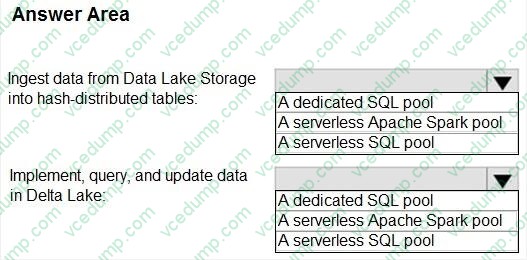
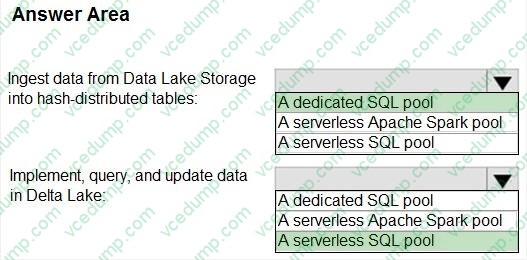
You need to recommend Azure Synapse pools to meet the following requirements:
1. Ingest data from Data Lake Storage into hash-distributed tables.
2. Implement query, and update data in Delta Lake.
What should you recommend for each requirement? To answer, select the appropriate options in the answer area.
NOTE: Each correct selection is worth one point.
-
Question 362:
Note: This question is part of a series of questions that present the same scenario. Each question in the series contains a unique solution that might meet the stated goals. Some question sets might have more than one correct solution, while others might not have a correct solution.
After you answer a question in this section, you will NOT be able to return to it. As a result, these questions will not appear in the review screen.
Your company has deployed several virtual machines (VMs) on-premises and to Azure. Azure ExpressRoute has been deployed and configured for on-premises to Azure connectivity.
Several VMs are exhibiting network connectivity issues.
You need to analyze the network traffic to determine whether packets are being allowed or denied to the VMs.
Solution: Use Azure Network Watcher to run IP flow verify to analyze the network traffic Does the solution meet the goal?
A. Yes
B. No -
Question 363:
HOTSPOT
You have an Azure subscription.
You create a storage account that will store documents.
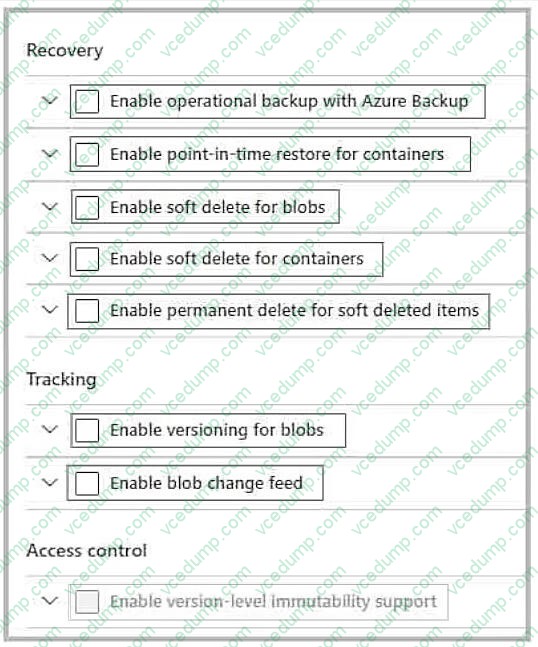
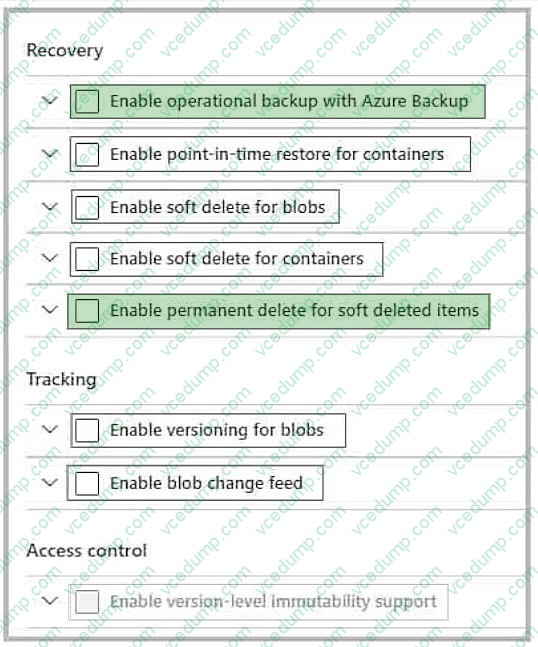
You need to configure the storage account to meet the following requirements:
1. Ensure that retention policies are standardized across the subscription.
2. Ensure that data can be purged if the data is copied to an unauthorized location.
Which two settings should you enable? To answer, select the appropriate settings in the answer area.
NOTE: Each correct selection is worth one point.
-
Question 364:
You have an Azure subscription that contains 10 web apps. The apps are integrated with Azure AD and are accessed by users on different project teams.
The users frequently move between projects.
You need to recommend an access management solution for the web apps. The solution must meet the following requirements:
1. The users must only have access to the app of the project to which they are assigned currently.
2. Project managers must verify which users have access to their project's app and remove users that are no longer assigned to their project.
3. Once every 30 days, the project managers must be prompted automatically to verify which users are assigned to their projects.
What should you include in the recommendation?
A. Azure AD Identity Protection
B. Microsoft Defender for Identity
C. Microsoft Entra Permissions Management
D. Azure AD Identity Governance -
Question 365:
You have an Azure subscription.
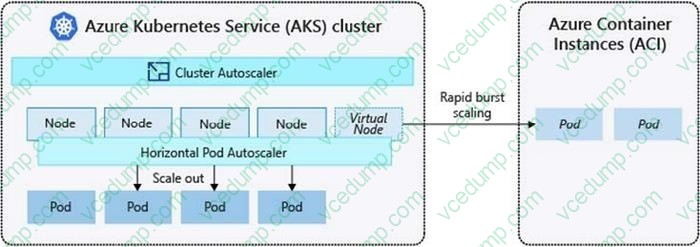
You need to deploy an Azure Kubernetes Service (AKS) solution that will use Windows Server 2019 nodes.
The solution must meet the following requirements:
1. Minimize the time it takes to provision compute resources during scale-out operations.
2. Support autoscaling of Windows Server containers.
Which scaling option should you recommend?
A. cluster autoscaler
B. horizontal pod autoscaler
C. Kubernetes version 1.20.2 or newer
D. Virtual nodes with Virtual Kubelet ACI -
Question 366:
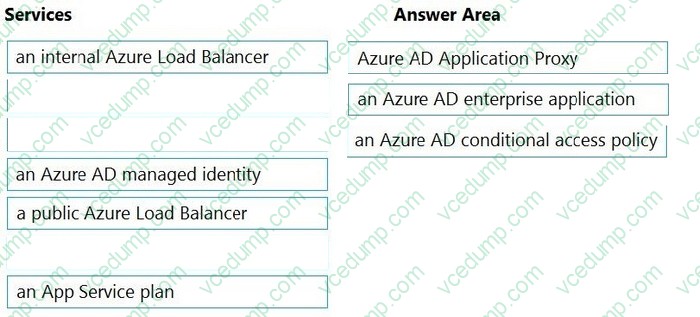
DRAG DROP
Your on-premises network contains a server named Server1 that runs an ASP.NET application named App1.
You have a hybrid deployment of Azure Active Directory (Azure AD).
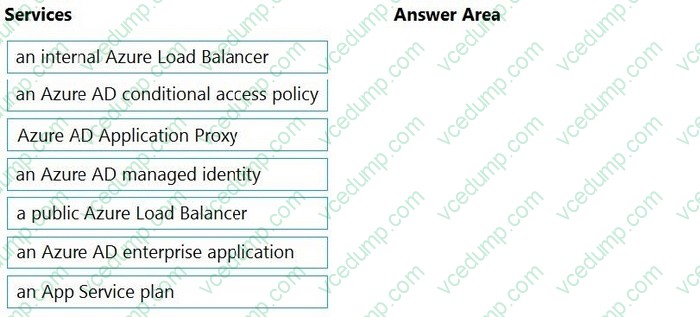
You need to recommend a solution to ensure that users sign in by using their Azure AD account and Azure Multi-Factor Authentication (MFA) when they connect to App1 from the internet.
Which three features should you recommend be deployed and configured in sequence? To answer, move the appropriate features from the list of features to the answer area and arrange them in the correct order.
Select and Place:
-
Question 367:
Note: This section contains one or more sets of questions with the same scenario and problem. Each question presents a unique solution to the problem. You must determine whether the solution meets the stated goals. More than one solution in the set might solve the problem. It is also possible that none of the solutions in the set solve the problem.
After you answer a question in this section, you will NOT be able to return. As a result, these questions do not appear on the Review Screen.
Your company, Contoso, Ltd., has a Microsoft Entra tenant named contoso.com that uses Privileged Identity Management (PIM) and is linked to an Azure subscription named Sub1.
You use Azure Backup to back up all the resources in Sub1 to a Recovery Services vault named Vault1.
An external company, Fabrikam, Inc., provides security management services to Contoso. Fabrikam has a Microsoft Entra tenant named fabrikam.com and an Azure subscription.
You need to prevent a compromised administrator account in contoso.com from modifying backup policies in Sub1 and from deleting backups from Sub1.
Solution: You configure Multi-User Authorization (MUA) in Sub1 by using a Resource Guard from fabrikam.com.
Does this meet the goal?
A. Yes
B. No -
Question 368:
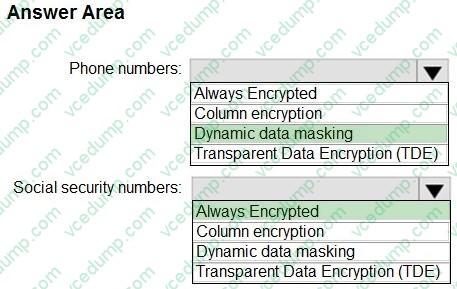
HOTSPOT
You have an Azure subscription. The subscription contains an Azure SQL managed instance that stores employee details, including social security numbers and phone numbers.
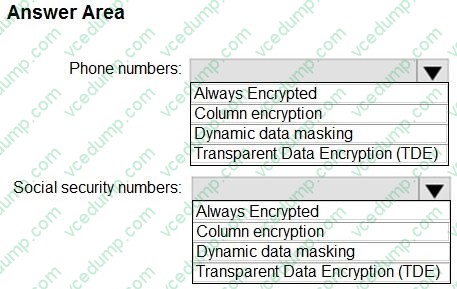
You need to configure the managed instance to meet the following requirements:
1. The helpdesk team must see only the last four digits of an employee's phone number.
2. Cloud administrators must be prevented from seeing the employee's social security numbers.
What should you enable for each column in the managed instance? To answer, select the appropriate options in the answer area.
NOTE: Each correct selection is worth one point.
-
Question 369:
You have an Azure subscription.
You need to implement a policy to ensure that all new resource groups include a value for a tag named Department.
The solution must ensure that if a value is NOT entered for the Department tag, a resource group is created.
Which effect should you use?
A. deny
B. modify
C. manual
D. deploylfNotExists -
Question 370:
HOTSPOT
Your on-premises network contains an Active Directory Domain Services (AD DS) forest. The forest contains a top-level domain, three child domains, and an on-premises server named Server1.
You have a Microsoft Entra tenant. Server1 uses Microsoft Entra Connect Sync to replicate all the user objects from the three child domains to the tenant.
New contractors and employees are onboarded manually by using the Workday cloud-based human resources (HR) application.
You plan to automatically provision accounts for new users in one of the on-premises child domains and the Microsoft Entra tenant. The provisioning logic for the employees will be distinct from the provisioning logic for the contractors.
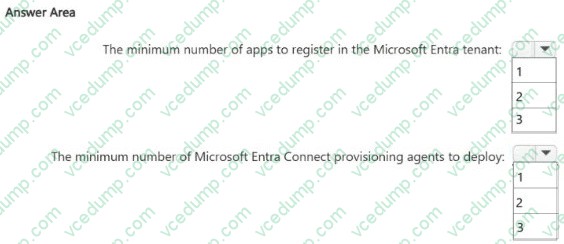
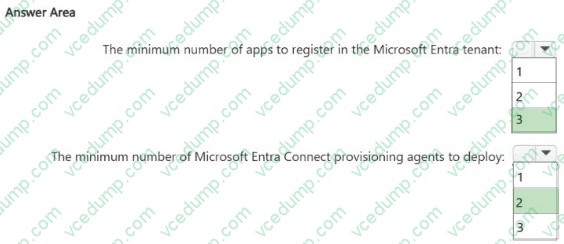
You need to identify the following:
The minimum number of apps to register in the Microsoft Entra tenant
The minimum number of Microsoft Entra Connect provisioning agents to deploy
The solution must minimize implementation effort.
What should you identify? To answer, select the appropriate options in the answer area.
NOTE: Each correct selection is worth one point.
Related Exams:
-
62-193
Technology Literacy for Educators -
70-243
Administering and Deploying System Center 2012 Configuration Manager -
70-355
Universal Windows Platform – App Data, Services, and Coding Patterns -
77-420
Excel 2013 -
77-427
Excel 2013 Expert Part One -
77-725
Word 2016 Core Document Creation, Collaboration and Communication -
77-726
Word 2016 Expert Creating Documents for Effective Communication -
77-727
Excel 2016 Core Data Analysis, Manipulation, and Presentation -
77-728
Excel 2016 Expert: Interpreting Data for Insights -
77-731
Outlook 2016 Core Communication, Collaboration and Email Skills
Tips on How to Prepare for the Exams
Nowadays, the certification exams become more and more important and required by more and more enterprises when applying for a job. But how to prepare for the exam effectively? How to prepare for the exam in a short time with less efforts? How to get a ideal result and how to find the most reliable resources? Here on Vcedump.com, you will find all the answers. Vcedump.com provide not only Microsoft exam questions, answers and explanations but also complete assistance on your exam preparation and certification application. If you are confused on your AZ-305 exam preparations and Microsoft certification application, do not hesitate to visit our Vcedump.com to find your solutions here.