AZ-204 Exam Details
-
Exam Code
:AZ-204 -
Exam Name
:Developing Solutions for Microsoft Azure -
Certification
:Microsoft Certifications -
Vendor
:Microsoft -
Total Questions
:588 Q&As -
Last Updated
:Jul 12, 2026
Microsoft AZ-204 Online Questions & Answers
-
Question 481:
DRAG DROP
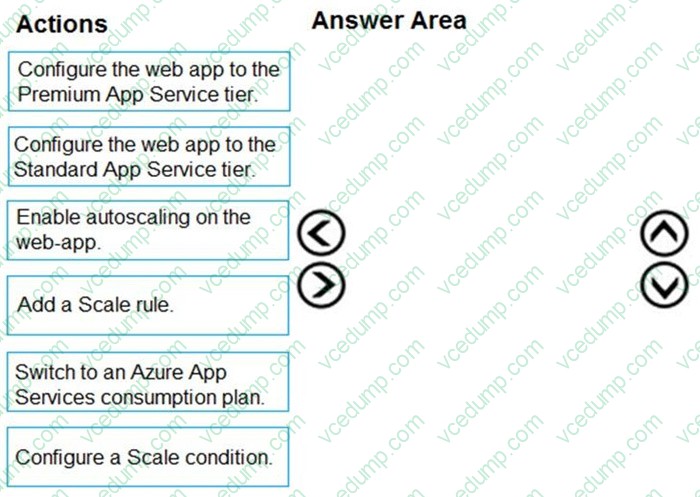
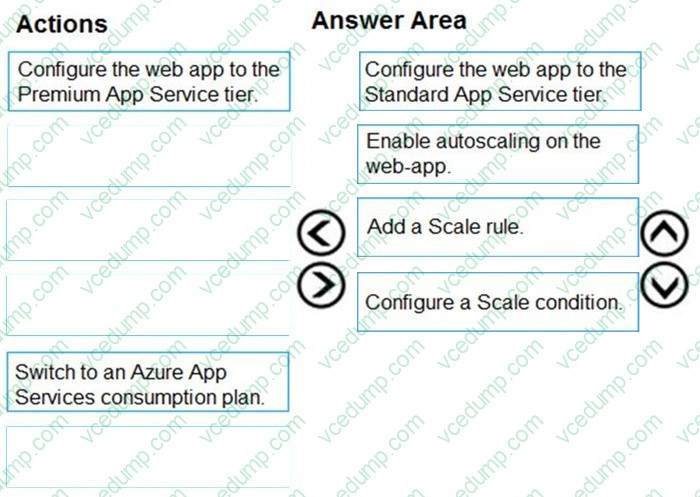
You develop a web app that uses tier D1 app service plan by using the Web Apps feature of Microsoft Azure App Service.
Spikes in traffic have caused increases in page load times.
You need to ensure that the web app automatically scales when CPU load is about 85 percent and minimize costs.
Which four actions should you perform in sequence? To answer, move the appropriate actions from the list of actions to the answer area and arrange them in the correct order.
NOTE: More than one order of answer choices is correct. You will receive credit for any of the correct orders you select.
Select and Place:
-
Question 482:
Note: This question is part of a series of questions that present the same scenario. Each question in the series contains a unique solution that might meet the stated goals. Some question sets might have more than one correct solution, while others might not have a correct solution.
After you answer a question in this section, you will NOT be able to return to it. As a result, these questions will not appear in the review screen.
You develop an HTTP triggered Azure Function app to process Azure Storage blob data. The app is triggered using an output binding on the blob.
The app continues to time out after four minutes. The app must process the blob data.
You need to ensure the app does not time out and processes the blob data.
Solution: Configure the app to use an App Service hosting plan and enable the Always On setting.
Does the solution meet the goal?
A. Yes
B. No -
Question 483:
HOTSPOT
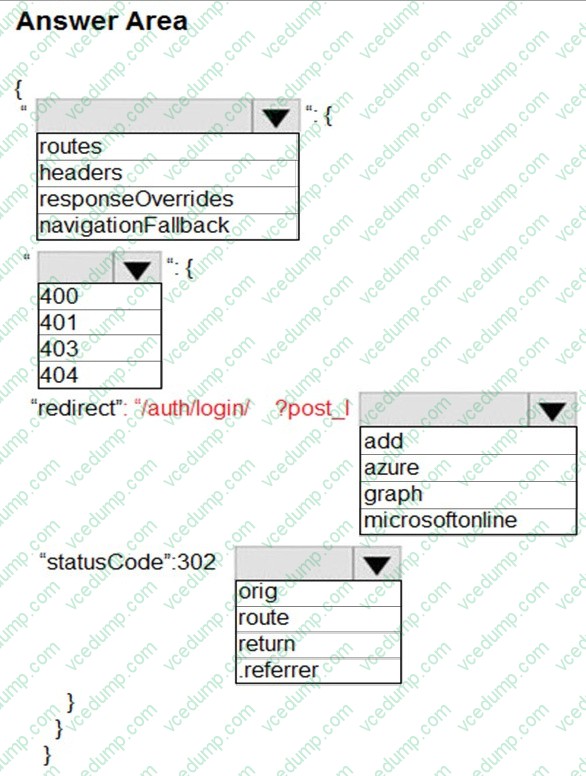
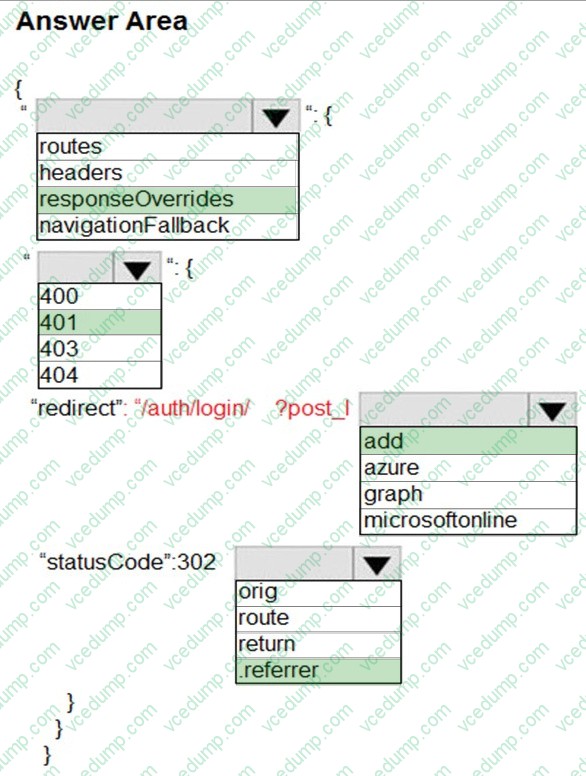
You are developing an Azure Static Web app that contains training materials for a tool company. Each tool's training material is contained In a static web page that Is linked from the tool's publicly available description page.
A user must be authenticated using Azure AD prior to viewing training.
You need to ensure.
That the user can view training material pages after authentication.
How should you complete the configuration file? To answer, select the appropriate options In the answer area.
NOTE: Each correct selection is worth one point.
-
Question 484:
You have a Standard tier instance of Azure Cache for Radis named redis1 configured with the default settings.
You need to configure a Maxmemory policy to increase the amount of cache available for read operations.
How should you configure the Maxmemory policy?
A. Decrease the value of maxmemory-reserved.
B. Increase the value of maxmemory-reserved.
C. Set the Maxmemory policy to noeviction.
D. Set the Maxmemory policy to volatile-lru. -
Question 485:
HOTSPOT
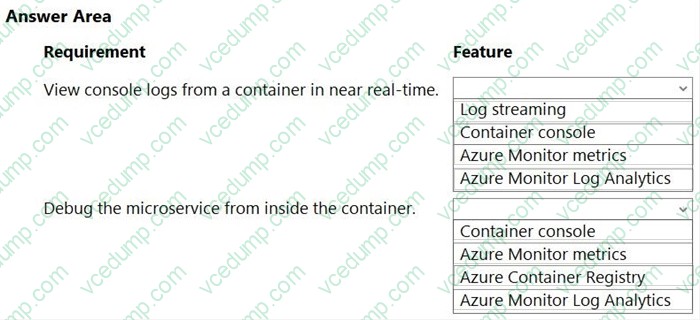
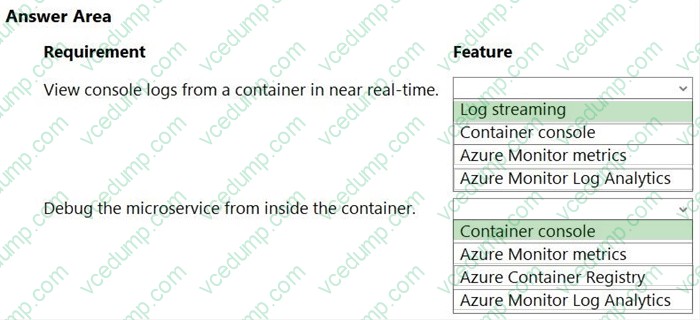
You are developing several microservices to run on Azure Container Apps.
You need to monitor and diagnose the microservices.
Which features should you use? To answer, select the appropriate feature in the answer area.
NOTE: Each correct selection is worth one point.
-
Question 486:
You create and publish a new Azure App Service web app.
User authentication and authorization must use Azure Active Directory (Azure AD).
You need to configure authentication and authorization.
What should you do first?
A. Add an identity provider.
B. Map an existing custom DNS name.
C. Create and configure a new app setting.
D. Add a private certificate.
E. Create and configure a managed identity. -
Question 487:
DRAG DROP
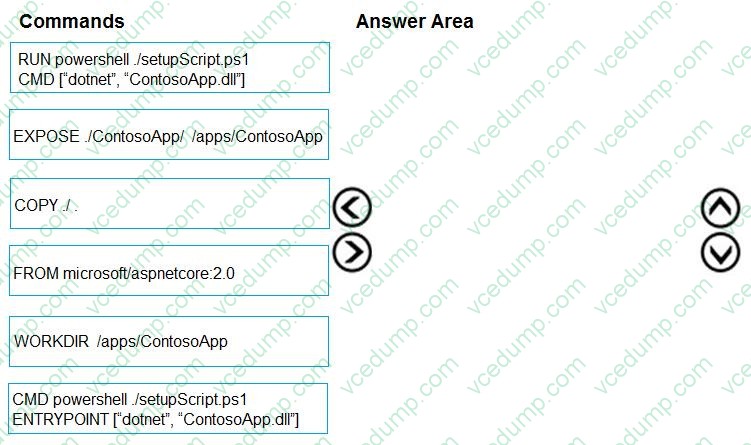
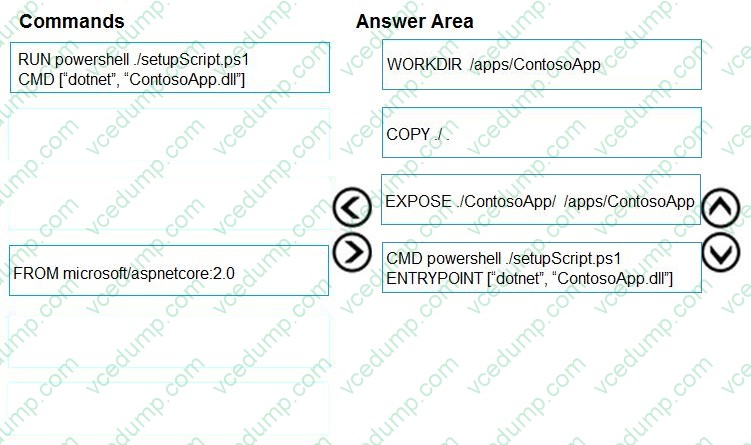
You plan to create a Docker image that runs as ASP.NET Core application named ContosoApp. You have a setup script named setupScript.ps1 and a series of application files including ContosoApp.dll.
You need to create a Dockerfile document that meets the following requirements:
1. Call setupScript.ps1 when the container is built.
2. Run ContosoApp.dll when the container starts.
The Docker document must be created in the same folder where ContosoApp.dll and setupScript.ps1 are stored.
Which four commands should you use to develop the solution? To answer, move the appropriate commands from the list of commands to the answer area and arrange them in the correct order.
Select and Place:
-
Question 488:
You are developing a software solution for an autonomous transportation system. The solution uses large data sets and Azure Batch processing to simulate navigation sets for entire fleets of vehicles.
You need to create compute nodes for the solution on Azure Batch.
What should you do?
A. In the Azure portal, create a Batch account.
B. In a .NET method, call the method: BatchClient.PoolOperations.CreatePool
C. In Python, implement the class: JobAddParameter
D. In Python, implement the class: TaskAddParameter -
Question 489:
HOTSPOT
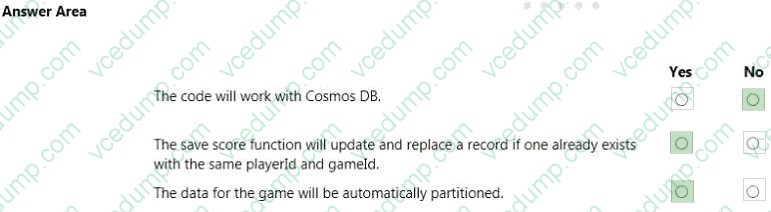
A company develops a series of mobile games. All games use a single leaderboard service.
You have the following requirements:
1. Code should be scalable and allow for growth.
2. Each record must consist of a playerld, gameld. score, and time played.
3. When users reach a new high score, the system will save the new score using the SaveScore function below.
4. Each game is assigned an Id based on the series title.
You have the following code. (Line numbers are included for reference only.)

You store customer information in an Azure Cosmos database. The following data already exists in the database:

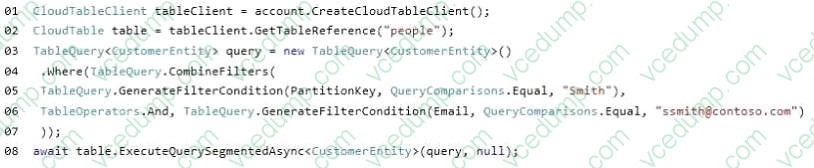
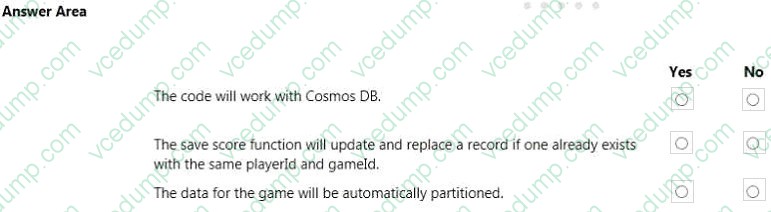
For each of the following statements, select Yes if the statement is true. Otherwise, select No.
NOTE: Each correct selection is worth one point
-
Question 490:
You need to secure the corporate website to meet the security requirements.
What should you do?
A. Create an App Service instance with a standard plan. Configure the custom domain with a TLS/SSL certificate.
B. Create an Azure Application Gateway with a Web Application Firewall (WAF). Configure end-to-end TLS encryption and the WAF.
C. Create an Azure Cache for Radis instance. Update the code to support the cache.
D. Create an Azure Content Delivery Network profile and endpoint. Configure the endpoint.
Related Exams:
-
62-193
Technology Literacy for Educators -
70-243
Administering and Deploying System Center 2012 Configuration Manager -
70-355
Universal Windows Platform – App Data, Services, and Coding Patterns -
77-420
Excel 2013 -
77-427
Excel 2013 Expert Part One -
77-725
Word 2016 Core Document Creation, Collaboration and Communication -
77-726
Word 2016 Expert Creating Documents for Effective Communication -
77-727
Excel 2016 Core Data Analysis, Manipulation, and Presentation -
77-728
Excel 2016 Expert: Interpreting Data for Insights -
77-731
Outlook 2016 Core Communication, Collaboration and Email Skills
Tips on How to Prepare for the Exams
Nowadays, the certification exams become more and more important and required by more and more enterprises when applying for a job. But how to prepare for the exam effectively? How to prepare for the exam in a short time with less efforts? How to get a ideal result and how to find the most reliable resources? Here on Vcedump.com, you will find all the answers. Vcedump.com provide not only Microsoft exam questions, answers and explanations but also complete assistance on your exam preparation and certification application. If you are confused on your AZ-204 exam preparations and Microsoft certification application, do not hesitate to visit our Vcedump.com to find your solutions here.