AZ-204 Exam Details
-
Exam Code
:AZ-204 -
Exam Name
:Developing Solutions for Microsoft Azure -
Certification
:Microsoft Certifications -
Vendor
:Microsoft -
Total Questions
:588 Q&As -
Last Updated
:Jul 12, 2026
Microsoft AZ-204 Online Questions & Answers
-
Question 471:
Note: This question is part of a series of questions that present the same scenario. Each question in the series contains a unique solution that might meet the stated goals. Some question sets might have more than one correct solution, while others might not have a correct solution.
After you answer a question in this section, you will NOT be able to return to it. As a result, these questions will not appear in the review screen.
You are developing a website that will run as an Azure Web App. Users will authenticate by using their Azure Active Directory (Azure AD) credentials.
You plan to assign users one of the following permission levels for the website: admin, normal, and reader. A user's Azure AD group membership must be used to determine the permission level.
You need to configure authorization.
Solution:
1. Create a new Azure AD application. In the application's manifest, define application roles that match the required permission levels for the application.
2. Assign the appropriate Azure AD group to each role. In the website, use the value of the roles claim from the JWT for the user to determine permissions.
Does the solution meet the goal?
A. Yes
B. No -
Question 472:
You are developing a solution that will use a multi-partitioned Azure Cosmos DB database. You plan to use the latest Azure Cosmos DB SDK for development.
The solution must meet the following requirements:
1. Send insert and update operations to an Azure Blob storage account.
2. Process changes to all partitions immediately.
3. Allow parallelization of change processing.
You need to process the Azure Cosmos DB operations.
What are two possible ways to achieve this goal? Each correct answer presents a complete solution.
NOTE: Each correct selection is worth one point.
A. Create an Azure App Service API and implement the change feed estimator of the SDK. Scale the API by using multiple Azure App Service instances.
B. Create a background job in an Azure Kubernetes Service and implement the change feed feature of the SDK.
C. Create an Azure Function to use a trigger for Azure Cosmos DB. Configure the trigger to connect to the container.
D. Create an Azure Function that uses a FeedIterator object that processes the change feed by using the pull model on the container. Use a FeedRange objext to parallelize the processing of the change feed across multiple functions. -
Question 473:
HOTSPOT
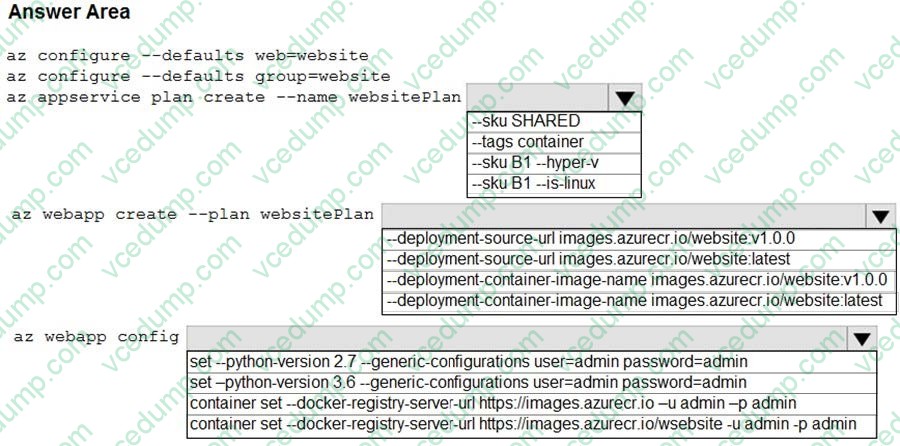
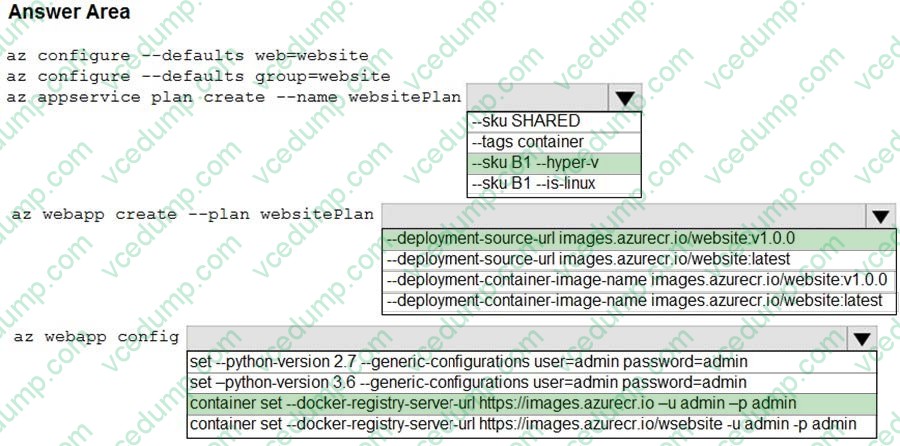
You are preparing to deploy a Python website to an Azure Web App using a container. The solution will use multiple containers in the same container group. The Dockerfile that builds the container is as follows:
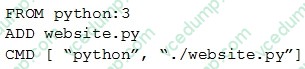
You build a container by using the following command. The Azure Container Registry instance named images is a private registry.

The user name and password for the registry is admin.
The Web App must always run the same version of the website regardless of future builds.
You need to create an Azure Web App to run the website.
How should you complete the commands? To answer, select the appropriate options in the answer area.
NOTE: Each correct selection is worth one point.
-
Question 474:
You develop an app that allows users to upload photos and videos to Azure storage. The app uses a storage REST API call to upload the media to a blob storage account named Account1. You have blob storage containers named
Container1 and Container2.
Uploading of videos occurs on an irregular basis.
You need to copy specific blobs from Container1 to Container2 when a new video is uploaded.
What should you do?
A. Copy blobs to Container2 by using the Put Blob operation of the Blob Service REST API
B. Create an Event Grid topic that uses the Start-AzureStorageBlobCopy cmdlet
C. Use AzCopy with the Snapshot switch to copy blobs to Container2
D. Download the blob to a virtual machine and then upload the blob to Container2 -
Question 475:
DRAG DROP
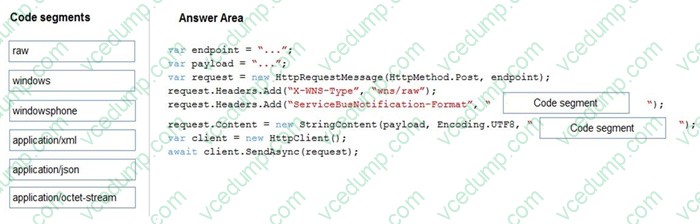
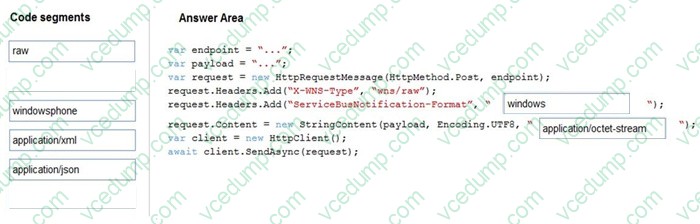
You are a developer for a Software as a Service (SaaS) company. You develop solutions that provide the ability to send notifications by using Azure Notification Hubs.
You need to create sample code that customers can use as a reference for how to send raw notifications to Windows Push Notification Services (WNS) devices. The sample code must not use external packages.
How should you complete the code segment? To answer, drag the appropriate code segments to the correct locations. Each code segment may be used once, more than once, or not at all. You may need to drag the split bar between panes or scroll to view content.
NOTE: Each correct selection is worth one point.
Select and Place:
-
Question 476:
You are developing a road tollway tracking application that sends tracking events by using Azure Event Hubs using premium tier.
Each road must have a throttling policy uniquely assigned.
You need to configure the event hub to allow for per-road throttling.
What should you do?
A. Use a unique consumer group for each road.
B. Ensure each road stores events in a different partition.
C. Ensure each road has a unique connection string.
D. Use a unique application group for each road. -
Question 477:
HOTSPOT
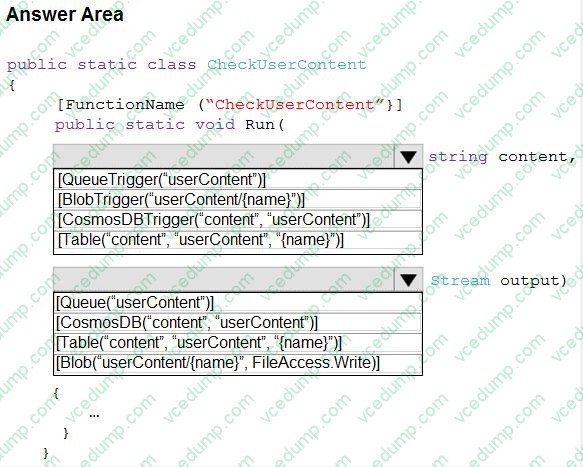
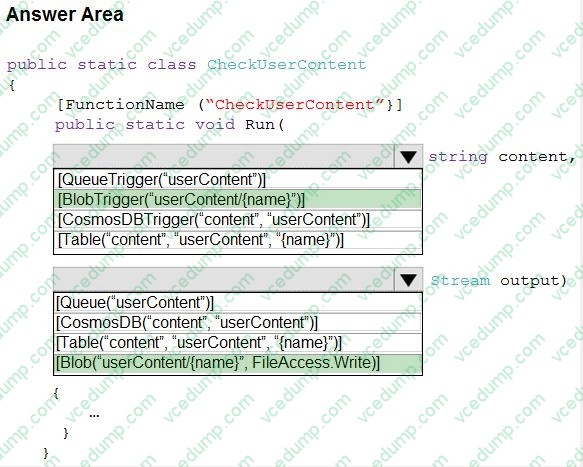
You need to implement the bindings for the CheckUserContent function.
How should you complete the code segment? To answer, select the appropriate options in the answer area.
NOTE: Each correct selection is worth one point.
-
Question 478:
Note: This question is part of a series of questions that present the same scenario. Each question in the series contains a unique solution that might meet the stated goals. Some question sets might have more than one correct solution, while others might not have a correct solution.
After you answer a question in this section, you will NOT be able to return to it. As a result, these questions will not appear in the review screen.
You develop a software as a service (SaaS) offering to manage photographs. Users upload photos to a web service which then stores the photos in Azure Storage Blob storage. The storage account type is General-purpose V2.
When photos are uploaded, they must be processed to produce and save a mobile-friendly version of the image. The process to produce a mobile-friendly version of the image must start in less than one minute.
You need to design the process that starts the photo processing.
Solution: Move photo processing to an Azure Function triggered from the blob upload.
Does the solution meet the goal?
A. Yes
B. No -
Question 479:
HOTSPOT
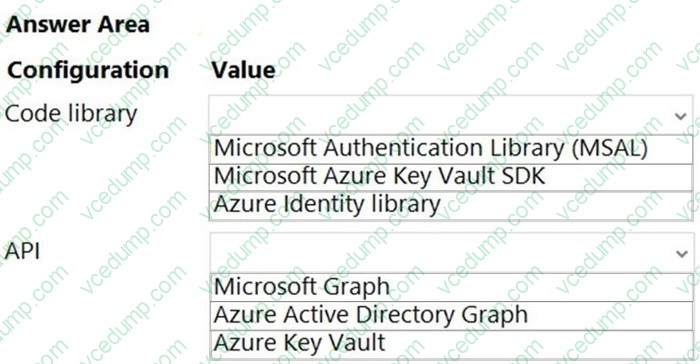
You need to implement the Azure Function for delivery driver profile information.
Which configurations should you use? To answer, select the appropriate options in the answer area.
NOTE: Each correct selection is worth one point.
-
Question 480:
You need to investigate the Azure Function app error message in the development environment.
What should you do?
A. Connect Live Metrics Stream from Application Insights to the Azure Function app and filter the metrics.
B. Create a new Azure Log Analytics workspace and instrument the Azure Function app with Application Insights.
C. Update the Azure Function app with extension methods from Microsoft.Extensions.Logging to log events by using the log instance.
D. Add a new diagnostic setting to the Azure Function app to send logs to Log Analytics.
Related Exams:
-
62-193
Technology Literacy for Educators -
70-243
Administering and Deploying System Center 2012 Configuration Manager -
70-355
Universal Windows Platform – App Data, Services, and Coding Patterns -
77-420
Excel 2013 -
77-427
Excel 2013 Expert Part One -
77-725
Word 2016 Core Document Creation, Collaboration and Communication -
77-726
Word 2016 Expert Creating Documents for Effective Communication -
77-727
Excel 2016 Core Data Analysis, Manipulation, and Presentation -
77-728
Excel 2016 Expert: Interpreting Data for Insights -
77-731
Outlook 2016 Core Communication, Collaboration and Email Skills
Tips on How to Prepare for the Exams
Nowadays, the certification exams become more and more important and required by more and more enterprises when applying for a job. But how to prepare for the exam effectively? How to prepare for the exam in a short time with less efforts? How to get a ideal result and how to find the most reliable resources? Here on Vcedump.com, you will find all the answers. Vcedump.com provide not only Microsoft exam questions, answers and explanations but also complete assistance on your exam preparation and certification application. If you are confused on your AZ-204 exam preparations and Microsoft certification application, do not hesitate to visit our Vcedump.com to find your solutions here.