AZ-204 Exam Details
-
Exam Code
:AZ-204 -
Exam Name
:Developing Solutions for Microsoft Azure -
Certification
:Microsoft Certifications -
Vendor
:Microsoft -
Total Questions
:588 Q&As -
Last Updated
:Jul 12, 2026
Microsoft AZ-204 Online Questions & Answers
-
Question 501:
You need to ensure that the solution can meet the scaling requirements for Policy Service.
Which Azure Application Insights data model should you use?
A. an Application Insights dependency
B. an Application Insights event
C. an Application Insights trace
D. an Application Insights metric -
Question 502:
HOTSPOT
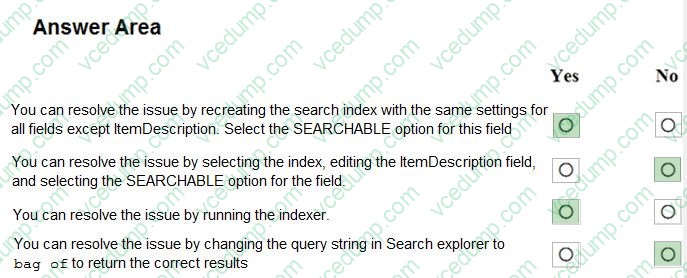
You are validating the configuration of an Azure Search indexer.
The service has been configured with an indexer that uses the Import Data option. The index is configured using options as shown in the Index Configuration exhibit. (Click the Index Configuration tab.)
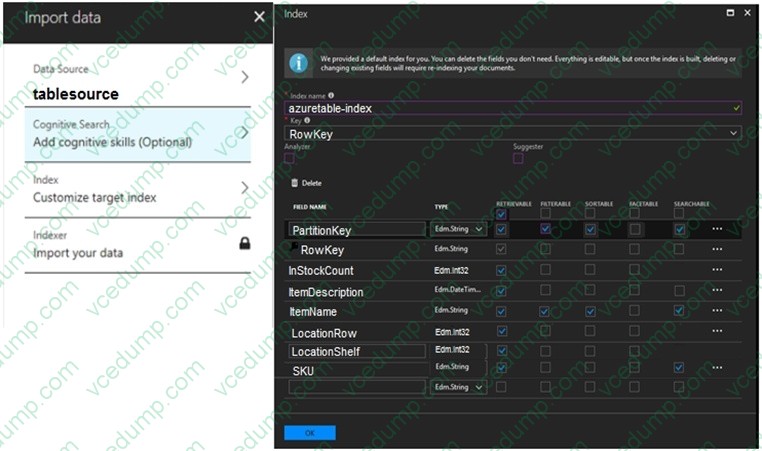
You use an Azure table as the data source for the import operation. The table contains three records with item inventory data that matches the fields in the Storage data exhibit. These records were imported when the index was created. (Click the Storage Data tab.) When users search with no filter, all three records are displayed.

When users search for items by description, Search explorer returns no records. The Search Explorer exhibit shows the query and results for a test. In the test, a user is trying to search for all items in the table that have a description that contains the word bag. (Click the Search Explorer tab.)
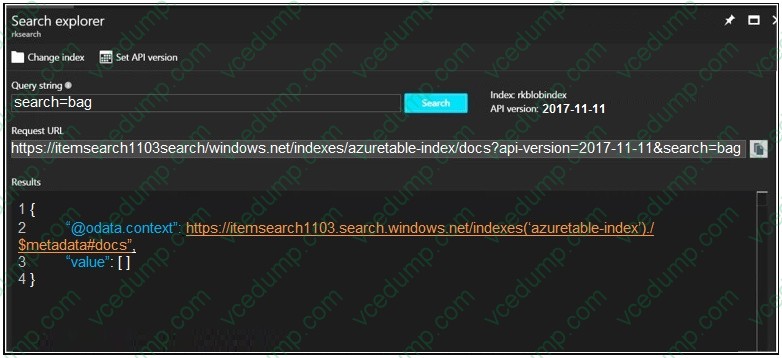
You need to resolve the issue.
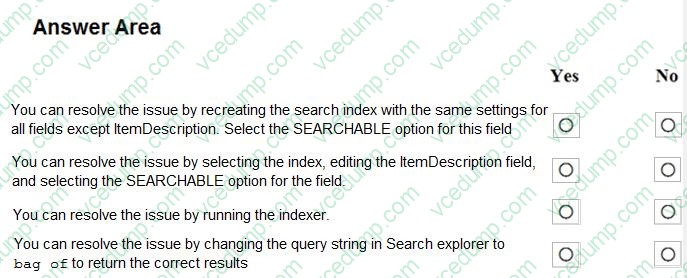
For each of the following statements, select Yes if the statement is true. Otherwise, select No.
NOTE: Each correct selection is worth one point.
-
Question 503:
Note: This question is part of a series of questions that present the same scenario. Each question in the series contains a unique solution. Determine whether the solution meets the stated goals.
You are developing and deploying several ASP.NET web applications to Azure App Service. You plan to save session state information and HTML output.
You must use a storage mechanism with the following requirements:
1. Share session state across all ASP.NET web applications.
2. Support controlled, concurrent access to the same session state data for multiple readers and a single writer.
3. Save full HTTP responses for concurrent requests.
You need to store the information.
Proposed Solution: Deploy and configure Azure Cache for Redis. Update the web applications.
Does the solution meet the goal?
A. Yes
B. No -
Question 504:
DRAG DROP
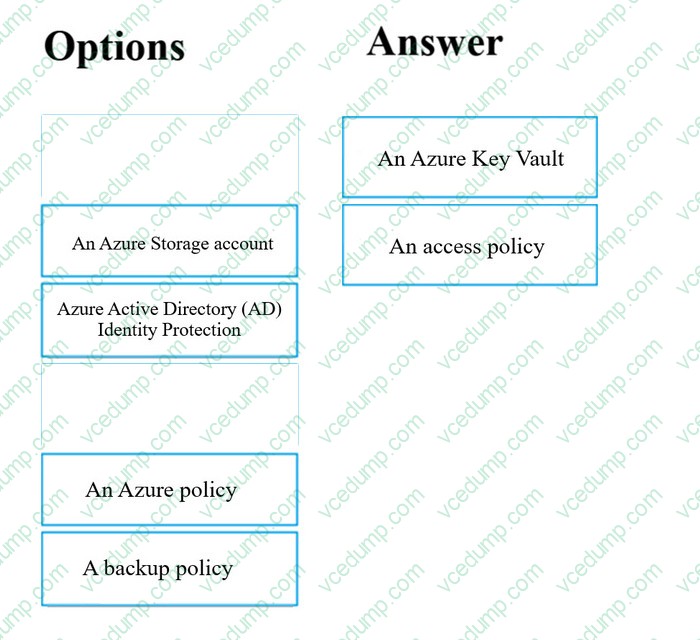
You have downloaded an Azure Resource Manager template to deploy numerous virtual machines. The template is based on a current virtual machine, but must be adapted to reference an administrative password.
You need to make sure that the password is not stored in plain text.
You are preparing to create the necessary components to achieve your goal.
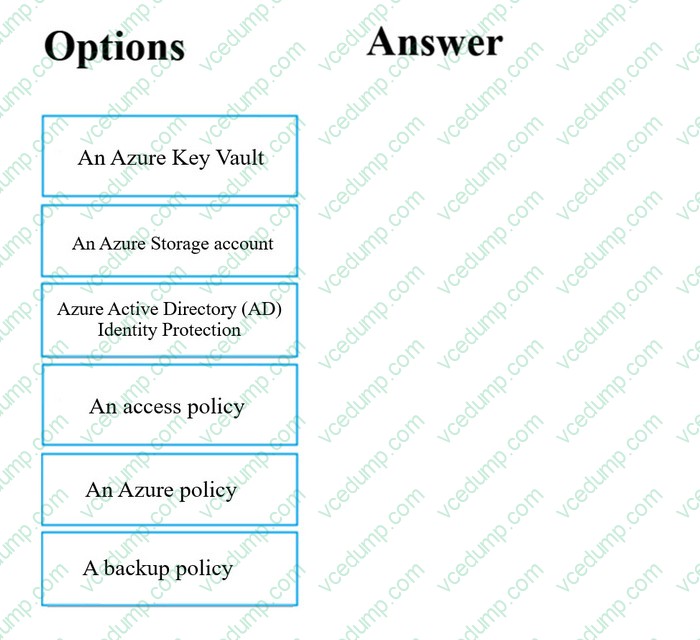
Which of the following should you create to achieve your goal? Answer by dragging the correct option from the list to the answer area.
Select and Place:
-
Question 505:
You have two Hyper-V hosts named Host1 and Host2. Host1 has an Azure virtual machine named VM1 that was deployed by using a custom Azure Resource Manager template.
You need to move VM1 to Host2.
What should you do?
A. From the Update management blade, click Enable.
B. From the Overview blade, move VM1 to a different subscription.
C. From the Redeploy blade, click Redeploy.
D. From the Profile blade, modify the usage location. -
Question 506:
HOTSPOT
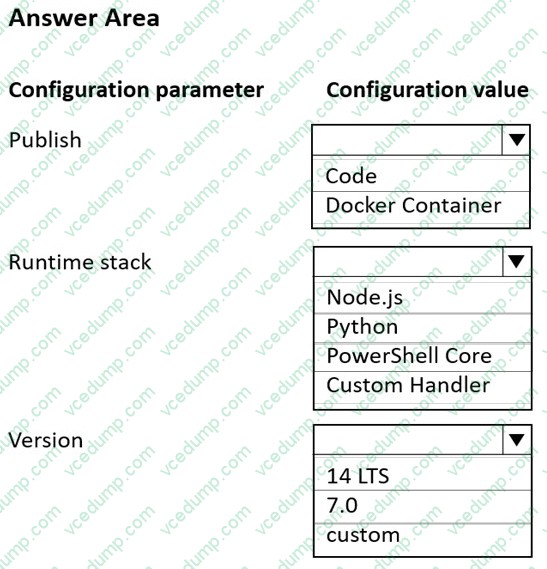
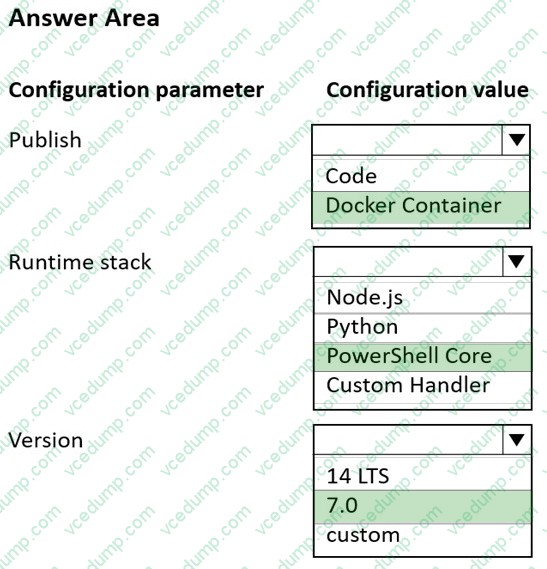
You are developing an Azure Function App. You develop code by using a language that is not supported by the Azure Function App host. The code language supports HTTP primitives.
You must deploy the code to a production Azure Function App environment.
You need to configure the app for deployment.
Which configuration values should you use? To answer, select the appropriate options in the answer area.
NOTE: Each correct selection is worth one point.
-
Question 507:
You deploy an API to API Management
You must secure all operations on the API by using a client certificate.
You need to secure access to the backend service of the API by using client certificates.
Which two security features can you use?
A. Azure AD token
B. Self-signed certificate
C. Certificate Authority (CA) certificate
D. Triple DES (3DES) cipher
E. Subscription key -
Question 508:
HOTSPOT
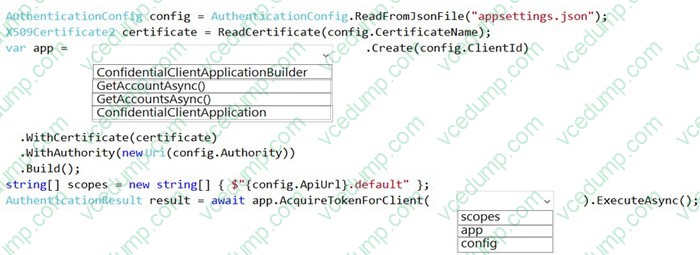
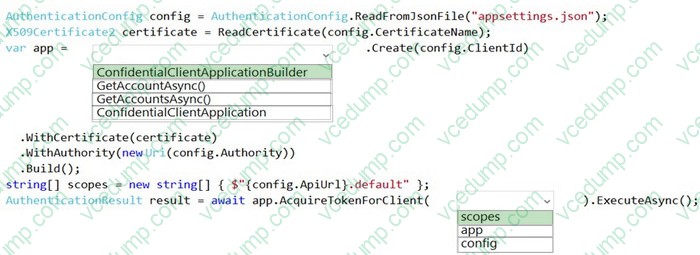
You are developing a web application that makes calls to the Microsoft Graph API. You register the application in the Azure portal and upload a valid X509 certificate.
You create an appsettings.json file containing the certificate name, client identifier for the application, and the tenant identifier of the Azure Active Directory (Azure AD). You create a method named ReadCertificate to return the X509 certificate by name.
You need to implement code that acquires a token by using the certificate.
How should you complete the code segment? To answer, select the appropriate options in the answer area.
NOTE: Each correct selection is worth one point.
-
Question 509:
You are developing an application to transfer data between on-premises file servers and Azure Blob storage. The application stores keys, secrets, and certificates in Azure Key Vault and makes use of the Azure Key Vault APIs.
You want to configure the application to allow recovery of an accidental deletion of the key vault or key vault objects for 90 days after deletion.
What should you do?
A. Run the Add-AzKeyVaultKey cmdlet.
B. Run the az keyvault update --enable-soft-delete true --enable-purge-protection true CLI.
C. Implement virtual network service endpoints for Azure Key Vault.
D. Run the az keyvault update --enable-soft-delete false CLI. -
Question 510:
Your company is developing an Azure API.
You need to implement authentication for the Azure API. You have the following requirements:
1. All API calls must be secure.
2. Callers to the API must not send credentials to the API.
Which authentication mechanism should you use?
A. Basic
B. Anonymous
C. Managed identity
D. Client certificate
Related Exams:
-
62-193
Technology Literacy for Educators -
70-243
Administering and Deploying System Center 2012 Configuration Manager -
70-355
Universal Windows Platform – App Data, Services, and Coding Patterns -
77-420
Excel 2013 -
77-427
Excel 2013 Expert Part One -
77-725
Word 2016 Core Document Creation, Collaboration and Communication -
77-726
Word 2016 Expert Creating Documents for Effective Communication -
77-727
Excel 2016 Core Data Analysis, Manipulation, and Presentation -
77-728
Excel 2016 Expert: Interpreting Data for Insights -
77-731
Outlook 2016 Core Communication, Collaboration and Email Skills
Tips on How to Prepare for the Exams
Nowadays, the certification exams become more and more important and required by more and more enterprises when applying for a job. But how to prepare for the exam effectively? How to prepare for the exam in a short time with less efforts? How to get a ideal result and how to find the most reliable resources? Here on Vcedump.com, you will find all the answers. Vcedump.com provide not only Microsoft exam questions, answers and explanations but also complete assistance on your exam preparation and certification application. If you are confused on your AZ-204 exam preparations and Microsoft certification application, do not hesitate to visit our Vcedump.com to find your solutions here.