Which of the following materials serves as a conductor?
Show answer and explanation
Correct answer: A
ASVAB-SECTION-3 Real Exam Questions
188 questions available · Page 1 of 19
Updated Exam DumpsVerified AnswersPass Guarantee
Which of the following materials serves as a conductor?
Correct answer: A
A 130-pound woman is wearing shoes with high heels that measure 1-inch square.
If the woman is standing on one heel, what psi does the heel exert as it rests on the ground? (Disregard atmospheric pressure from your calculations.)
Correct answer: A
Power = Force/Area.
P = 130/1 = 130.
If a force of 200 pounds is exerted over an area of 10-square inches, what's the psi?
Correct answer: C
You can calculate psi as Pressure = Force/Area. So, in this problem, P = 200/10 = 20.
The center of gravity of a baseball bat would be best described as __________.
Correct answer: C
The center of gravity is the place on an object where there is equal weight on either side.
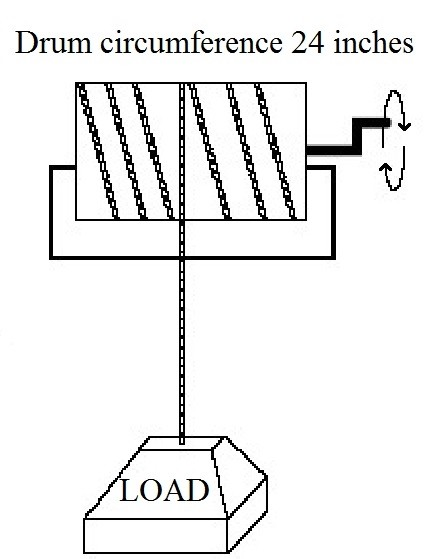
With one complete revolution of the cable winch shown above, the load will move __________.
Correct answer: C
One revolution of the winch will move the weight 24 inches, the circumference of the winch drum.
Weight is directly proportional to the acceleration due to ___________.
Correct answer: D
Weight is not a fixed property of an object; it varies with location.
Your weight is slightly less at the North Pole than it is at the equator. Your weight is much less on the moon than on earth.
Everything weighs less where the acceleration due to gravity is smaller.
Weight is directly proportional to local acceleration due to gravity.
Water in an engine can cause damage in winter weather because __________.
Correct answer: B
Water expands when it freezes, possibly damaging engine components.
If you use a lever to lift a 200-pound weight with an effort of 40 pounds, with is the mechanical advantage?
Correct answer: D
Mechanical advantage = load/effort = 200/40 = 5
Springs used in machines are usually made of __________.
Correct answer: D
Machine springs are usually made of steel although sometimes they're made of brass or other metal alloys.
The mechanical advantage of a winch is the ratio of the radius of the crank to the radius of the
__________.
Correct answer: D
The principle of a winch is not much different from that of a lever.
Since the crank and the shaft turn together, the torque exerted by the effort (the force on the handle) must be equal to the torque exerted by the load (the tension in the rope). The mechanical advantage then is the ratio of the radius of the crank to the radius of the shaft.