ASCP-MLT Exam Details
-
Exam Code
:ASCP-MLT -
Exam Name
:MEDICAL LABORATORY TECHNICIAN - MLT(ASCP) -
Certification
:ASCP Certifications -
Vendor
:ASCP -
Total Questions
:572 Q&As -
Last Updated
:Jul 14, 2026
ASCP ASCP-MLT Online Questions & Answers
-
Question 181:
Convert the following temperature from Celsius to Fahrenheit 20 degrees C Question options:
A. 77 degrees F
B. 14 degrees F
C. 68 degrees F
D. 39.2 degrees F -
Question 182:
This integrity of this specimen is compromised. The unit cannot be used.
What action should be taken if a large clot is noticed in a red blood cell unit while the product is being prepared for release to the patient?
A. Issue the product as you normally would but with a filter.
B. Issue the product, but note the presence of the clot in the computer records.
C. Filter the product prior to issue and record the process.
D. Do not issue the product. -
Question 183:
Heinz bodies occur as the result of denaturation and precipitation of hemoglobin, and are often attached to the red cell membrane. They require staining with crystal violet or methyl violet to be visible. They may be seen in thalassemia, with
unstable hemoglobins, or during a hemolytic episode in G6PD deficiency.
Hematology
The intracellular precipitates seen in the RBCs in this illustration is termed:
A. Dohle bodies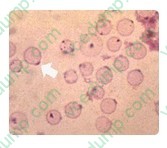
B. Heinz bodies
C. May-Hegglin anomaly
D. Reticulocytes -
Question 184:
Patients who develop severe sepsis or septic shock commonly have increased plasma lactic acid values.
Patients who develop severe sepsis or septic shock commonly have __________ plasma lactic acid values.
A. Decreased
B. Normal
C. Increased -
Question 185:
Nucleated RBCs may be seen in the peripheral blood in cases of beta thalassemia major. Nucleated RBCs are usually not found in peripheral blood in cases of beta thalassemia minor and beta thalassemia intermedia, and would not be a finding in beta thalassemia minima.
Nucleated RBCs are most likely to be seen in the peripheral blood of which of these beta thalassemias?
A. Beta thalassemia minima
B. Beta thalassemia minor
C. Beta thalassemia intermedia
D. Beta thalassemia major -
Question 186:
The role of the laboratory supervisor or manager is to
A. Supervise business functions of testing.
B. Screen cytology for Pap smears.
C. Examine surgically removed organ
D. Supervise technical aspects of testing. -
Question 187:
In excess triglycerides, the triglycerides reduce the amount of cholesterol in LDL particles producing small dense LDL molecules. Because of size and density, these molecules more easily enter damaged endothelium and vessel walls and are more easily incorporated as plaque is formed.
Which statement best describes small dense LDL particles that can occur in atherogenic dyslipidemia?
A. Small dense LDL molecules are less atherogenic than larger, less dense or buoyant LDL particles because they are metabolized faster
B. Small dense LDL molecules transport more cholesterol and thus are more atherogenic
C. Small dense LDL molecules are more atherogenic because they can more easily move into the endothelium and vessel wall -
Question 188:
Protein in urine can be confirmed using sulfosalicylic acid (SSA) precipitation. The SSA reagent is added to a small volume of urine. Acidification causes precipitation of protein in the sample, which is subjectively graded as trace, 1+, 2+, 3+ or 4+. SSA reaction will detect albumin, globulins, and Bence-Jones proteins.
Which of the following would be the most appropriate method to confirm a positive protein from a urine dipstick:
A. Immunoelectropheresis
B. Heat precipitation
C. Sulfosalicylic acid precipitation
D. Protein electrophoresis -
Question 189:
Know what you are handling - read label carefully.
What is the first thing you do before you handle or open a chemical:
A. Read the label
B. Ask a supervisor for assistance
C. Obtain a copy of the SDS
D. Consult procedure manual for information -
Question 190:
MLTs must be provided with free immunization for:
A. hepatitis C
B. hepatitis A
C. HIV
D. hepatitis B
Related Exams:
Tips on How to Prepare for the Exams
Nowadays, the certification exams become more and more important and required by more and more enterprises when applying for a job. But how to prepare for the exam effectively? How to prepare for the exam in a short time with less efforts? How to get a ideal result and how to find the most reliable resources? Here on Vcedump.com, you will find all the answers. Vcedump.com provide not only ASCP exam questions, answers and explanations but also complete assistance on your exam preparation and certification application. If you are confused on your ASCP-MLT exam preparations and ASCP certification application, do not hesitate to visit our Vcedump.com to find your solutions here.