ASCP-MLT Exam Details
-
Exam Code
:ASCP-MLT -
Exam Name
:MEDICAL LABORATORY TECHNICIAN - MLT(ASCP) -
Certification
:ASCP Certifications -
Vendor
:ASCP -
Total Questions
:572 Q&As -
Last Updated
:Jul 14, 2026
ASCP ASCP-MLT Online Questions & Answers
-
Question 171:
Either immunofixation or immunoelectrophoresis can be used to confirm Bence-Jones proteinuria.
Which of the following methods would be used to confirm the presence of Bence-Jones protein in the urine:
A. Urine protein electrophoresis
B. Sulfosalicylic acid
C. Isoelectric focusing
D. Immunofixation -
Question 172:
Hemolytic anemia, myelodysplasia, and liver disease may each fit this peripheral blood picture. Each of these conditions can display peripheral blood macrocytosis. It is easy to observe the overall larger size of the red blood cells in this image
compared to the normal lymphocyte also present.
When macrocytes are present, they should be examined for their shape (round vs. oval), the hemoglobin content (central pallor), and whether or not there are any inclusions present in the cell.
Iron deficiency would not be the correct answer in this case, since this condition is associated with microcytosis instead.
The complete blood count was obtained from a patient recently admitted to the emergency room. The red blood cell indices obtained revealed an MCV of 115 femtoliters (fL) (normal range 80 - 90 fL). The patient met the criteria for a
peripheral blood smear examination. A representative field is shown on the right.
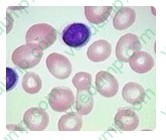
Which of the following conditions may be indicated by the results seen on this peripheral blood smear?
A. Hemolytic anemia
B. Myelodysplasia
C. Iron deficiency
D. Liver disease -
Question 173:
Type B blood is found in higher frequency in:
A. Blacks
B. Whites
C. Asians
D. Black and Asians -
Question 174:
The lecithin-sphingomyelin ratio is a test for assessing fetal lung maturity that is useful in determining risk of an infant born with respiratory distress syndrome.
The Lecithin/Sphingomyelin ratio determination of amniotic fluid is useful in assessing the probability of:
A. cystic fibrosis
B. phenylketonuria
C. respiratory distress syndrome
D. chromosomal abnormalities -
Question 175:
A casual blood glucose >/= 200 mg/dL on a patient with symptoms and an A1C >/= 6.5% meet diagnostic criteria for diabetes.
Chemistry
A physician is evaluating a 45-year-old obese male for diabetes and orders a plasma glucose at time of evaluation and a HbA1C one week later. The patient has a family history of diabetes and currently exhibits symptoms of diabetes.
What would be the best course of action if these are the blood glucose results?
Casual Blood Glucose: 208 mg/dL
HbA1C one week later: 7.2%
A. Order insulin levels; if decreased, diagnose diabetes
B. Patient meets criteria for diagnosis of diabetes
C. Order a C-peptide for diagnosis
D. The patient is at risk for diabetes (pre-diabetic); monitor for diabetes with yearly FPG levels -
Question 176:
Yellow/gray or orange stopper tubes contain thrombin. Question options:
A. True
B. False -
Question 177:
High-sensitivity C-reactive protein (hs-CRP) is used as an aid in the diagnosis and treatment of cardiovascular disease (CVD). At low levels, it can detect those at risk for cardiac heart disease. At high levels in those with no history of heart disease, it indicates a high risk for acute myocardial infarction (AMI), stroke, or peripheral vascular disease. For patients with acute coronary syndrome (ACS) or stable coronary disease, hs-CRP is used to predict future coronary events.
Ranges of hs-CRP in prediction of risk for CVD are:
<1.0
mg/L Low CVD risk 1.0-3.0 mg/L Average risk for CVD >3.0 mg/L High risk for future CVD If results are >10.0 mg/L, the patient should be evaluated for an acute inflammatory condition. Chemistry A high-sensitivity C-reactive protein (hs-CRP) test result of 5 mg/L (normal = < 1 mg/L) may indicate which of the following?
A. Low risk for cardiovascular disease (CVD)
B. High risk for future CVD
C. Acute inflammatory condition -
Question 178:
The MCV is indicative of microcytosis with MCV=<80fL. The RDW is within normal limits and indicative of a homogenous cell population.
If the MCV was >100 fL, this would be indicative of macrocytosis. An RDW that was outside of normal limits would be indicative of a heterogenous cell population.
An 18 year old female has a CBC as part of a routine physical exam. The following results were obtained and the physician determines she is anemic. After reviewing her CBC results shown below, which of the following would be an
appropriate description of the anemia?
White blood cells (WBC): 5.6 x 10^9/L (RR:4.0-10.0 x 10^9/L)
Red blood cells (RBC): 3.7 x 10^12/L (RR: 4.2-5.9 x 10^12/L)
Hemoglobin: 9.9 g/dL (RR:12-16 g/dL)
Hematocrit: 28% (RR: 37-48%)
MCV: 75 fL (80-100 fL)
RDW-CV: 14% (RR: 11.0-15.0%)
A. Macrocytic, heterogenous
B. Macrocytic, homogenous
C. Microcytic, heterogenous
D. Microcytic, homogenous -
Question 179:
HCG levels rise rapidly during the first trimester, then the levels start to decline around week 16. The hCG levels slowly decrease and can level off during the remainder of the pregnancy. The following BEST describes serum hCG levels during pregnancy:
A. Rise in levels throughout pregnancy
B. Highest levels found at end of pregnancy
C. Rapid rise in levels during first trimester; slow decline and possible level-off throughout remainder of pregnancy
D. Slow rise in levels during first trimester; rapid rise during second trimester; slow decline during the third trimester -
Question 180:
Hematology
What is Coombs sera comprised of:
A. Complement
B. Indicator red cells
C. Anti-human globulins
D. Anti-red cell globulins
Related Exams:
Tips on How to Prepare for the Exams
Nowadays, the certification exams become more and more important and required by more and more enterprises when applying for a job. But how to prepare for the exam effectively? How to prepare for the exam in a short time with less efforts? How to get a ideal result and how to find the most reliable resources? Here on Vcedump.com, you will find all the answers. Vcedump.com provide not only ASCP exam questions, answers and explanations but also complete assistance on your exam preparation and certification application. If you are confused on your ASCP-MLT exam preparations and ASCP certification application, do not hesitate to visit our Vcedump.com to find your solutions here.