ACP-100 Exam Details
-
Exam Code
:ACP-100 -
Exam Name
:Jira Administrator -
Certification
:Atlassian Certifications -
Vendor
:Atlassian -
Total Questions
:72 Q&As -
Last Updated
:Jul 15, 2026
Atlassian ACP-100 Online Questions & Answers
-
Question 61:
Martin has Create Attachments permission in a software project, but he cannot attach anything to issues in Approved status. What is the problem?
A. There is a workflow step property configured.
B. He is not a member of a security level.
C. There is a workflow condition configured.
D. The Attachment field is missing from the screen for that issue type.
E. He does not have the correct project permission. -
Question 62:
A project manager wants to stay aware of the support requests that are being raised in his project.
He wants to know if:
the team is able to handle the number of issues that are being raised in the project
there are team members who work on more than 2 issues at any given time there are sets of issues that need significantly more time to resolve when compared to others over time Which three gadgets will show him the information he needs? (Choose three.)
A. Activity Stream
B. Created vs. Resolved Chart
C. Two Dimensional Filter Statistics
D. Resolution Time
E. Labels -
Question 63:
Your marketing group is using Jira to track media print advertisements. They would like to track TV and radio commercials as well.
The same team handles all three formats, but each format requires a unique workflow. The team would like to keep everything on the same dashboard, and they will also be using the same permissions, notifications and screens.
Without using third-party apps, how should you configure Jira to meet these requirements?
A. Clone the existing project and key for TV and Radio.
B. Copy the existing permissions and notification schemes, and associate them with new projects for TV and Radio.
C. Create a sub-component hierarchy.
D. Create two new projects for TV and Radio.
E. Add TV and Radio into the existing project as components.
F. Use issue types of Print, Radio and TV in the existing project. -
Question 64:
A project is using the Approval workflow shown.
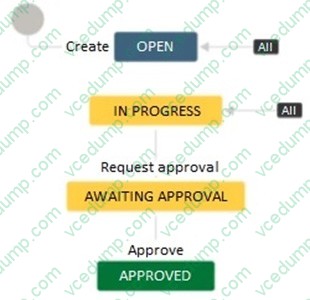
The project lead has communicated the following change requests:
It should be possible to transition issues into the Awaiting Approval status from any other status apart from the Approved status.
Different transition screens will be needed for each transition into the Awaiting Approval status.
How do you configure the workflow to satisfy these requirements?
A. Create a global transition to the Awaiting Approval status. Create multiple appropriate transition screens and associate it with the global transition.
B. Reuse the Request approval transition between the Open and Awaiting Approval status. Create an appropriate transition screen and associate it with the transition.
C. Create a transition from the Open to the Awaiting Approval status. Create appropriate transition screens and associate them with the individual transitions into the Awaiting Approval status.
D. Create a global transition to the Awaiting Approval status. Create an appropriate transition screen and associate it with the global transition.
E. Create a transition from the Open to the Awaiting Approval status. Reuse the existing transition screen from the Request approval transition. -
Question 65:
Your organization has a Jira project for managing work on a software development project.
As the team has grown, two groups have formed within it, working on different tasks. To help bring more focus to the work being conducted, the team has requested a second Jira project to split the team's work into two.
Which set of schemes can likely be shared between the two projects?
A. Custom Field and Issue Security
B. Resolution and Notification
C. Workflow and Custom Field
D. Issue Type and Sub-task
E. Notification and Workflow -
Question 66:
Your HR project has two issue types:
Join
Leave
Both issue types share a field configuration, screens and the workflow.
You currently use the Due Date system field to indicate when someone actually joins or leaves.
New HR staff members complain that using the Due Date field is not very intuitive.
How can you help your HR team?
A. Create individual Join Date and Leave Date custom fields to replace the Due Date field. Create separate screens for each issue operation and issue type. Delete the Due Date field.
B. Rename the Due Date field to Join Date and create a separate Leave Date custom field. Create new screens for the Leave issue type and replace the Due Date field with the newly created field. Migrate existing field values to the new Leave Date field.
C. Create individual field contexts for each issue type. Label the Due Date field as Join Date and Leave Date in their respective contexts. Associate each context with its matching issue type.
D. Create individual Join Date and Leave Date custom fields to replace the Due Date field. Appropriately migrate existing data from the Due Date field to the new custom fields. Remove the Due Date field from all project screens. -
Question 67:
One of your teams is maintaining and updating an application that has grown into three distinct modules.
The modules are on different release cycles. The team is struggling to track the versions of the modules, because they have similar numbering schemes.
Which action would you recommend?
A. Define an issue type for each module.
B. Create a new Version field for each module.
C. Split the modules into separate components.
D. Split the project into several projects, one for each module. -
Question 68:
Your Jira support project has allowed anonymous customers to create issues through an incoming mail handler for some time.
In order to enhance efficiency, your project manager has inquired about the possibility of allowing anonymous users to also create issues using Jira instead of the mail handler, but without allowing further access or need of a license.
Which two actions will let you meet the requirement? (Choose two.)
A. Create an issue security scheme with a default level allowing only licensed Jira users to access issues.
B. Ensure that the Jira mode in the general configuration has been set to Public.
C. Add Group Anyone to the Browse Projects permission in the project's permission scheme.
D. Add Group Anyone to the Create Issues permission in the project's permission scheme.
E. Ensure that the Reporter is not required in the project's field configuration scheme. -
Question 69:
The OPS team will start using Jira to track and approve Change Requests in the OPS project. They have these workflow requirements:
Requests can be approved by two individuals only.
The approvers will change weekly.
Jira is connected to your corporate LDAP with Read-Only permissions.
What is the best way to structure permissions for the OPS project to support these workflow requirements?
A. Create the group it-approvers in the Jira Internal Directory and have the approvers maintain it.
B. Create a new project role for approvers and have the Project Role (Administrators) maintain it.
C. Request the group it-approvers to be created in the corporate LDAP directory and add it to the Approve Issues permission for the project.
D. Request the group it-approvers to be created in the corporate LDAP directory and have the Project Role (Administrators) maintain it in Jira.
E. Add individual names to Project Role (Administrators) and add this role to the Approve Issues permission for the project. -
Question 70:
Your marketing company wants to evaluate Jira and purchased a 10-user license. A frequently changing group of key stakeholders ?both internal employees and external customers ?will participate in the evaluation.
If the evaluation is successful the company wants all 50 employees to start working with the tool.
You have to manage the frequently changing group of stakeholders and need to make sure only the intended users participate in the evaluation.
How should you meet these requirements?
A. Create and manage the users for stakeholders manually in the internal directory.
B. Connect Jira to your internal LDAP directory and whitelist the IPs of stakeholders.
C. Enable public signup and CAPTCHA but limit account creation to stakeholders.
D. Disable public signup and grant all project permissions to Group Anyone.
Tips on How to Prepare for the Exams
Nowadays, the certification exams become more and more important and required by more and more enterprises when applying for a job. But how to prepare for the exam effectively? How to prepare for the exam in a short time with less efforts? How to get a ideal result and how to find the most reliable resources? Here on Vcedump.com, you will find all the answers. Vcedump.com provide not only Atlassian exam questions, answers and explanations but also complete assistance on your exam preparation and certification application. If you are confused on your ACP-100 exam preparations and Atlassian certification application, do not hesitate to visit our Vcedump.com to find your solutions here.