70-764 Exam Details
-
Exam Code
:70-764 -
Exam Name
:Administering a SQL Database Infrastructure -
Certification
:Microsoft Certifications -
Vendor
:Microsoft -
Total Questions
:452 Q&As -
Last Updated
:Feb 07, 2022
Microsoft 70-764 Online Questions & Answers
-
Question 371:
General Overview
You are the Senior Database Administrator (DBA) for a software development company named Leafield Solutions. The company develops software applications custom designed to meet customer requirements.
Requirements Leafield Solutions has been asked by a customer to develop a web-based Enterprise Resource Planning and Management application. The new application will eventually replace a desktop application that the customer is
currently using. The current application will remain in use while the users are trained to use the new webbased application.
You need to design the SQL Server and database infrastructure for the web-based application.
Databases
You plan to implement databases named Customers, Sales, Products, Current_Inventory, and TempReporting.
The Sales database contains a table named OrderTotals and a table named SalesInfo.
A stored procedure named SPUpdateSalesInfo reads data in the OrderTotals table and modifies data in the SalesInfo table.
The stored procedure then reads data in the OrderTotals table a second time and makes further changes to the information in the SalesInfo table. The Current_Inventory database contains a large table named Inv_Current. The Inv_Current
table has a clustered index for the primary key and a nonclustered index. The primary key column uses the identity property. The data in the Inv_Current table is over 120GB in size. The tables in the Current_Inventory database are accessed
by multiple queries in the Sales database. Another table in the Current_Inventory database contains a self-join with an unlimited number of hierarchies. This table is modified by a stored procedure named SPUpdate2. An external application
named ExternalApp1 will periodically query the Current_Inventory database to generate statistical information. The TempReporting database contains a single table named GenInfo. A stored procedure named SPUPdateGenInfo combines
data from multiple databases and generates millions of rows of data in the GenInfo table.
The GenInfo table is used for reports.
When the information in GenInfo is generated, a reporting process reads data from the Inv_Current table and queries information in the GenInfo table based on that data. The GenInfo table is deleted after the reporting process completes. The
Products database contains tables named ProductNames and ProductTypes.
Current System
The current desktop application uses data stored in a SQL Server 2005 database named DesABCopAppDB. This database will remain online and data from the Current_Inventory database will be copied to it as soon as data is changed in the
Current_Inventory database.
SQL Servers
A new SQL Server 2012 instance will be deployed to host the databases for the new system. The databases will be hosted on a Storage Area Network (SAN) that provides highly available storage.
Design Requirements
Your SQL Server infrastructure and database design must meet the following requirements:
Confidential information in the Current_ Inventory database that is accessed by ExternalApp1 must be securely stored.
Direct access to database tables by developers or applications must be denied.
The account used to generate reports must have restrictions on the hours when it is allowed to make a connection.
Deadlocks must be analyzed with the use of Deadlock Graphs.
In the event of a SQL Server failure, the databases must remain available.
Software licensing and database storage costs must be minimized.
Development effort must be minimized.
The Tempdb databases must be monitored for insufficient free space.
Failed authentication requests must be logged.
Every time a new row is added to the ProductTypes table in the Products database, a user defined function that validates the row must be called before the row is added to the table.
When SPUpdateSalesInfo queries data in the OrderTotals table the first time, the same rows must be returned along with any newly added rows when SPUpdateSalesInfo queries data in the OrderTotals table the second time.
You need to configure a synchronization solution to copy data from the Current_Inventory database the DesABCopAppDB database.
What should you configure?
A. Transactional Replication.
B. Database Mirroring.
C. Snapshot Replication.
D. Incremental Backups -
Question 372:
You are the administrator of a Microsoft SQL Server 2016 server. Some applications consume significant resources.
You need to manage the server workload by restricting resource-intensive applications.
You need to dynamically limit resource consumption.
What should you do?
A. Set up Service Broker to ensure that applications are not allowed to consume more than the specified amount of resources.
B. Configure Resource Pools, Workload Groups, and Classifier Function, and then enable the Resource Governor.
C. Configure Extended Events to monitor and restrict resource limits allowed by each application type.
D. Create a new Plan Guide with a Scope Type of sql and define the resource limits for each application. -
Question 373:
HOTSPOT
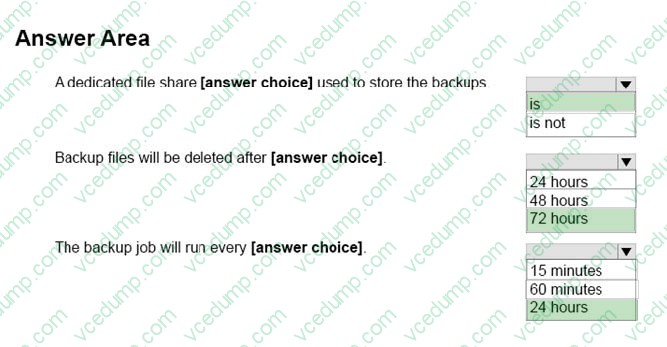
You are configuring log shipping for a Microsoft SQL Server database named salesOrders. You run the following Transact-SQL script:
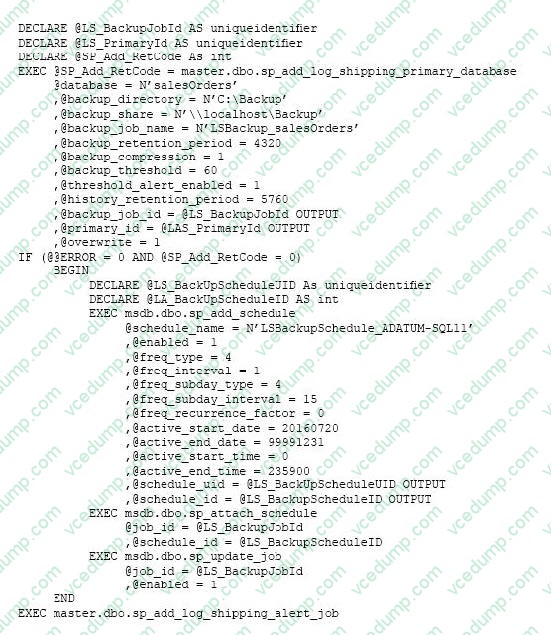
You need to determine the changes that the script has on the environment.
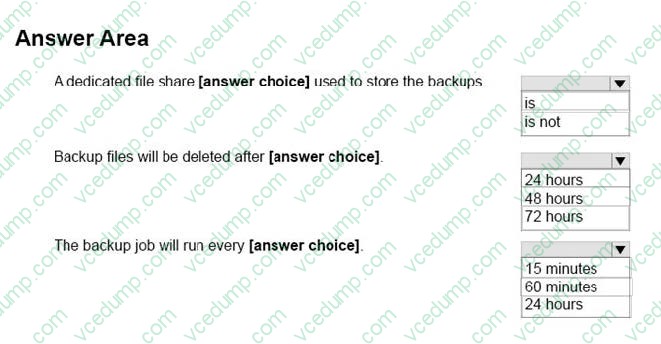
How does the script affect the environment? To answer, select the appropriate options in the answer area.
NOTE: Each correct selection is worth one point.
Hot Area:
-
Question 374:
DRAG DROP
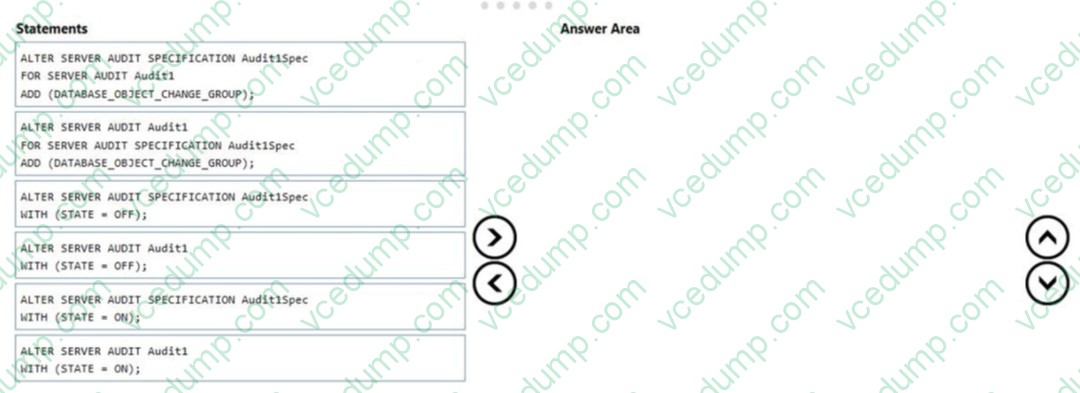
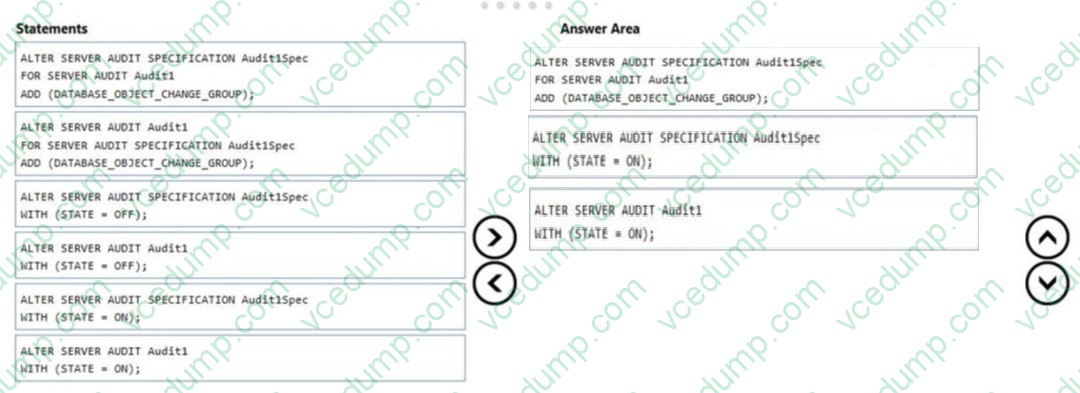
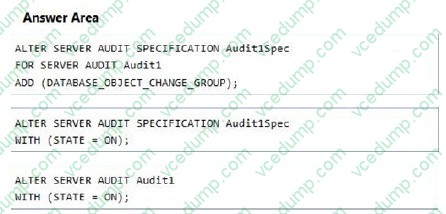
You have a Microsoft SQL Server audit named Audit1. Audit1 contains an audit specification named AuditSpec that audits failed logins.
You need to configure the audit to capture CREATE, ALTER, and DROP statements.
Which three statements should you execute in sequence? To answer, move the appropriate statements from the list to the answer area and arrange them in the correct order.
Select and Place:
-
Question 375:
DRAG DROP
Note: This question is part of a series of questions that use the same scenario. For your convenience, the scenario is repeated in each question. Each question presents a different goal and answer choices, but the text of the scenario is
exactly the same in each question in this series.
You have five servers that run Microsoft Windows 2012 R2. Each server hosts a Microsoft SQL Server instance. The topology for the environment is shown in the following diagram.
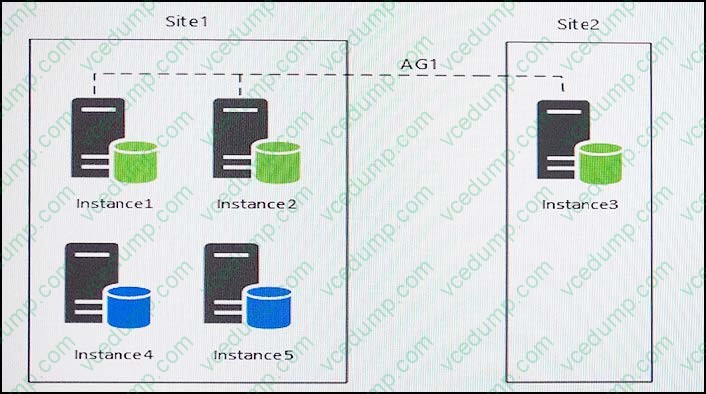
You have an Always On Availability group named AG1. The details for AG1 are shown in the following table.
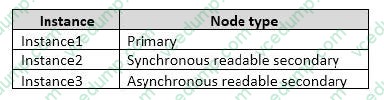
Instance1 experiences heavy read-write traffic. The instance hosts a database named OperationsMain that is four terabytes (TB) in size. The database has multiple data files and filegroups. One of the filegroups is read_only and is half of the
total database size.
Instance4 and Instance5 are not part of AG1. Instance4 is engaged in heavy read-write I/O.
Instance5 hosts a database named StagedExternal. A nightly BULK INSERT process loads data into an empty table that has a rowstore clustered index and two nonclustered rowstore indexes.
You must minimize the growth of the StagedExternal database log file during the BULK INSERT operations and perform point-in-time recovery after the BULK INSERT transaction.
Changes made must not interrupt the log backup chain.
You plan to add a new instance named Instance6 to a datacenter that is geographically distant from Site1 and Site2. You must minimize latency between the nodes in AG1.
All databases use the full recovery model. All backups are written to the network location \\SQLBackup\. A separate process copies backups to an offsite location. You should minimize both the time required to restore the databases and the
space required to store backups. The recovery point objective (RPO) for each instance is shown in the following table.
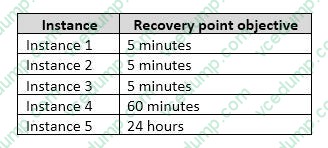
Full backups of OperationsMain take longer than six hours to complete. All SQL Server backups use the keyword COMPRESSION.
You plan to deploy the following solutions to the environment. The solutions will access a database named DB1 that is part of AG1.
Reporting system: This solution accesses data inDB1with a login that is mapped to a database user that is a member of the db_datareader role. The user has EXECUTE permissions on the database. Queries make no changes to the data.
The queries must be load balanced over variable read-only replicas.
Operations system: This solution accesses data inDB1with a login that is mapped to a database user that is a member of the db_datareader and db_datawriter roles.
The user has EXECUTE permissions on the database. Queries from the operations system will perform both DDL and DML operations.
The wait statistics monitoring requirements for the instances are described in the following table.

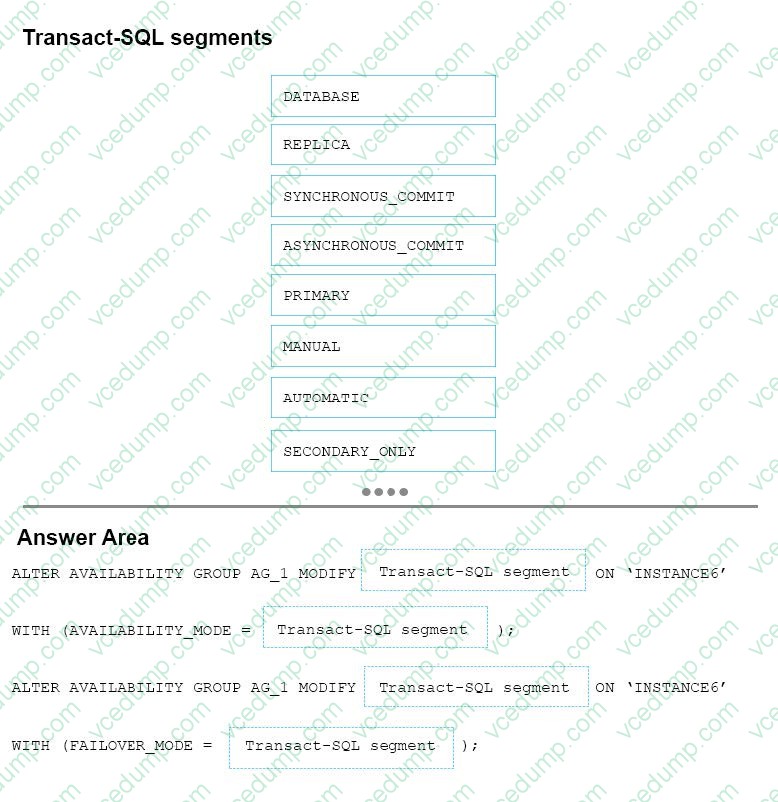
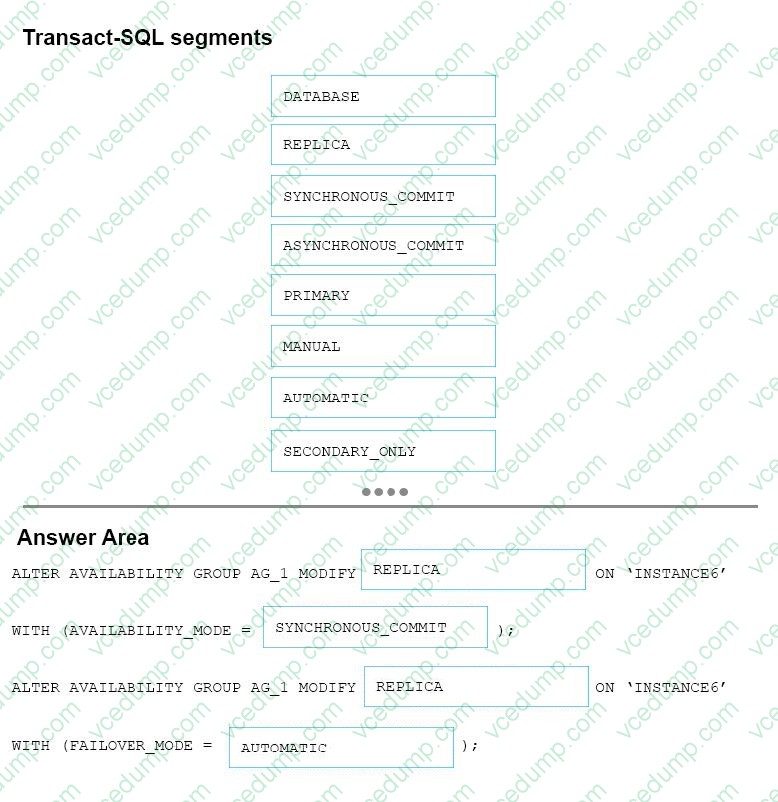
You need to configure a new replica of AG1 on Instance6.
How should you complete the Transact-SQL statement? To answer, drag the appropriate Transact-SQL statements to the correct locations. Each Transact-SQL segment may be used once, more than once, or not at all. You may need to drag
the split bar between panes or scroll to view content.
Select and Place:
-
Question 376:
You run the sp_who system stored procedure. A process is blocked by a long-running operation.
You need to identify details of the processes involved in the deadlock including the resources that are being accessed. You must able to view the deadlock chain.
What should you use?
A. Query performance insights
B. SQL Audit
C. SQL Profiler
D. Query Store -
Question 377:
You have a database named DB1.
You plan to create a stored procedure that will insert rows into three different tables. Each insert must use the same identifying value for each table, but the value must increase from one invocation of the stored procedure to the next.
Occasionally, the identifying value must be reset to its initial value. You need to design a mechanism to hold the identifying values for the stored procedure to use.
What should you do? More than one answer choice may achieve the goal. Select the BEST answer.
A. Create a sequence object that holds the next value in the sequence. Retrieve the next value by using the stored procedure. Reset the value by using an ALTER SEQUENCE statement as needed.
B. Create a sequence object that holds the next value in the sequence. Retrieve the next value by using the stored procedure. Increment the sequence object to the next value by using an ALTER SEQUENCE statement. Reset the value as needed by using a different ALTER SEQUENCE statement.
C. Create a fourth table that holds the next value in the sequence. At the end each transaction, update the value by using the stored procedure. Reset the value as needed by using an UPDATE statement.
D. Create an identity column in each of the three tables. Use the same seed and the same increment for each table. Insert new rows into the tables by using the stored procedure. Use the DBCC CHECKIDENT command to reset the columns as needed. -
Question 378:
You create an availability group that has replicas named HA/Server01 and HA/Server02. Currently, HA/Server01 is the primary replica.
You have multiple queries that read data and produce reports from the database.
You need to offload the reporting workload to the secondary replica when HA/Server01 is the primary replica.
What should you do?
A. Set the Availability Mode property of HA/Server02 to Asynchronous commit.
B. Set the Readable Secondary property of HA/Server02 to Read-intent only.
C. Set the Connections in Primary Role property of HA/Server01 to Allow read/write connections.
D. Set the Availability Mode property of HA/Server01 to Asynchronous commit. -
Question 379:
Note: This question is part of a series of questions that use the same or similar answer choices. An answer choice may be correct for more than one question in the series. Each question is independent of the other questions in this series.
Information and details provided in a question apply only to that question.
You need to deploy a new Microsoft SQL Server environment that meets the following requirements:
The SQL Server instance must be highly available.
There must be minimal downtime incurred during hardware failure or operating system maintenance.
All instance-level security settings and SQL Server Agent jobs must be available without additional synchronization tasks.
What should you implement?
A. a Microsoft Azure Stretch Database
B. log shipping
C. an Always On Availability Group with all replicas in synchronous-commit mode
D. a file share witness
E. a Microsoft SQL Server failover cluster instance (FCI)
F. a Windows cluster with a shared-nothing architecture
G. an Always On Availability Group with secondary replicas in asynchronous-commit mode -
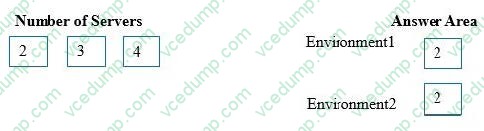
Question 380:
DRAG DROP
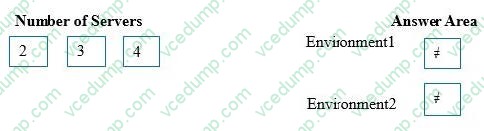
You plan to install two SQL Server 2012 environments named Environment1 and Environment2. Your company identifies the following availability requirements for each environment:
Environment1 must have mirroring with manual failover implemented.
Environment2 must have AlwaysOn with automatic failover implemented.
You need to identify the minimum number of SQL Server 2012 servers that must be deployed to each environment to ensure that all data remains available if a physical server fails.
How many servers should you identify? To answer, drag the appropriate number to the correct environment in the answer area
Select and Place:
Related Exams:
-
62-193
Technology Literacy for Educators -
70-243
Administering and Deploying System Center 2012 Configuration Manager -
70-355
Universal Windows Platform – App Data, Services, and Coding Patterns -
77-420
Excel 2013 -
77-427
Excel 2013 Expert Part One -
77-725
Word 2016 Core Document Creation, Collaboration and Communication -
77-726
Word 2016 Expert Creating Documents for Effective Communication -
77-727
Excel 2016 Core Data Analysis, Manipulation, and Presentation -
77-728
Excel 2016 Expert: Interpreting Data for Insights -
77-731
Outlook 2016 Core Communication, Collaboration and Email Skills
Tips on How to Prepare for the Exams
Nowadays, the certification exams become more and more important and required by more and more enterprises when applying for a job. But how to prepare for the exam effectively? How to prepare for the exam in a short time with less efforts? How to get a ideal result and how to find the most reliable resources? Here on Vcedump.com, you will find all the answers. Vcedump.com provide not only Microsoft exam questions, answers and explanations but also complete assistance on your exam preparation and certification application. If you are confused on your 70-764 exam preparations and Microsoft certification application, do not hesitate to visit our Vcedump.com to find your solutions here.