70-764 Exam Details
-
Exam Code
:70-764 -
Exam Name
:Administering a SQL Database Infrastructure -
Certification
:Microsoft Certifications -
Vendor
:Microsoft -
Total Questions
:452 Q&As -
Last Updated
:Feb 07, 2022
Microsoft 70-764 Online Questions & Answers
-
Question 11:
Overview
You are a database administrator for a company named Litware, Inc.
Litware is a book publishing house. Litware has a main office and a branch office.
You are designing the database infrastructure to support a new web-based application that is being developed.
The web application will be accessed at www.litwareinc.com. Both internal employees and external partners will use the application.
You have an existing desktop application that uses a SQL Server 2008 database named App1_DB.
App1_DB will remain in production.
Requirements
Planned Changes
You plan to deploy a SQL Server 2014 instance that will contain two databases named Database1 and Database2.
All database files will be stored in a highly available SAN.
Database1 will contain two tables named Orders and OrderDetails.
Database1 will also contain a stored procedure named usp_UpdateOrderDetails.
The stored procedure is used to update order information. The stored procedure queries the Orders table twice each time the procedure executes. The rows returned from the first query must be returned on the second query unchanged
along with any rows added to the table between the two read operations.
Database1 will contain several queries that access data in the Database2 tables.
Database2 will contain a table named Inventory.
Inventory will contain over 100 GB of data.
The Inventory table will have two indexes: a clustered index on the primary key and a nonclustered index.
The column that is used as the primary key will use the identity property.
Database2 wilt contains a stored procedure named usp_UpdateInventory. usp_UpdateInventory will manipulate a table that contains a self-join that has an unlimited number of hierarchies. All data in Database2 is recreated each day ad does
not change until the next data creation process. Data from Database2 will be accessed periodically by an external application named Application1. The data from Database2 will be sent to a database named Appl_Dbl as soon as changes
occur to the data in Database2. Litware plans to use offsite storage for all SQL Server 2014 backups.
Business Requirements
You have the following requirements:
Costs for new licenses must be minimized.
Private information that is accessed by Application must be stored in a secure format.
Development effort must be minimized whenever possible.
The storage requirements for databases must be minimized.
System administrators must be able to run real-time reports on disk usage.
The databases must be available if the SQL Server service fails.
Database administrators must receive a detailed report that contains allocation errors and data corruption.
Application developers must be denied direct access to the database tables. Applications must be denied direct access to the tables.
You must encrypt the backup files to meet regulatory compliance requirements.
The encryption strategy must minimize changes to the databases and to the applications.
You need to recommend a solution for Application1 that meets the security requirements. What should you include in the recommendation?
A. Encrypted columns
B. Certificate Authentication
C. Secure Socket Layer (SSL)
D. Signed stored procedures -
Question 12:
You have a SQL Server 2012 database named DB1.
You plan to import a large number of records from a SQL Azure database to DB1.
You need to recommend a solution to minimize the amount of space used in the transaction log during the import operation. What should you include in the recommendation?
A. a new log file
B. a new filegroup
C. the full recovery model
D. a new partitioned table
E. the bulk-logged recovery model -
Question 13:
Background
Corporate Information
Fabrikam, Inc. is a retailer that sells electronics products on the Internet. The company has a headquarters site and one satellite sales office. You have been hired as the database administrator, and the company wants you to change the
architecture of the Fabrikam ecommerce site to optimize performance and reduce downtime while keeping capital expenditures to a minimum. To help with the solution, Fabrikam has decided to use cloud resources as well as on-premise
servers.
Physical Locations
All of the corporate executives, product managers, and support staff are stationed at the headquarters office. Half of the sales force works at this location. There is also a satellite sales office. The other half of the sales force works at the
satellite office in order to have sales people closer to clients in that area. Only sales people work at the satellite location.
Problem Statement
To be successful, Fabrikam needs a website that is fast and has a high degree of system uptime. The current system operates on a single server and the company is not happy with the single point of failure this presents. The current nightly
backups have been failing due to insufficient space on the available drives and manual drive cleanup often needing to happen to get past the errors. Additional space will not be made available for backups on the HQ or satellite servers.
During your investigation, you discover that the sales force reports are causing significant contention.
Configuration
Windows Logins
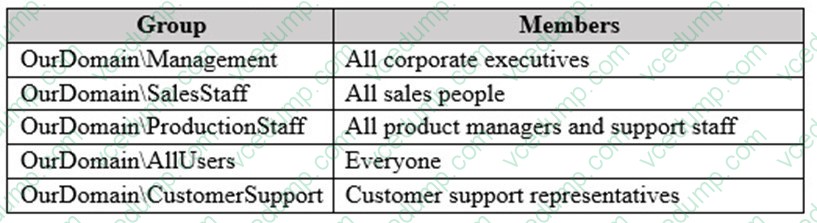
The network administrators have set up Windows groups to make it easier to manage security. Users may belong to more than one group depending on their role. The groups have been set up as shown in the following table:
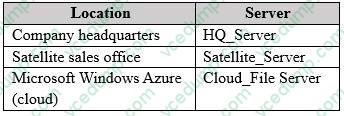
Server Configuration The IT department has configured two physical servers with Microsoft Windows Server 2012 R2 and SQL Server 2014 Enterprise Edition and one Windows Azure Server. There are two tiers of storage available for use by database files only a fast tier and a slower tier. Currently the data and log files are stored on the fast tier of storage only. If a possible use case exists, management would like to utilize the slower tier storage for data files. The servers are configured as shown in the following table:
Database
Currently all information is stored in a single database called ProdDB, created with the following script:

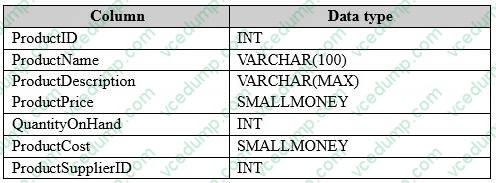
The Product table is in the Production schema owned by the ProductionStaff Windows group. It is the main table in the system so access to information in the Product table should be as fast as possible. The columns in the Product table are defined as shown in the following table:
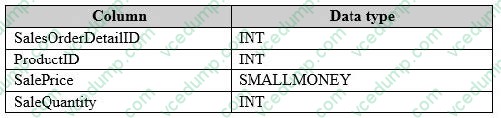
The SalesOrderDetail table holds the details about each sale. It is in the Sales schema owned by the SalesStaff Windows group. This table is constantly being updated, inserted into, and read. The columns in the SalesOrderDetail table are defined as shown in the following table:
Database Issues
The current database does not perform well. Additionally, a recent disk problem caused the system to go down, resulting in lost sales revenue. In reviewing the current system, you found that there are no automated maintenance procedures.
The database is severely fragmented, and everyone has read and write access.
Requirements
Database
The database should be configured to maximize uptime and to ensure that very little data is lost in the event of a server failure. To help with performance, the database needs to be modified so that it can support in-memory data, specifically
for the Product table, which the CIO has indicated should be a memoryoptimized table. The auto-update statistics option is set off on this database. Only product managers are allowed to add products or to make changes to the name,
description, price, cost, and supplier. The changes are made in an internal database and pushed to the Product table in ProdDB during system maintenance time. Product managers and others working at the headquarters location also should
be able to generate reports that include supplier and cost information.
Customer data access
Customers access the company's website to order products, so they must be able to read product information such asname, description, and price from the Product table. When customers place orders, stored procedures calledby the website
update product quantityon-hand values. This means the product table is constantly updated at randomtimes.
Customer support data access
Customer support representatives need to be able to view and not update or change product information. Management does not want the customer support representatives to be able to see the product cost or any supplier information.
Sales force data access
Sales people at both the headquarters office and the satellite office must generate reports that read from the Product and SalesOrderDetail tables. No updates or inserts are ever made by sales people. These reports are run at random times
and there can be no reporting downtime to refresh the data set except during the monthly maintenance window. The reports that run from the satellite office are process intensive queries with large data sets. Regardless of which office runs a
sales force report, the SalesOrderDetail table should only return valid, committed order data; any orders not yet committed should be ignored.
Historical Data
The system should keep historical information about customers who access the site so that sales people can see how frequently customers log in and how long they stay on the site.
The information should be stored in a table called Customer Access. Supporting this requirement should have minimal impact on production website performance.
Backups
The recovery strategy for Fabrikam needs to include the ability to do point in time restores and minimize the risk of data loss by performing transaction log backups every 15 minutes.
Database Maintenance
The company has defined a maintenance window every month when the server can be unavailable. Any maintenance functions that require exclusive access should be accomplished during that window.
Project milestones completed
Revoked all existing read and write access to the database, leaving the schema ownership in place.
Configured an Azure storage container secured with the storage account name MyStorageAccount with the primary access key StorageAccountKey on the cloud file server.
SQL Server 2014 has been configured on the satellite server and is ready for use.
On each database server, the fast storage has been assigned to drive letter F:, and the slow storage has been assigned to drive letter D:.
You need to recommend a solution to back up DB1. What should you include in the recommendation?
A. Azure Table Storage
B. Azure Queue storage
C. Azure Blob storage
D. Azure Document DB -
Question 14:
Overview
Application Overview
Contoso, Ltd., is the developer of an enterprise resource planning (ERP) application.
Contoso is designing a new version of the ERP application. The previous version of the ERP application used SQL Server 2008 R2.
The new version will use SQL Server 2014.
The ERP application relies on an import process to load supplier data. The import process updates thousands of rows simultaneously, requires exclusive access to the database, and runs daily. You receive several support calls reporting
unexpected behavior in the ERP application. After analyzing the calls, you conclude that users made changes directly to the tables in the database.
Tables
The current database schema contains a table named OrderDetails.
The OrderDetails table contains information about the items sold for each purchase order. OrderDetails stores the product ID, quantities, and discounts applied to each product in a purchase order. The product price is stored in a table named
Products. The Products table was defined by using the SQL_Latin1_General_CP1_CI_AS collation.
A column named ProductName was created by using the varchar data type. The database contains a table named Orders.
Orders contains all of the purchase orders from the last 12 months. Purchase orders that are older than 12 months are stored in a table named OrdersOld.
The previous version of the ERP application relied on table-level security.
Stored Procedures
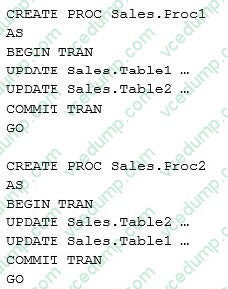
The current version of the database contains stored procedures that change two tables. The following shows the relevant portions of the two stored procedures:
Customer Problems
Installation Issues
The current version of the ERP application requires that several SQL Server logins be set up to function correctly. Most customers set up the ERP application in multiple locations and must create logins multiple times.
Index Fragmentation Issues
Customers discover that clustered indexes often are fragmented. To resolve this issue, the customers defragment the indexes more frequently. All of the tables affected by fragmentation have the following columns that are used as the
clustered index key:

Backup Issues
Customers who have large amounts of historical purchase order data report that backup time is unacceptable.
Search Issues
Users report that when they search product names, the search results exclude product names that contain accents, unless the search string includes the accent.
Missing Data Issues
Customers report that when they make a price change in the Products table, they cannot retrieve the price that the item was sold for in previous orders.
Query Performance Issues
Customers report that query performance degrades very quickly. Additionally, the customers report that users cannot run queries when SQL Server runs maintenance tasks. Import Issues During the monthly import process, database
administrators receive many supports call from users who report that they cannot access the supplier data. The database administrators want to reduce the amount of time required to import the data.
Design Requirements
File Storage Requirements
The ERP database stores scanned documents that are larger than 2 MB. These files must only be accessed through the ERP application. File access must have the best possible read and write performance.
Data Recovery Requirements
If the import process fails, the database must be returned to its prior state immediately.
Security Requirements
You must provide users with the ability to execute functions within the ERP application, without having direct access to the underlying tables.
Concurrency Requirements
You must reduce the likelihood of deadlocks occurring when Sales.Prod and Sales.Proc2 execute.
You need to recommend a solution that addresses the backup issue.
The solution must minimize the amount of development effort.
What should you include in the recommendation?
A. Indexed views
B. Filegroups
C. Table partitioning
D. Indexes -
Question 15:
Note: This question is part of a series of questions that use the same scenario. For your convenience, the scenario is repeated in each question. Each question presents a different goal and answer choices, but the next of the scenario is exactly the same in each question in this series.
Start of repeated scenario
Contoso, Ltd. has Microsoft SQL Server databases that support a custom application. The current SQL Server environment consists of two servers: ContosoSQL1 and ContosoSQL2. These two servers participate in an Always On Availability Group named ContosoAG1 that is configured to use synchronous-commit with automatic failover. The secondary replica is not configured for read-only access.
The application performs both transactional processing and historical data retrieval in a database named ContosoDB. The application includes an inventory management module. The inventory management module and database have experienced performance issues.
Users report that a query named InventoryQuery1 takes a long time to complete. The query is shown as follows:
SELECT ProductNumber, Name, ProductLine FROM Production.Product WHERE ProductNumber = N'
' The query plan used by SQL Server for this query is shown in the exhibit. (Click the Exhibit tab.) Various performance issues, including frequent long-term blocking episodes, prevent business users from completing their daily tasks. You suspect the tempdb database resources could be responsible. You must create Blocking reports for the ContosoDB database to identify issues.
You plan to use Extended Events to review all Transact-SQL statements that are run against the ContosoSQL1 instance. The output from the Extended Events session must contain both start and stop events and must be written to a file. You must configure the Extended Events session to minimize possible data loss and reduce the effect on server performance.
You plan to deploy an additional secondary replica named ContosoSQL3 to ContosoAG1. Read-only traffic must be load-balanced between the two secondary replicas, regardless of which instance is the primary replica. Contoso plans to add
an additional dedicated reporting system that will rely on real-time data from the transactional databases.
The company plans to improve their high availability/disaster recovery (HA/DR) solution. As part of the planned improvements, you will back up all databases from ContosoSQL1 directly to an off-site location.
End of repeated scenario
You need to configure the backup process for ContosoSQL1.
What should you do?
Exhibit.
A. Perform a backup to a tape device.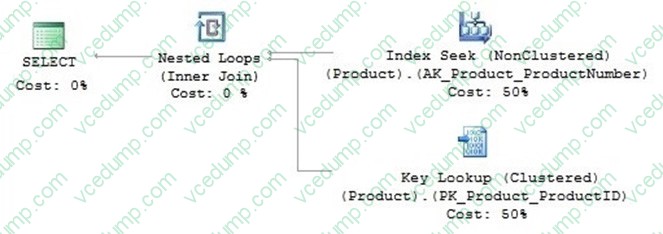
B. Perform mirrored backups to a DR datacenter.
C. Perform a COPY_ONLY backup.
D. Use the SQL Server Resource Governor while backing up databases. -
Question 16:
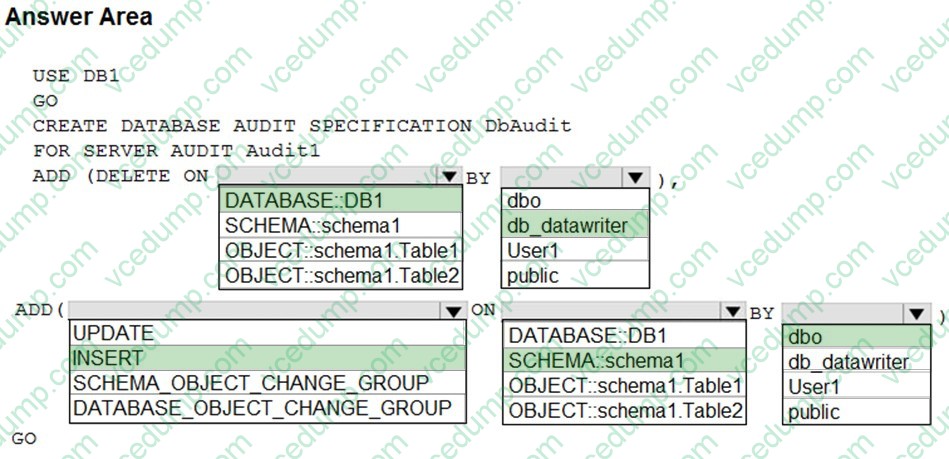
HOTSPOT
You manage a Microsoft SQL Server instance that has a database named DB1. The instance has a server audit named Audit1. DB1 uses the following schemas:

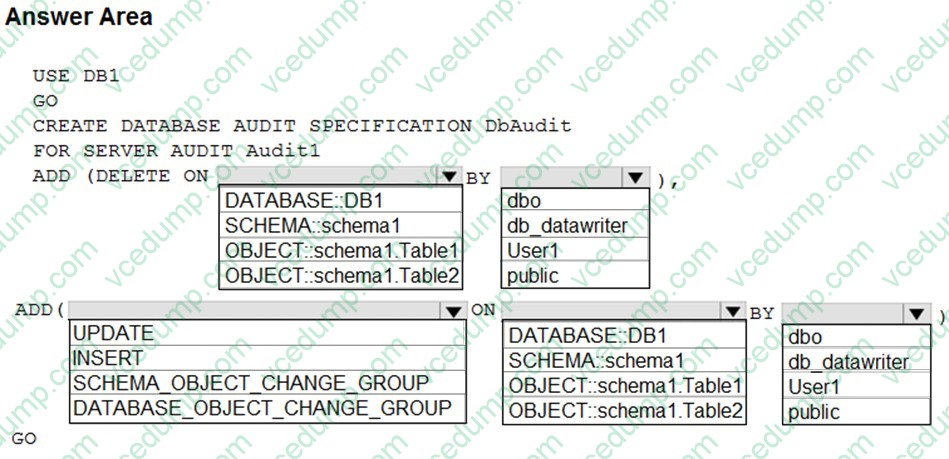
You need to implement a database audit specification for database DB1 that meets the following requirements:
Audit only delete statements performed by users in the db_datawriter role.
Audit insert statements for all tables in Schema1 for all users.
How should you complete the Transact-SQL statement? To answer, select the appropriate options in the answer area.
NOTE: Each correct selection is worth one point.
Hot Area:
-
Question 17:
You work as a Database Administrator (DBA) at ABC.com.
You are in the process of deploying new servers running SQL Server 2012.
You need to deploy a SQL Server 2012 server to host databases used to host databases used by Research and Development department.
The databases used by the Research and Development department will store sensitive data.
A company security policy states that if Research and Development department database files are moved to another server, the files must be encrypted.
Which of the following solutions would meet the encryption requirement?
A. Encrypting File System (EFS).
B. Transparent Data Encryption (TDE).
C. Windows Bitlocker Drive Encryption.
D. Secure Sockets Layer (SSL) -
Question 18:
Note: This question is part of a series of questions that present the same scenario. Each question in the series contains a unique solution that might meet the stated goals. Some question sets might have more than one correct solution, while
others might not have a correct solution.
After you answer a question in this section, you will NOT be able to return to it. As a result, these questions will not appear in the review screen.
You support an application that stores data in a Microsoft SQL Server database. You have a query that returns data for a report that users run frequently.
The query optimizer sometimes generates a poorly-performing plan for the query when certain parameters are used. You observe that this is due to the distribution of data within a specific table that the query uses.
You need to ensure that the query optimizer always uses the query plan that you prefer.
Solution: You force the desired plan.
Does the solution meet the goal?
A. Yes
B. No -
Question 19:
Note: This question is part of a series of questions that present the same scenario. Each question in the series contains a unique solution that might meet the stated goals. Some question sets might have more than one correct solution, while
others might not have a correct solution.
After you answer a question in this sections, you will NOT be able to return to it. As a result, these questions will not appear in the review screen.
You have a database that includes a table named Candidate.
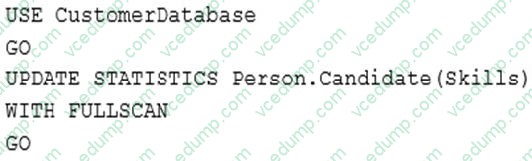
You need to update the statistics for a column named Skills in the table and turn off automatic statistics updates for the column.
Solution: You run the following query:
Does this meet the goal?
A. Yes
B. No -
Question 20:
You have a SQL Server 2012 database named DB1.
You have a backup device named Device1.
You discover that the log file for the database is full.
You need to ensure that DB1 can complete transactions.
The solution must not affect the chain of log sequence numbers (LSNs).
Which code segment should you execute?
A. BACKUP LCG DB1 TO Device1 WITH COPY_ONLY
B. BACKUP LOG DB1 TO Device1
C. BACKUP LOG DB1 TO Device1 WITH NCRECCVERY
D. BACKUP LOG D31 TO Device1 WITH TRUNCATE ONLY
Related Exams:
-
62-193
Technology Literacy for Educators -
70-243
Administering and Deploying System Center 2012 Configuration Manager -
70-355
Universal Windows Platform – App Data, Services, and Coding Patterns -
77-420
Excel 2013 -
77-427
Excel 2013 Expert Part One -
77-725
Word 2016 Core Document Creation, Collaboration and Communication -
77-726
Word 2016 Expert Creating Documents for Effective Communication -
77-727
Excel 2016 Core Data Analysis, Manipulation, and Presentation -
77-728
Excel 2016 Expert: Interpreting Data for Insights -
77-731
Outlook 2016 Core Communication, Collaboration and Email Skills
Tips on How to Prepare for the Exams
Nowadays, the certification exams become more and more important and required by more and more enterprises when applying for a job. But how to prepare for the exam effectively? How to prepare for the exam in a short time with less efforts? How to get a ideal result and how to find the most reliable resources? Here on Vcedump.com, you will find all the answers. Vcedump.com provide not only Microsoft exam questions, answers and explanations but also complete assistance on your exam preparation and certification application. If you are confused on your 70-764 exam preparations and Microsoft certification application, do not hesitate to visit our Vcedump.com to find your solutions here.